


























Views
Downloads


Essential Ordering Fractions Worksheet | Grade 4-6 Ready
Paste this activity's link or code into your existing LMS (Google Classroom, Canvas, Teams, Schoology, Moodle, etc.).
Students can open and work on the activity right away, with no student login required.
You'll still be able to track student progress and results from your teacher account.
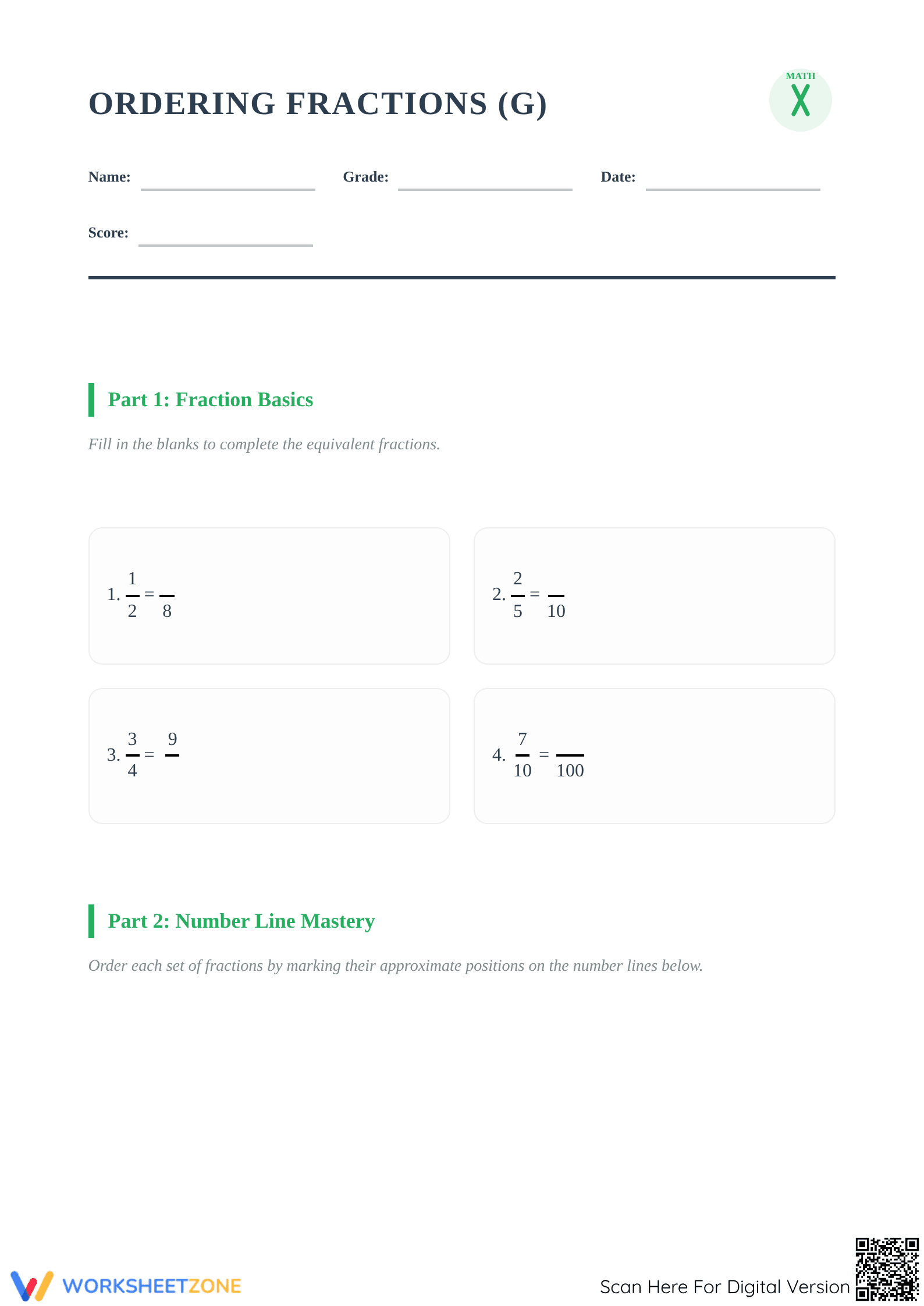
This comprehensive 5-page worksheet provides students with targeted practice in representing and ordering fractions on a number line. By progressing from equivalent fraction basics to advanced mixed-number comparisons and real-world measurement applications, learners develop a robust visual understanding of fraction magnitude. Students will confidently determine the relative values of proper and improper fractions.
At a Glance
- Grade: 4–6 · Subject: Math
- Standard:
CCSS.MATH.CONTENT.4.NF.A.2— Compare and order fractions with different denominators using number line benchmarks- Skill Focus: Fractional Number Line Representation
- Format: 5 pages · 19 problems · Answer key included · PDF
- Best For: Independent practice or small group instruction
- Time: 35–45 minutes
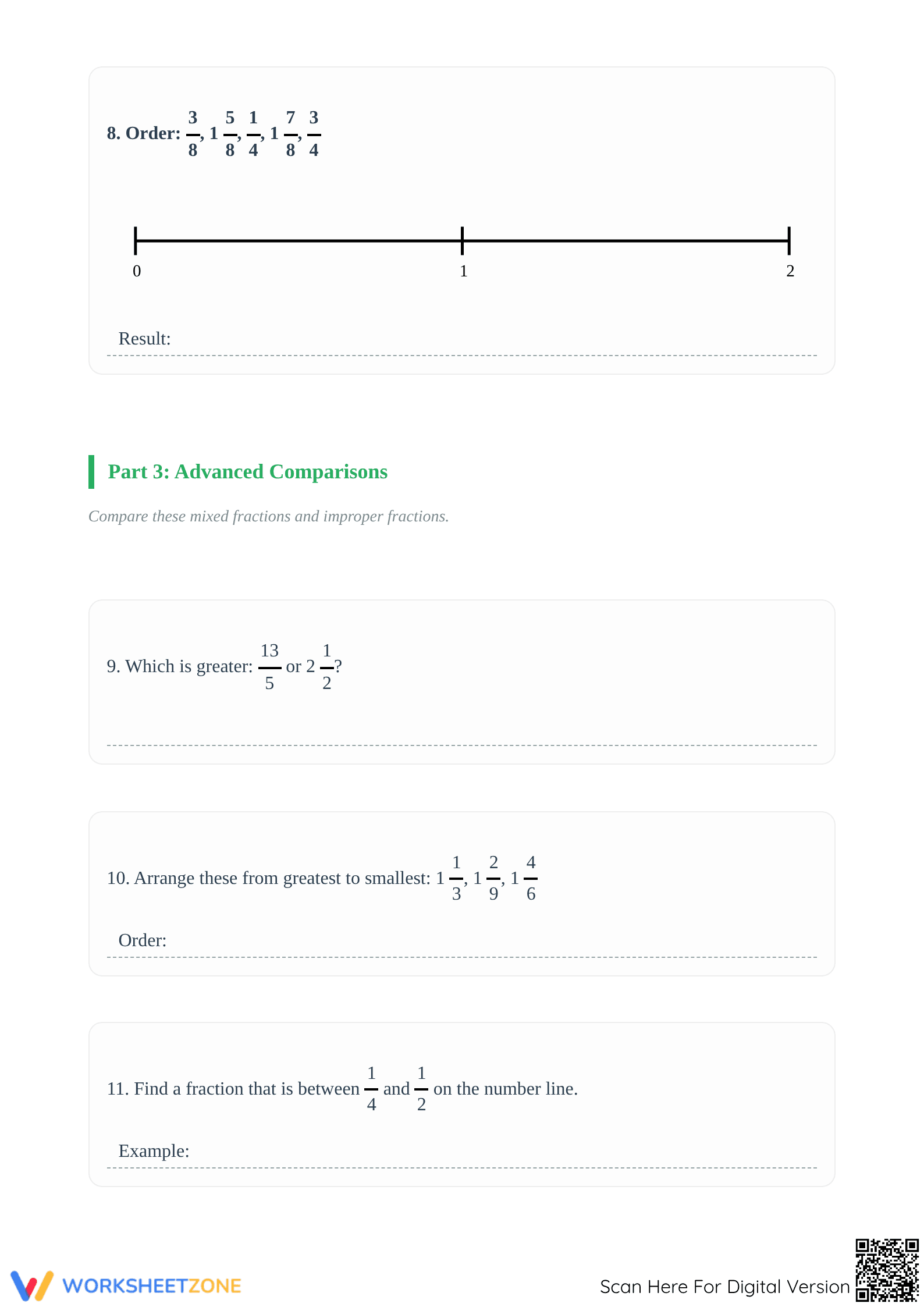
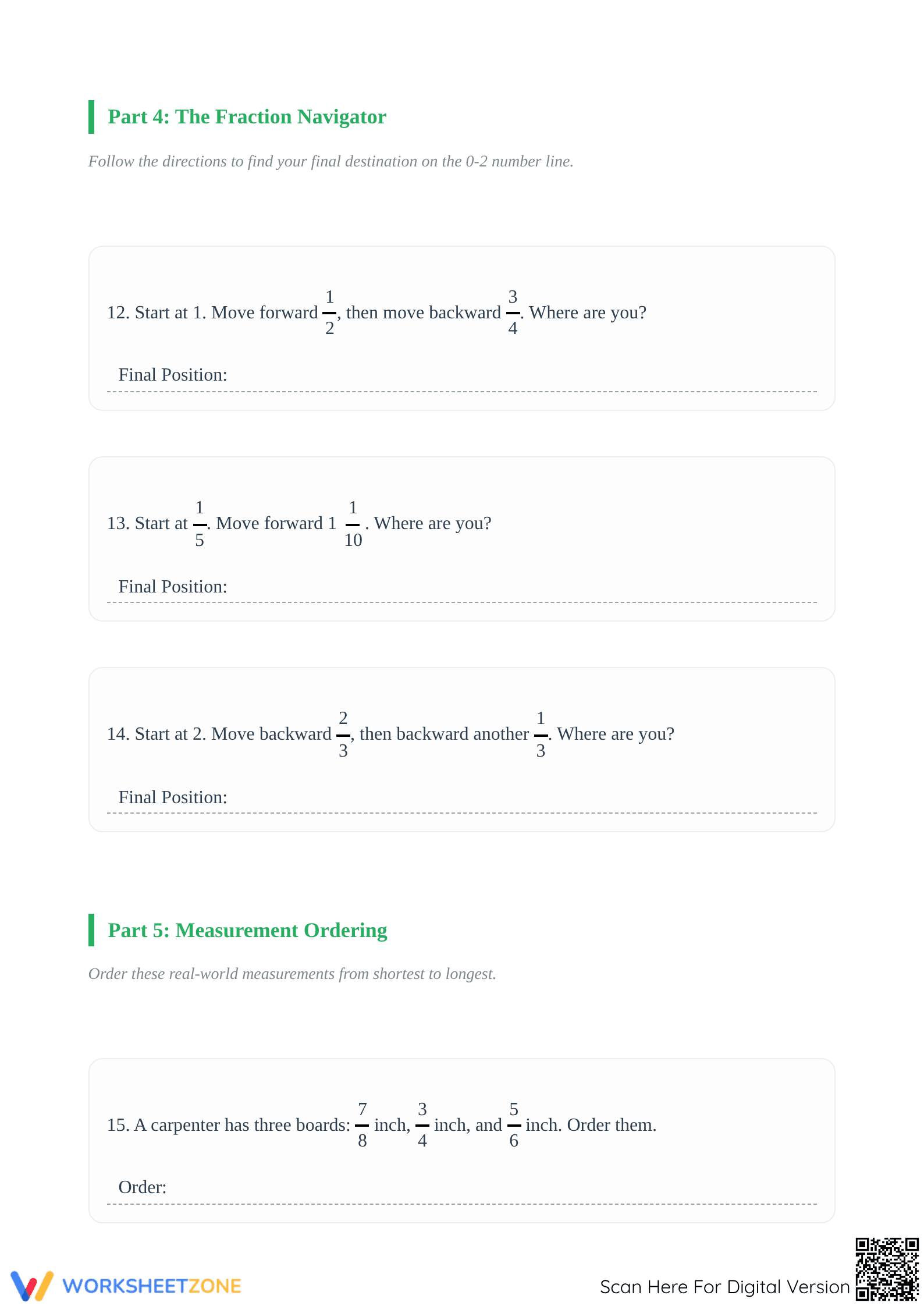
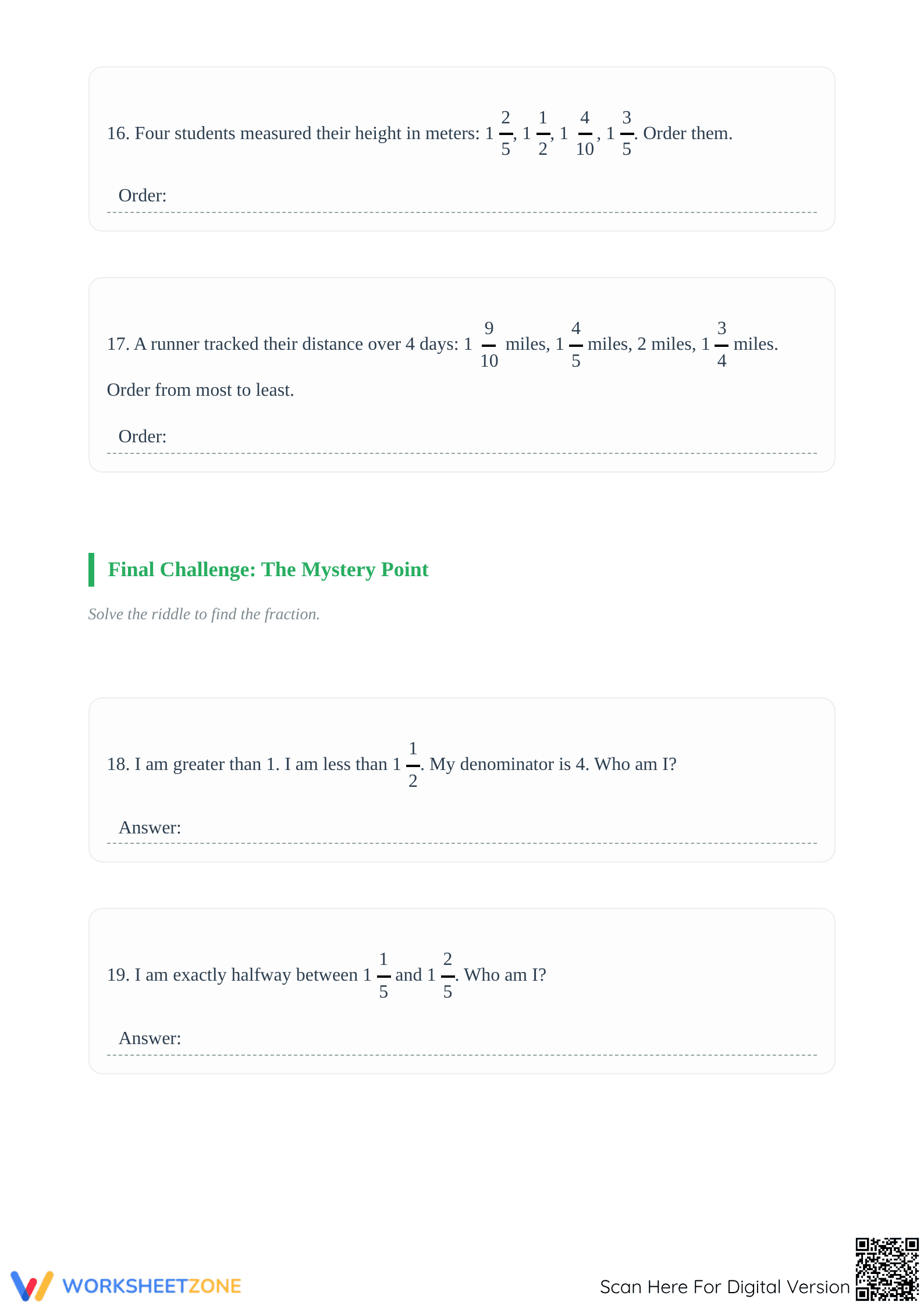
This multi-part resource includes 19 diverse tasks spread across five pages. It features equivalent fraction completion, number line plotting from 0 to 2, comparison of improper fractions, and directional Fraction Navigator logic puzzles. The worksheet also incorporates real-world word problems involving construction measurements and distance tracking. A full answer key is included for immediate feedback.
The zero-prep design allows teachers to implement this resource in under two minutes. Simply print the five-page packet, distribute it to students, and provide access to the answer key for self-checking or quick teacher review. The structured parts—ranging from Fraction Basics to the Final Challenge—make it an ideal plug-and-play solution for substitute plans or enrichment centers.
The primary focus of this worksheet is `CCSS.MATH.CONTENT.4.NF.A.2`, which requires students to compare two fractions with different numerators and different denominators. It specifically leverages benchmark fractions like 1 and 2 to help students visualize magnitudes. Both standard codes can be copied directly into lesson plans, IEP goals, or district curriculum mapping tools.
Use this worksheet as a summative assessment after a unit on fraction comparison or as a guided practice activity during direct instruction. Teachers should observe students during Part 2 to ensure they are using the 1 benchmark correctly when plotting fractions between 0 and 2. Expect a total completion time of approximately 40 minutes for the full packet.
This resource is designed for Grade 4-6 students who need to move beyond procedural fraction comparisons toward visual mastery. It provides scaffolds for struggling learners through Part 1's equivalent fraction review while offering extensions for advanced students in the Final Challenge riddle section. It pairs naturally with physical fraction tiles or classroom anchor charts.
According to research from Fisher & Frey (2014) on the gradual release of responsibility, students benefit most when complex mathematical concepts are broken down into discrete, scaffolded steps. This worksheet applies that principle by guiding learners from equivalent fraction foundations to independent ordering on number lines. Aligning with CCSS.MATH.CONTENT.4.NF.A.2, the resource emphasizes the importance of benchmark comparison—a skill the NAEP identifies as a critical predictor of later success in algebra and proportional reasoning. By integrating real-world measurements and directional navigation, the tasks move students beyond rote memorization toward a conceptual understanding of fractional space. The 5-page structure ensures sufficient at-bats for students to achieve fluency in identifying the relative positions of proper fractions, mixed numbers, and improper fractions. This evidence-based approach to fraction instruction provides teachers with a high-utility tool for classroom or small-group settings.


