


























Views
Downloads

Printable Ordering Fractions on a Number Line Worksheet
Paste this activity's link or code into your existing LMS (Google Classroom, Canvas, Teams, Schoology, Moodle, etc.).
Students can open and work on the activity right away, with no student login required.
You'll still be able to track student progress and results from your teacher account.
Students learn to visualize fractions as specific points on a number line, a critical precursor to algebraic reasoning. This worksheet provides structured practice in identifying marked points, plotting values, and comparing magnitudes. By completing these three pages, learners gain the confidence to order sets of fractions with precision and conceptual clarity.
At a Glance
- Grade: Elementary Grades 3–4 · Subject: Math · Fractions and Decimals
- Standard:
CCSS.MATH.CONTENT.3.NF.A.2— Represent fractions on a number line diagram by partitioning the interval into equal parts- Skill Focus: Plotting and ordering fractions on a linear model
- Format: 3 pages · 12 diverse problems · Full answer key included · High-quality PDF
- Best For: Independent student practice, small group visual fraction reinforcement, or targeted math remediation
- Time: Approximately 25 to 35 minutes
What's Inside
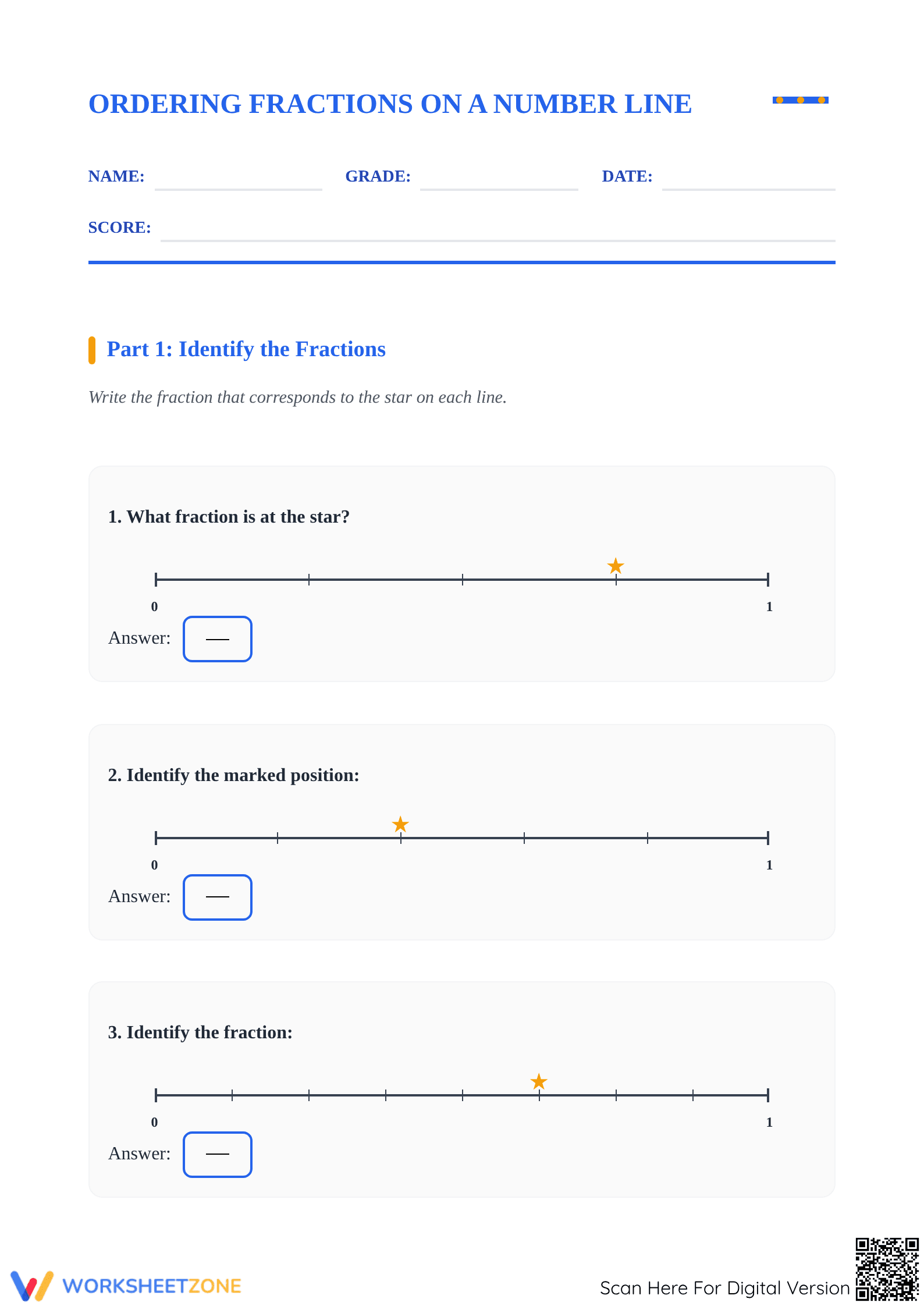
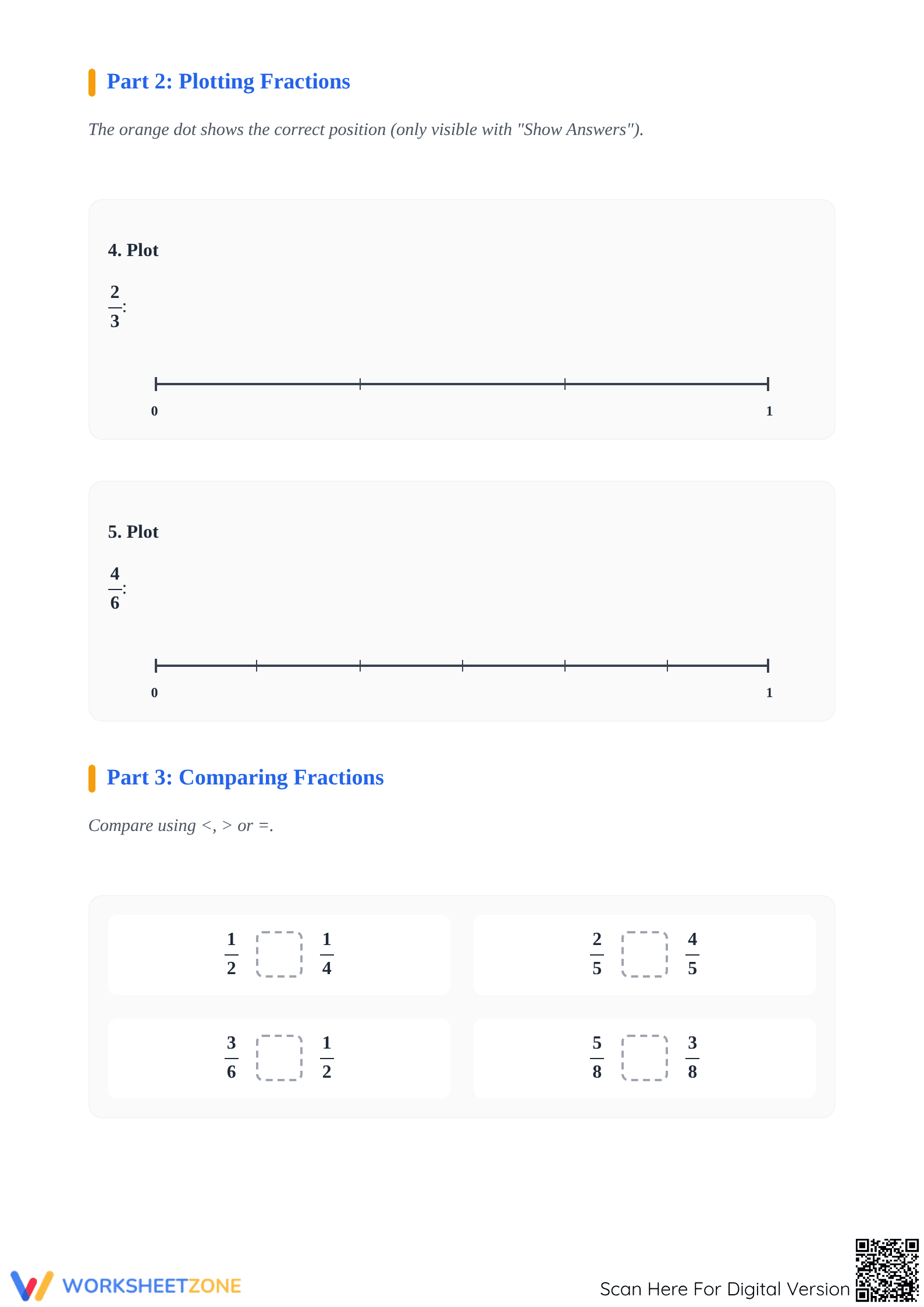
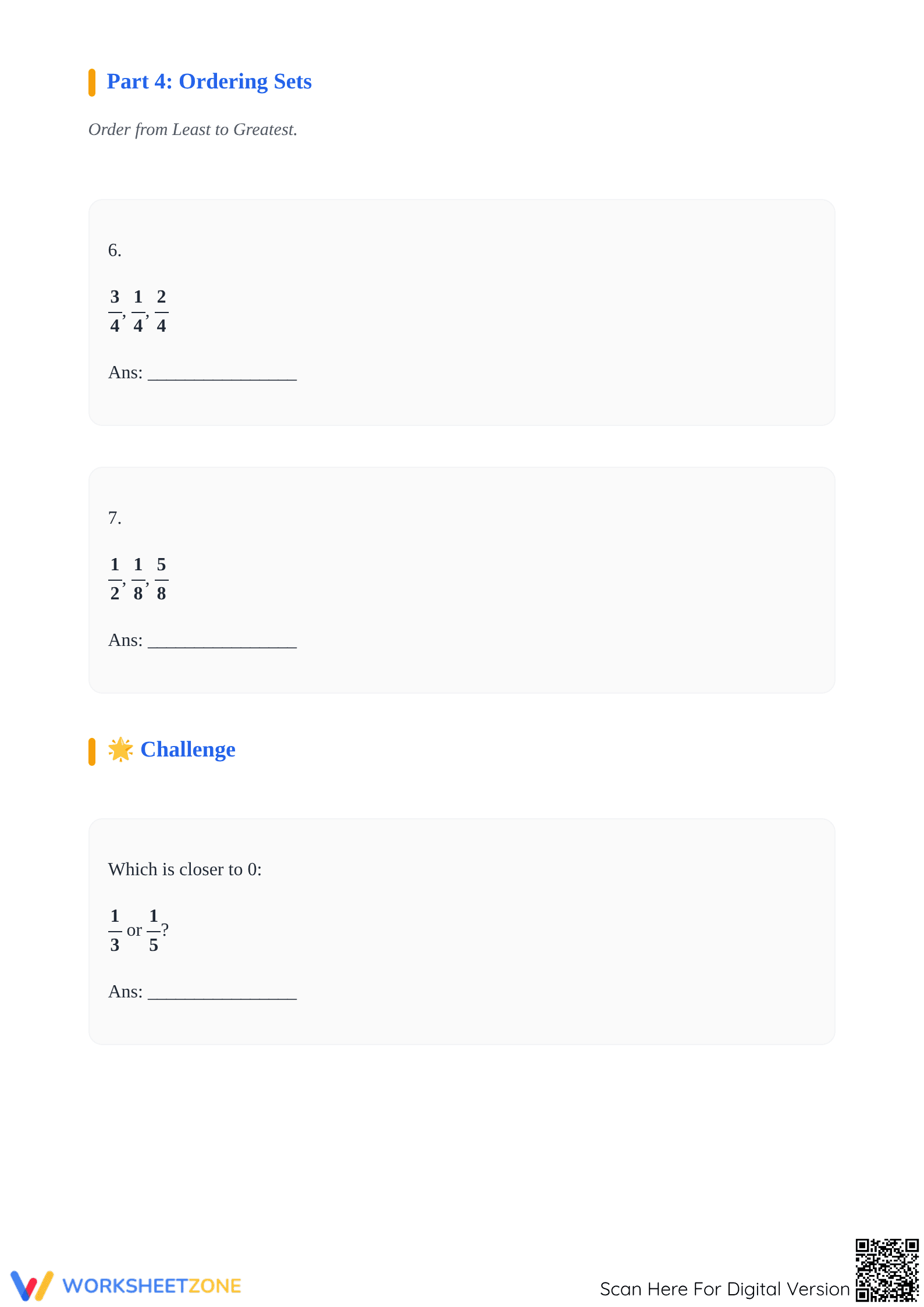
This three-page PDF contains 12 mathematical tasks designed to build conceptual depth. Part one focuses on identifying fractions marked by stars on pre-partitioned lines. Part two requires plotting values like 2/3 accurately. The final sections challenge learners to compare pairs using inequality symbols and order entire sets, supported by a final proximity-to-zero challenge.
Skill Progression
- Guided Identification: Three initial problems provide stars on number lines, prompting students to count intervals to determine the numerator.
- Supported Plotting: Two tasks require students to place a dot at a specific fraction, requiring them to partition the line between 0 and 1.
- Independent Ordering: The final problems remove visual scaffolds, asking students to compare and sequence sets using internalized magnitude.
The progression follows the gradual-release model, moving from basic recognition to higher-order comparative analysis.
Standards Alignment
The primary focus is CCSS.MATH.CONTENT.3.NF.A.2, which requires students to represent fractions on a number line diagram. Additionally, the ordering and comparison tasks support CCSS.MATH.CONTENT.4.NF.A.2 regarding comparisons of fractions with different denominators. Both standard codes can be copied directly into lesson plans, IEP goals, or district curriculum mapping tools.
How to Use It
This resource is ideal for the "We Do" portion of a lesson on fraction representation. Use the identification section as a quick check for understanding after instruction. For a formative assessment tip, observe whether students count the tick marks or the intervals; counting intervals correctly indicates a functional understanding of the partitioned whole.
Who It's For
Designed for third and fourth-grade students, this worksheet is also an excellent intervention tool for older learners. It pairs naturally with fraction strips or wall-mounted number lines. The clear layout and ample white space make it accessible for students who benefit from reduced visual clutter and straightforward instructions.
Representing fractions on a number line is essential for developing a robust sense of numerical magnitude, according to a **RAND AIRS 2024** study on elementary math pedagogy. The number line provides a linear model that helps students bridge the gap between whole-number counting and the dense field of rational numbers. Unlike area models, the number line emphasizes that fractions are specific locations in space, which is vital for later success in coordinate geometry and negative number operations. Research indicates that students who master plotting fractions on number lines perform significantly better on standardized assessments of mathematical fluency. This worksheet aligns with CCSS.MATH.CONTENT.3.NF.A.2 by requiring students to partition the unit interval into equal parts and recognize that the length of each part is 1/b. By integrating identification, plotting, and comparison, this tool ensures a comprehensive understanding of fraction placement and ordering.


