


























Views
Downloads


Printable Ordering Fractions on a Number Line Worksheet
Paste this activity's link or code into your existing LMS (Google Classroom, Canvas, Teams, Schoology, Moodle, etc.).
Students can open and work on the activity right away, with no student login required.
You'll still be able to track student progress and results from your teacher account.
This comprehensive Grade 4 math worksheet helps students visualize and master the relationship between fractions by placing them on a number line. By translating abstract numbers into spatial positions, learners develop a deep conceptual understanding of fraction magnitude. This Printable resource ensures students can confidently compare and order proper and improper fractions.
At a Glance
- Grade: 4 · Subject: Math
- Standard:
4.NF.A.2— Compare two fractions with different numerators and denominators and record results with symbols- Skill Focus: Ordering fractions on a number line
- Format: 5 pages · 15 problems · Answer key included · PDF
- Best For: Small group instruction or independent practice
- Time: 30–45 minutes
What's Inside
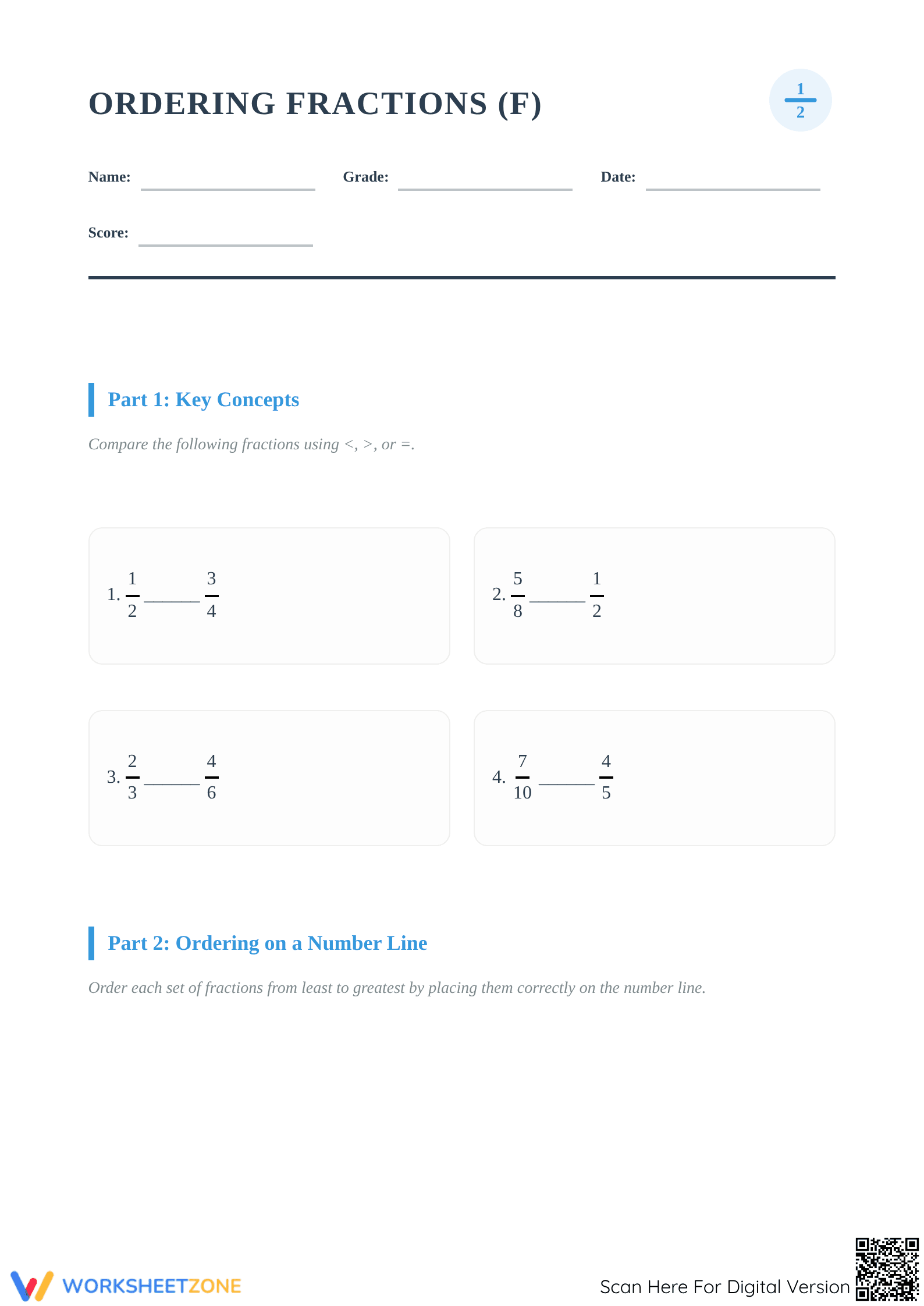
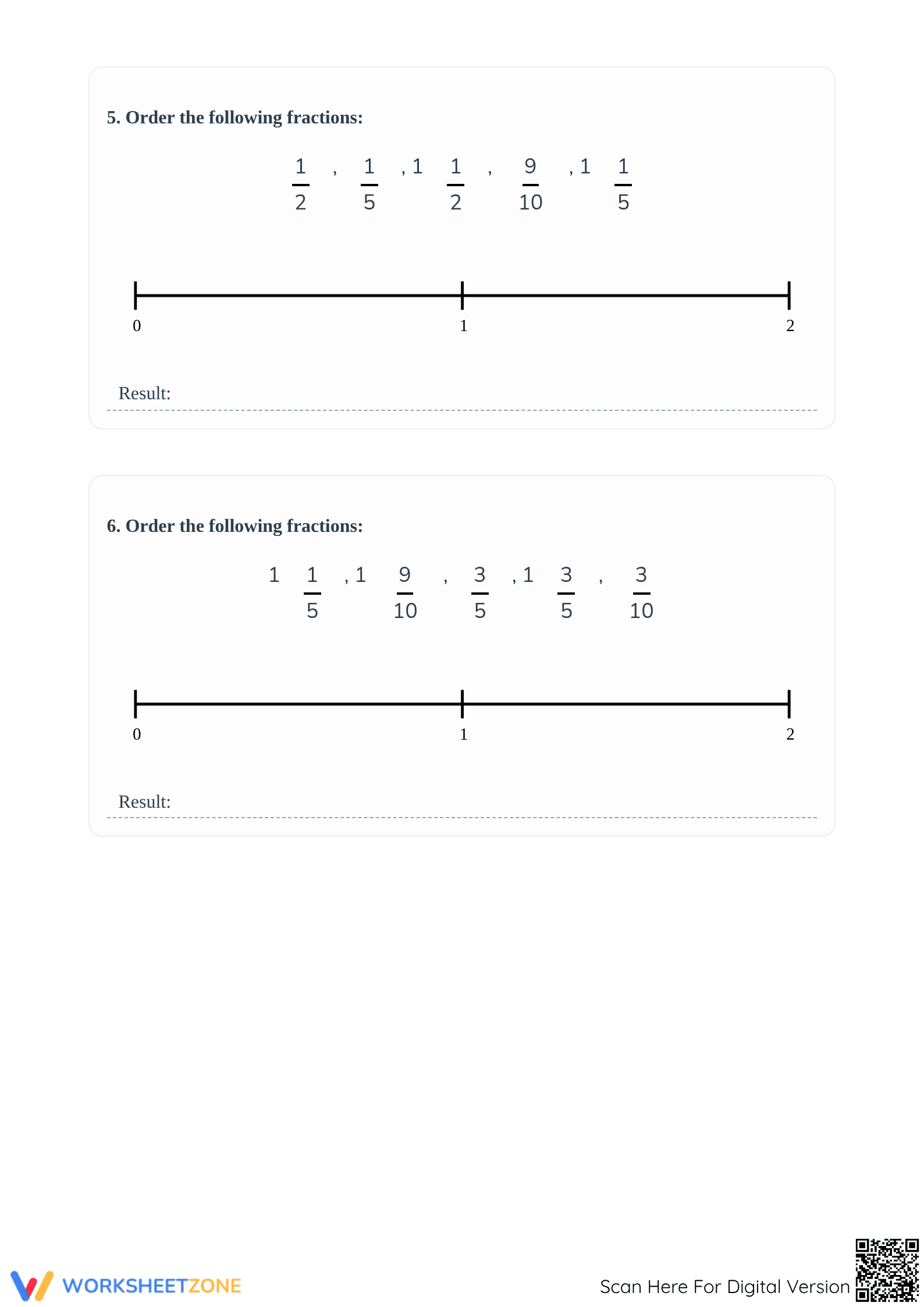
This 5-page packet features 15 multi-step problems designed to build fluency in fraction comparison. It includes comparison tasks using standard notation, multiple number line plotting exercises ranging from 0 to 2, conversion challenges for improper fractions, and real-world word problems. A complete answer key is provided for every page to facilitate quick grading and self-correction.
Skill Progression
- Guided practice: The initial section provides simple comparison tasks between two fractions, allowing students to use mathematical symbols while establishing baseline knowledge.
- Supported practice: The middle pages introduce number lines where students must plot multiple fractions and mixed numbers, providing a visual scaffold for relative magnitude.
- Independent practice: The final sections present word problems and decimal conversions, requiring students to apply their understanding to complex, real-world scenarios without visual aids.
This structure follows a gradual-release model, moving from conceptual establishment to independent application.
Standards Alignment
This worksheet is primarily aligned to 4.NF.A.2, which requires students to compare two fractions with different numerators and denominators by creating common denominators or comparing to a benchmark fraction. It also supports 3.NF.A.2 through number line use. Both standard codes can be copied directly into lesson plans or curriculum mapping tools.
How to Use It
Use this packet as a mid-unit assessment after students have learned to find common denominators. During instruction, observe if students correctly identify the halfway point on a number line, as this is a key formative indicator of benchmark fraction mastery. Expect a completion time of approximately 40 minutes for the full 5-page set.
Who It's For
This resource is ideal for Grade 4 general education students, Grade 5 students needing a conceptual refresh on number line visualization, or Grade 3 advanced learners. It pairs naturally with fraction tiles or anchor charts that display equivalent fractions to support struggling learners during the conversion tasks.
Fractions remain one of the most challenging hurdles in elementary mathematics, often serving as a gateway to success in middle school algebra. According to Fisher & Frey (2014), the use of a number line as a visual scaffold is critical for transitioning students from viewing fractions as two separate integers to understanding them as single numerical values. This worksheet addresses that need by providing structured tasks that align with the 4.NF.A.2 standard. By moving from basic comparison to complex word problems involving mixed numbers and improper fractions, the resource facilitates a gradual release of responsibility. Research from NAEP suggests that students who can accurately plot fractions on a number line demonstrate significantly higher overall math proficiency. This Printable Guide provides the necessary essential practice to move learners from procedural calculation to true conceptual mastery.


