


























Views
Downloads



Ordering Fractions on a Number Line | Essential Math Guide
Paste this activity's link or code into your existing LMS (Google Classroom, Canvas, Teams, Schoology, Moodle, etc.).
Students can open and work on the activity right away, with no student login required.
You'll still be able to track student progress and results from your teacher account.
Mastering the relationship between fractions and their placement on a number line is a pivotal milestone in elementary mathematics. This comprehensive five-page worksheet provides a structured pathway for students to visualize and order fractions. By placing values on a physical line, learners transition from abstract calculation to concrete spatial understanding of numerical magnitude.
At a Glance
- Grade: 3–5 · Subject: Math (Fractions)
- Standard:
CCSS.MATH.CONTENT.3.NF.A.2— Represent a fraction on a number line diagram to show numerical position- Skill Focus: Ordering fractions and mixed numbers
- Format: 5 pages · 9 problems · Answer key included · PDF
- Best For: Independent practice and fraction review
- Time: 25–40 minutes
What's Inside
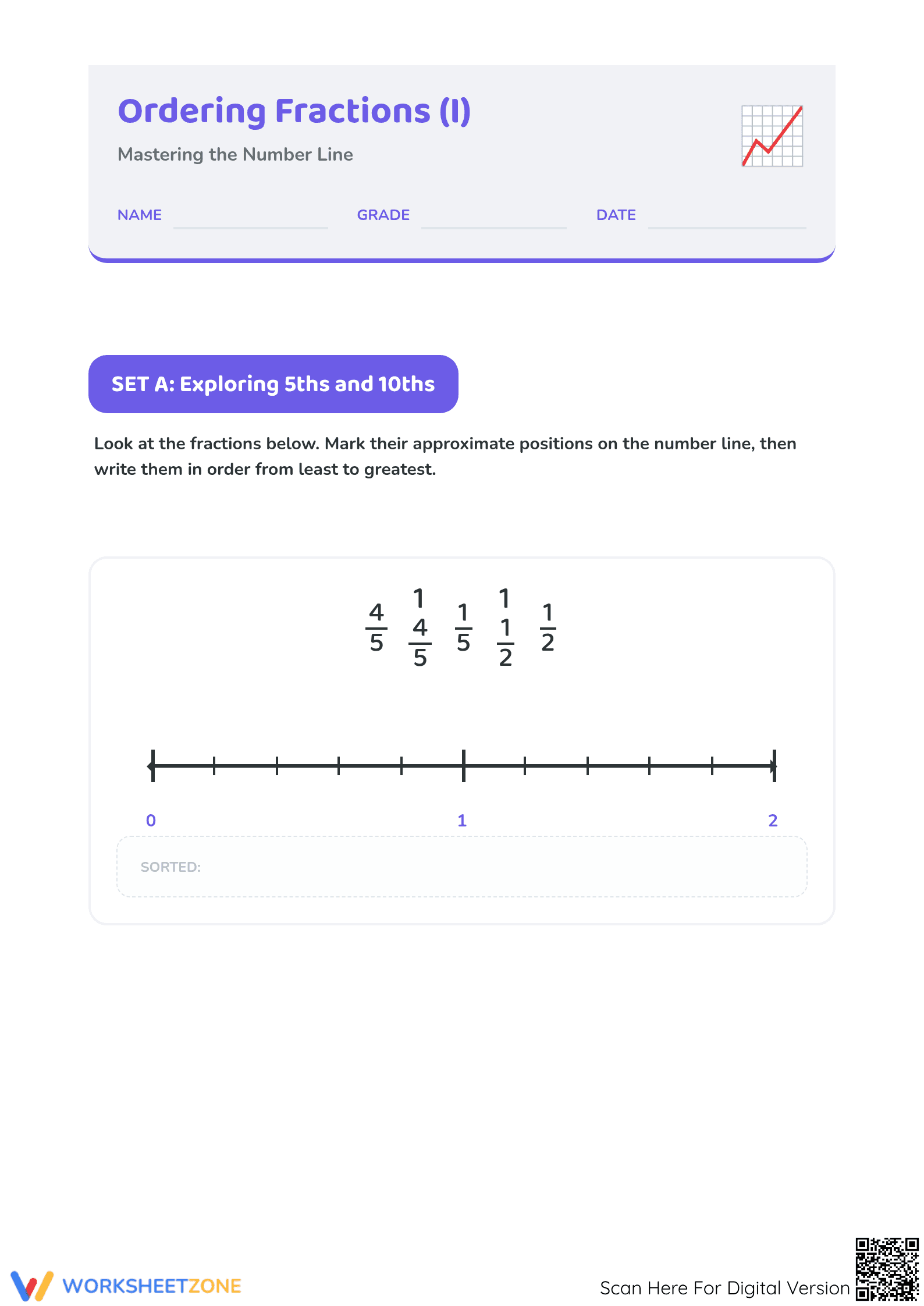
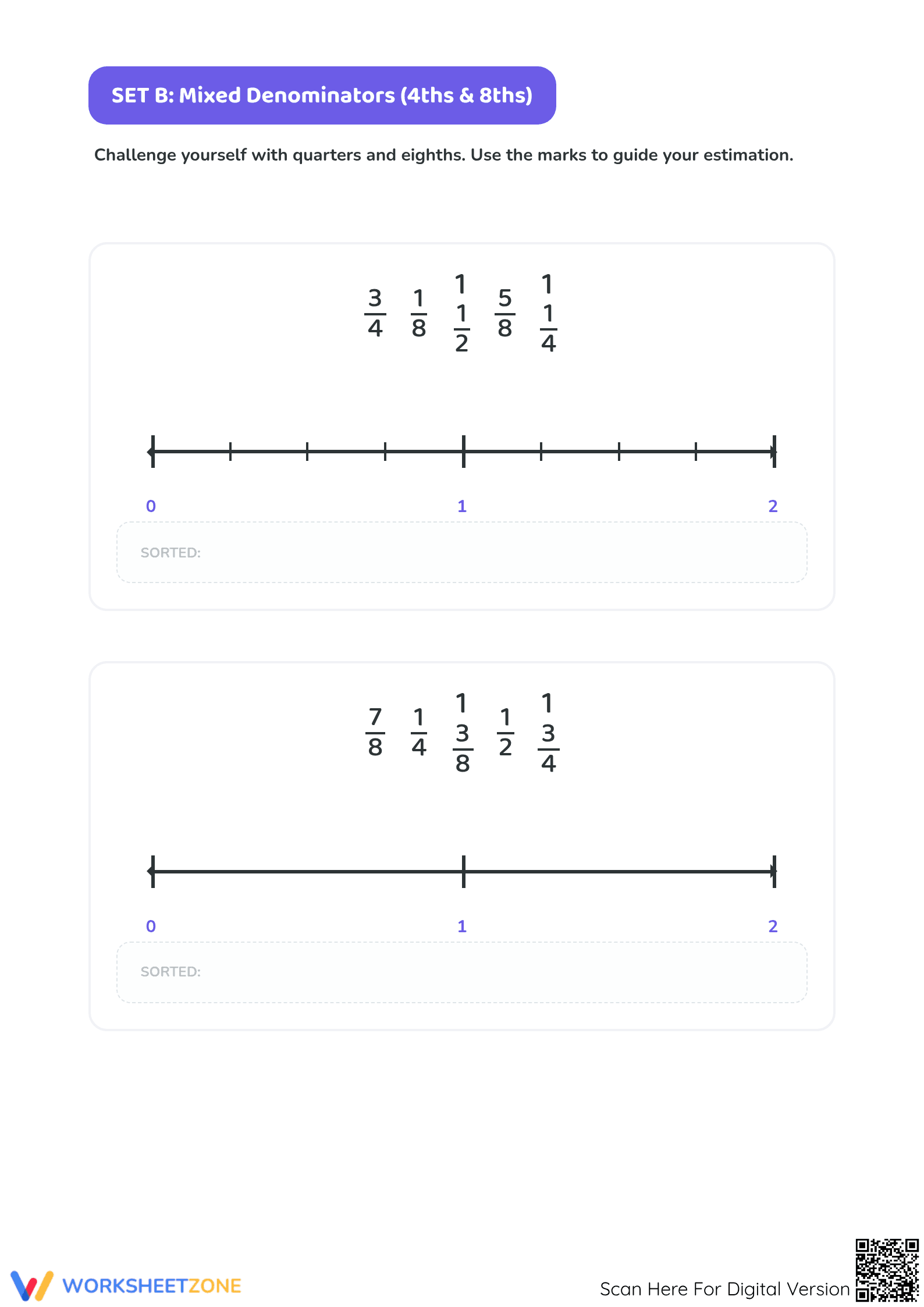
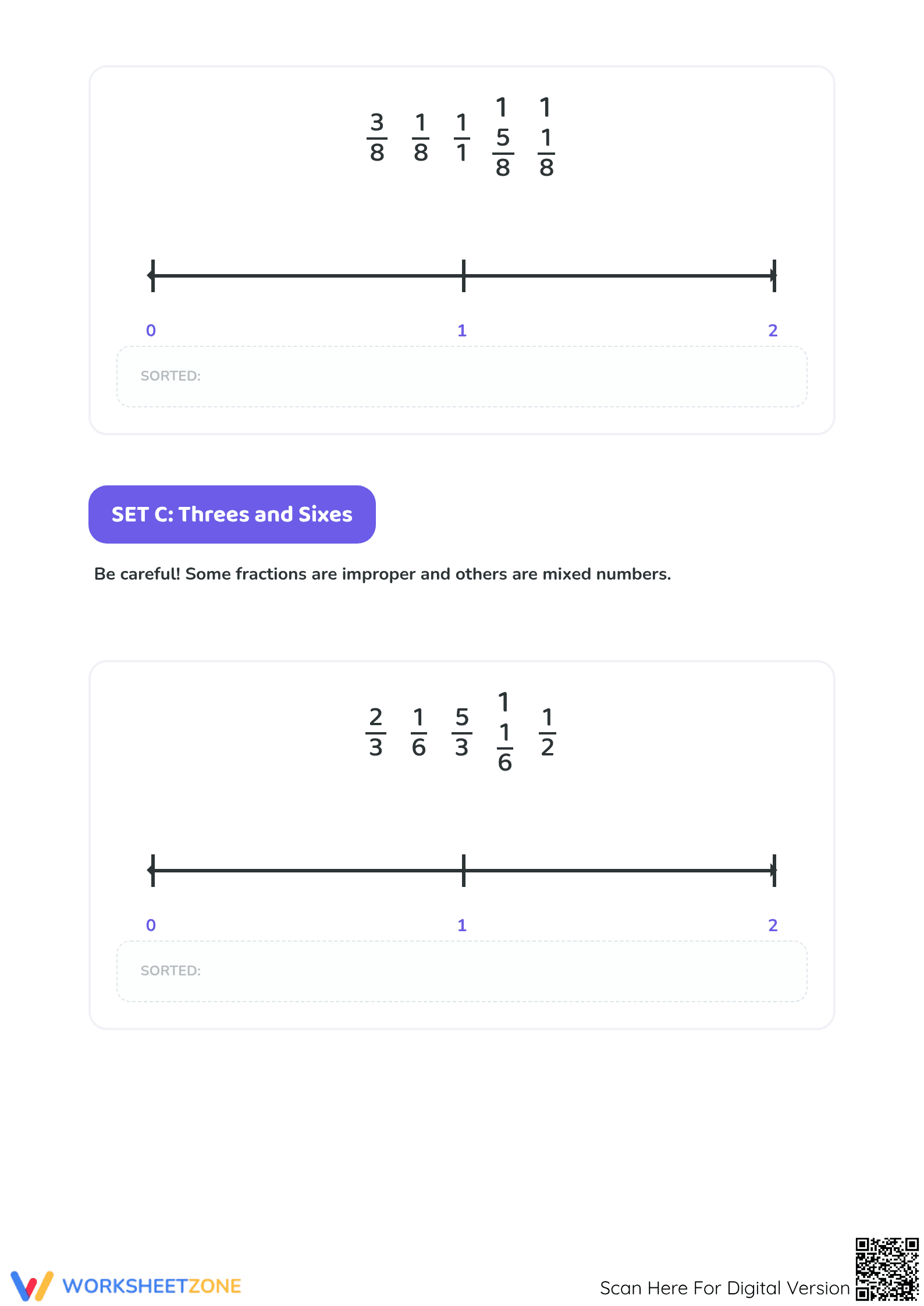
This extensive collection spans five printable pages, containing nine distinct sets of ordering challenges. Each set provides a list of fractions or mixed numbers and a corresponding number line ranging from zero to two. The layout includes dedicated space for students to write their final sorted list, ensuring work remains organized. A full answer key is provided for immediate grading.
Skill Progression
- Guided practice: The initial sets focus on fractions with like denominators, such as 5ths and 10ths, allowing students to anchor their understanding using familiar increments.
- Supported practice: Middle sets introduce mixed denominators like 4ths and 8ths, requiring students to find common ground and estimate positions with higher precision.
- Independent practice: The final "All Mixed Up" mastery test presents a variety of denominators, improper fractions, and mixed numbers to verify total conceptual grasp.
This progression follows a gradual release model, moving from scaffolded estimation to independent mastery across nine distinct sets.
Standards Alignment
The primary alignment for this resource is CCSS.MATH.CONTENT.3.NF.A.2, which requires students to represent a fraction on a number line. It also supports CCSS.MATH.CONTENT.4.NF.A.2 regarding comparing fractions with different denominators. Both standard codes can be copied directly into lesson plans, IEP goals, or district curriculum mapping tools.
How to Use It
Assign this worksheet as a concluding activity for a unit on fraction comparison. During the lesson, circulate and observe students as they place mixed numbers; check if they correctly identify that values greater than one must fall past the midpoint of the 0–2 line. This serves as an excellent formative assessment for identifying common misconceptions about improper fractions.
Who It's For
This resource is designed for Grade 3 through 5 students building foundational fraction skills, but it also serves as a robust remediation tool for middle schoolers. The clear visual layout supports English Language Learners and students with IEPs by providing a spatial anchor. Pair this with a physical string number line for an interactive classroom experience.
According to Fisher & Frey (2014), the use of visual representations like number lines is essential for the gradual release of responsibility in mathematics instruction. By transitioning from concrete models to abstract ordering tasks, this worksheet bridges conceptual gaps in understanding. Research indicates that students who can accurately place fractions on a number line demonstrate significantly higher achievement in later algebraic reasoning. This five-page resource provides the repeated, varied practice necessary to move from initial recognition to fluent application. Aligned to the CCSS.MATH.CONTENT.3.NF.A.2 standard, it ensures that students develop a robust "mental number line," a key predictor of mathematical success across secondary education. This evidence-based approach helps educators verify that students are not merely memorizing procedures but are internalizing the relative value of fractions, improper fractions, and mixed numbers.


