


























Views
Downloads



Essential Mastery: Ordering Fractions & Decimals on Number Line
Paste this activity's link or code into your existing LMS (Google Classroom, Canvas, Teams, Schoology, Moodle, etc.).
Students can open and work on the activity right away, with no student login required.
You'll still be able to track student progress and results from your teacher account.
This comprehensive 5-page packet enables students to master the visualization of rational numbers by ordering them on number lines. Students move from basic proper fractions to complex improper fractions, mixed numbers, and decimal comparisons. It is the perfect tool for bridging concrete models with abstract ordering skills and mastery.
At a Glance
- Grade: 4–6 · Subject: Math · Fractions
- Standard:
CCSS.MATH.CONTENT.4.NF.A.2— Compare and order fractions with different denominators using benchmarks or common denominators- Skill Focus: Multi-step fraction and decimal ordering
- Format: 5 pages · 13 problems · Answer key included · PDF
- Best For: Intensive mastery and comparative analysis practice
- Time: 45–60 minutes
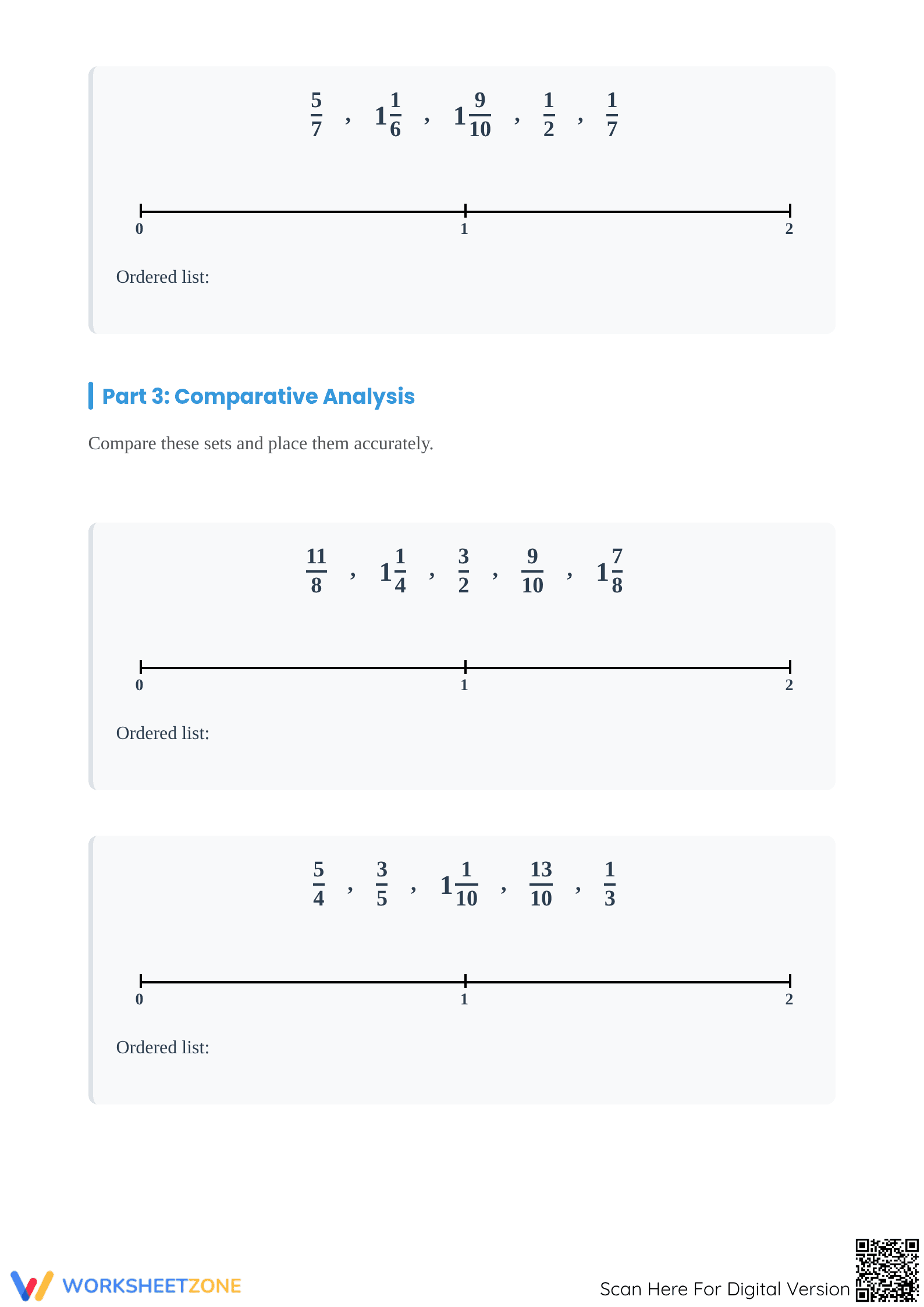
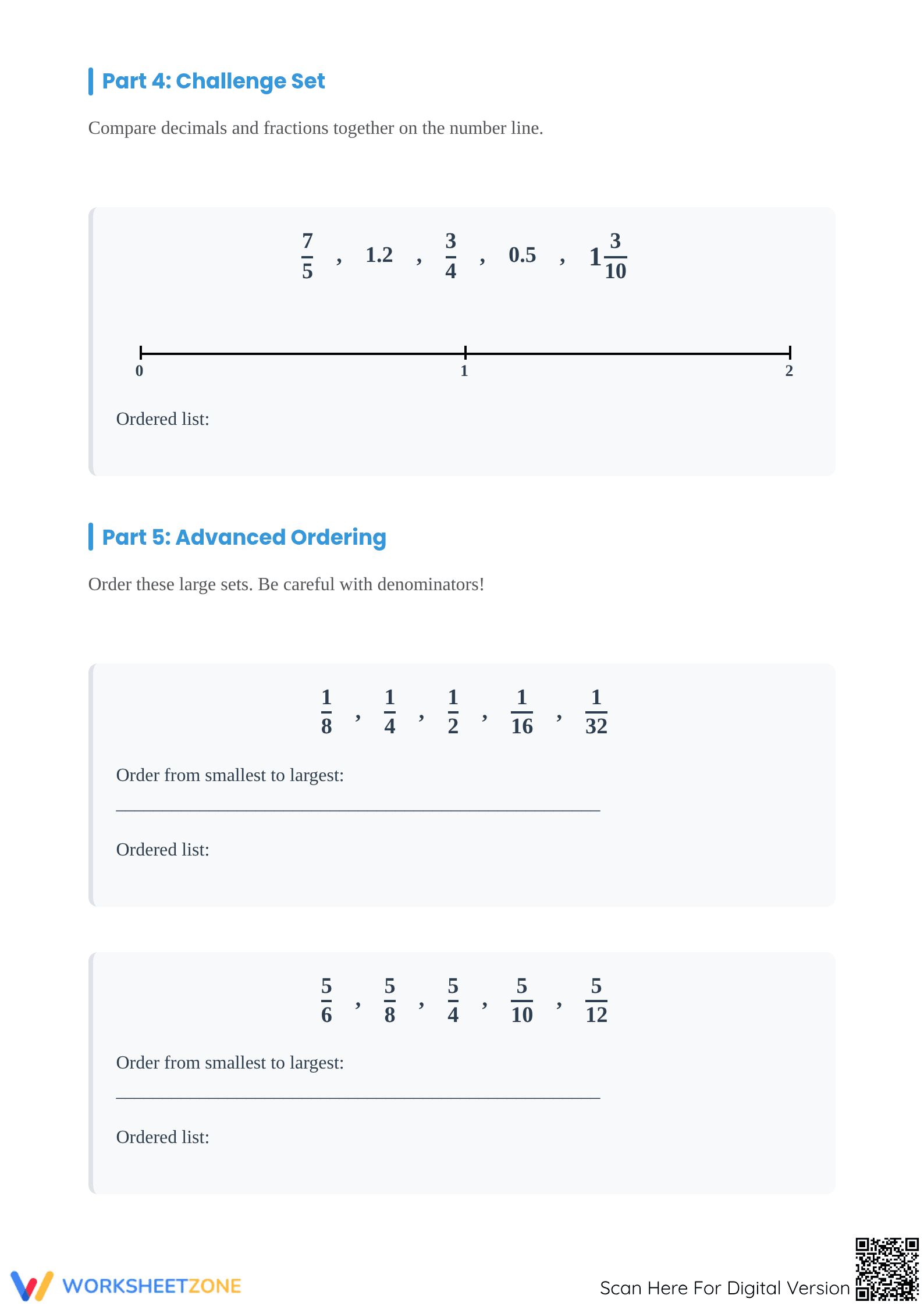
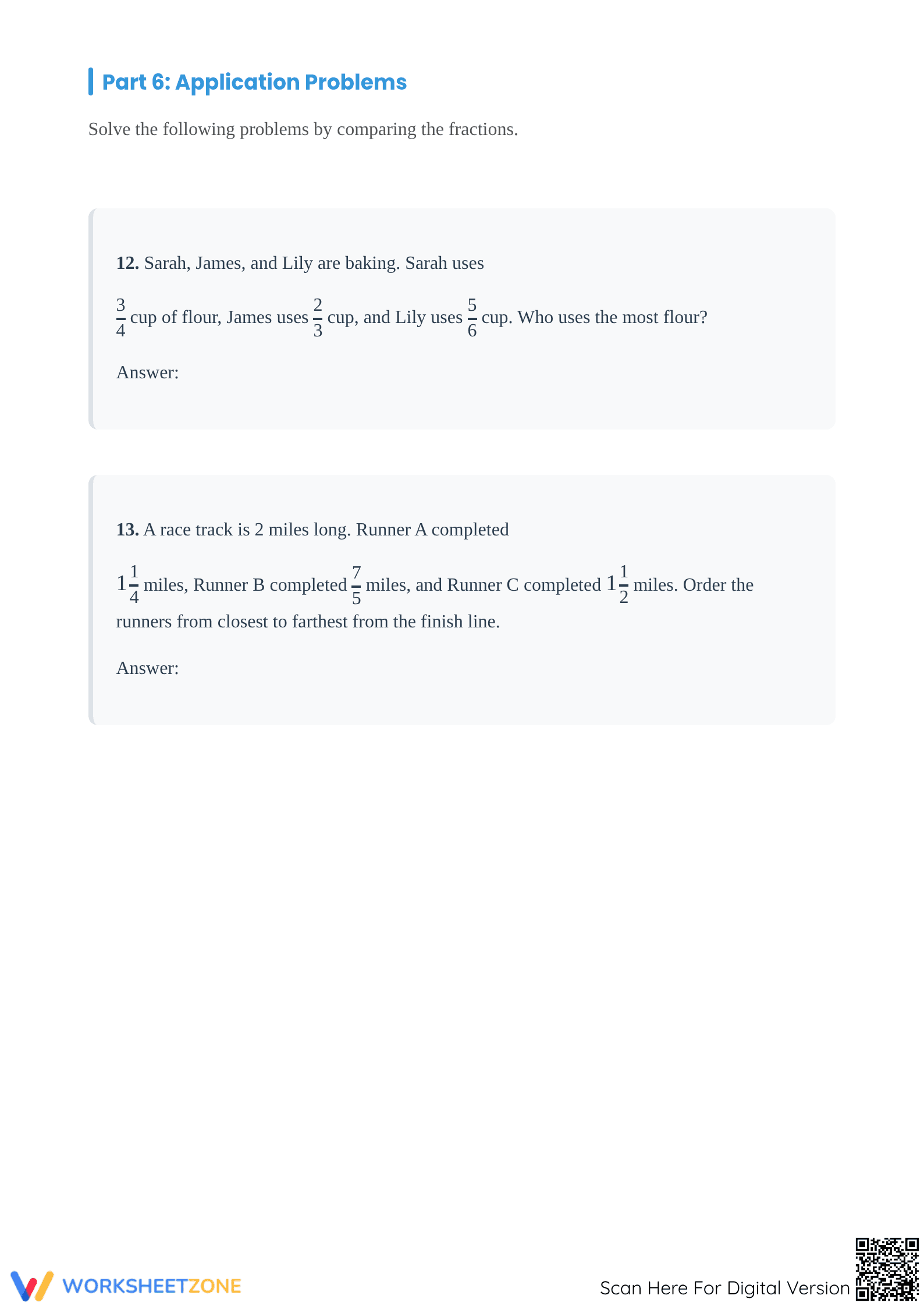
Inside this resource, you will find 13 distinct sets of ordering tasks spread across 5 pages. The packet begins with proper fractions (0-1) and expands to a 0-2 range for mixed numbers and improper fractions. It includes comparative analysis, a challenge set with decimals, advanced ordering with varied denominators, and two multi-step word problems for real-world application.
Skill Progression
- Guided Practice: Students begin with three sets of proper fractions on number lines featuring 0, 1/2, and 1 benchmarks to scaffold early spatial estimations.
- Supported Practice: Six sets focus on mixed numbers and improper fractions, requiring students to convert values before placing them on expanded 0-2 number lines.
- Independent Practice: The final four tasks involve decimal-fraction comparisons and word problems where students must independently determine ordering without visual assistance.
This progression adheres to the gradual-release model, moving from basic visualization to complex independent application of rational number concepts.
Standards Alignment
The primary standard CCSS.MATH.CONTENT.4.NF.A.2 focuses on comparing fractions with different denominators. This worksheet extends that skill by requiring students to order multiple values simultaneously across 13 distinct tasks. Both standard codes can be copied directly into lesson plans, IEP goals, or district curriculum mapping tools to track student progress throughout the unit.
How to Use It
This packet is best used after initial fraction comparison lessons to solidify number line visualization. Assign during a Math Workshop rotation for small group mastery or use the word problems as a formative exit ticket. This helps observe if students can translate abstract ordering skills into practical problem-solving contexts.
Who It's For
Designed for Grade 4 and 5 students meeting standard requirements, this resource is also suitable for Grade 6 review or Grade 3 enrichment. It works perfectly alongside visual anchor charts showing fraction-to-decimal equivalents or area models for proper fractions to support diverse learner needs.
The standard CCSS.MATH.CONTENT.4.NF.A.2 requires students to understand that ordering fractions is a spatial reasoning task as much as a computational one. This worksheet leverages the number line as a powerful cognitive tool for visualizing the relative magnitude of rational numbers. According to the NAEP 2024 reports on mathematics achievement, students who demonstrate proficiency with number line models are significantly more likely to succeed in later middle-school algebra and proportional reasoning tasks. By integrating decimals and mixed numbers, this resource forces students to move beyond rote procedures into deeper conceptual territory. This 5-page mastery set provides the necessary volume of practice required for long-term retention of fraction density concepts. It is an essential component for any curriculum focusing on the transition from whole numbers to the rational number system in elementary education.


