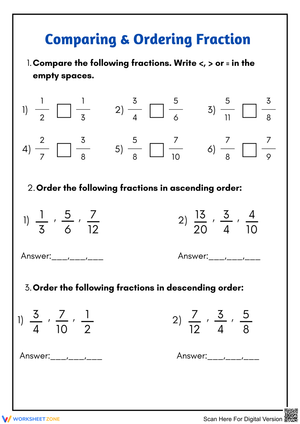
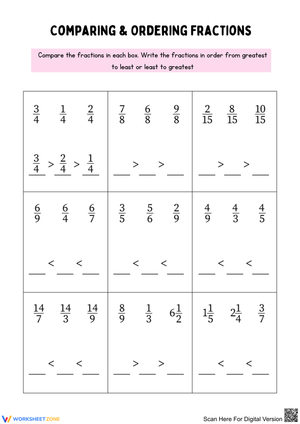
3rd Grade Comparing and Ordering Fractions worksheets
These 3rd grade comparing and ordering fractions worksheets give teachers a structured, visual-first set of practice tools built specifically around the reasoning demands of 3.NF — the point in elementary math where students stop treating fractions as shaded pictures and start treating them as numbers with actual positions and relative sizes. Each worksheet targets a distinct skill within that conceptual shift, so you can match the practice to exactly where your class is in the progression.
The Specific Skills Targeted
The set addresses four distinct comparison and ordering tasks that third graders encounter in sequence. Worksheets in the first group focus on fractions with the same denominator — students mark, shade, and compare, reinforcing that equal-sized pieces mean the larger count wins. The second group flips that logic: same numerator, different denominator. Students examine pairs like 1/3 and 1/6, using fraction bar models to see why the fraction with the smaller denominator is actually larger. A third cluster moves to number lines, asking students to place three or more fractions on a 0-to-1 scale and write them in order — least to greatest and greatest to least. The final group situates comparisons inside word problems: two friends each get a fraction of the same pan of cornbread; who got more? That context forces students to hold the "same whole" constraint in mind, which is where the real reasoning lives.
Standard Alignment
These worksheets address CCSS.MATH.CONTENT.3.NF.A.3.D, which requires students to compare two fractions with the same numerator or denominator by reasoning about size, and to recognize that comparisons are only valid when both fractions refer to the same whole. In classroom terms, this standard sits at the end of the 3.NF progression — students should already understand that fractions are numbers on a number line (3.NF.A.2) before comparison and ordering work begins. Teachers who find students struggling with these worksheets often discover the gap is upstream: the student hasn't yet internalized the unit fraction, not the comparison itself.
Common Misconceptions Worth Catching Early
The denominator-size reversal is the headline error, but there's a subtler one that shows up just as often: students who correctly handle same-denominator comparisons will still stumble on the "same whole" requirement. Ask a student whether 3/4 of a small personal pizza is more than 1/2 of a sheet pan pizza, and many third graders will mark 3/4 as larger — because they're comparing the fractions without anchoring to identical wholes. The word problem worksheets in this set are designed to surface exactly that confusion, presenting problems where the wholes are stated as equal so teachers can later discuss why that constraint matters.
A second pattern worth watching: when ordering three fractions on a number line, students often place the first two correctly but misposition the third because they compare it to the last fraction they placed rather than to zero as the reference point. Scanning completed number line worksheets for this cluster error — two fractions correctly spaced, third one visually crowded in — tells you the student understands pairwise comparison but hasn't internalized the number line as a fixed scale.
Fitting These Worksheets Into Your Lesson Plans
The visual model worksheets make strong Monday and Tuesday material — introduce or re-anchor the concept whole-group, then send students to independent practice while the lesson is still fresh. By Wednesday, the number line worksheets work well as a transition: students are comparing, but now they're also sequencing, which raises the cognitive demand without introducing new content. Thursday word problems work as either independent practice or a partner task; the natural-language phrasing slows students down enough that they often catch their own errors when reading aloud to a partner.
For the eight-minute block before lunch or pickup — too short for new instruction, too long to fill with nothing — a single same-denominator or same-numerator comparison worksheet gives students focused, completable practice. These also work reliably as Monday morning warm-ups after a weekend gap, since the visual models rebuild context quickly without requiring you to re-teach. If you're using the set for formative data, a completed word problem worksheet tells you two things at once: whether the student can execute the comparison and whether they understand why the wholes must match.
Adapting the Set for a Range of Learners
Students who are still shaky on what a denominator represents benefit from working through the visual model worksheets with physical fraction strips alongside — let them match the strip to the shaded model before they write the symbol. That scaffold can come off once they're consistently accurate on the visual pages.
For students ready to push further, the number line worksheets become more challenging when you ask them to generate their own example: given the answer (e.g., 1/4 < 1/2 < 3/4), write a word problem that matches. That reversal — constructing context for a given comparison — shows whether the concept is genuinely internalized. Students who can do that are ready to start thinking about fractions equivalent to one and fractions greater than one, which is where 4th grade begins.
Frequently Asked Questions
Do these worksheets require any prep beyond printing?
No cutting, laminating, or assembly required. Each worksheet is self-contained with its own models and instructions, so students can work independently once the concept has been introduced whole-group. The only prep that adds value is having paper strips available for students who need the physical folding experience before they attempt the same-numerator comparison worksheets.
How do I sequence these within my fractions unit?
Start with same-denominator comparisons once students can place basic unit fractions on a number line. Move to same-numerator worksheets only after the same-denominator logic is secure — rushing that transition is the most common pacing mistake in this unit. Number line ordering and word problems come last, after both comparison types are stable.
What if a student finishes quickly but the answers are wrong?
Speed plus errors on the same-numerator worksheets almost always signals the whole-number override: the student is comparing denominators as if larger means more. Have them fold or draw the model before writing the symbol, even if the worksheet already includes a visual — making them construct it rather than read it usually breaks the pattern within a few examples.
Are these worksheets appropriate for early 4th grade review?
Yes. Fourth graders who didn't fully consolidate 3.NF.A.3 often show gaps when equivalent fractions are introduced. The same-numerator and number line worksheets in this set work well as a two-day review before beginning 4.NF fraction equivalence work.
Clear All