


























Views
Downloads
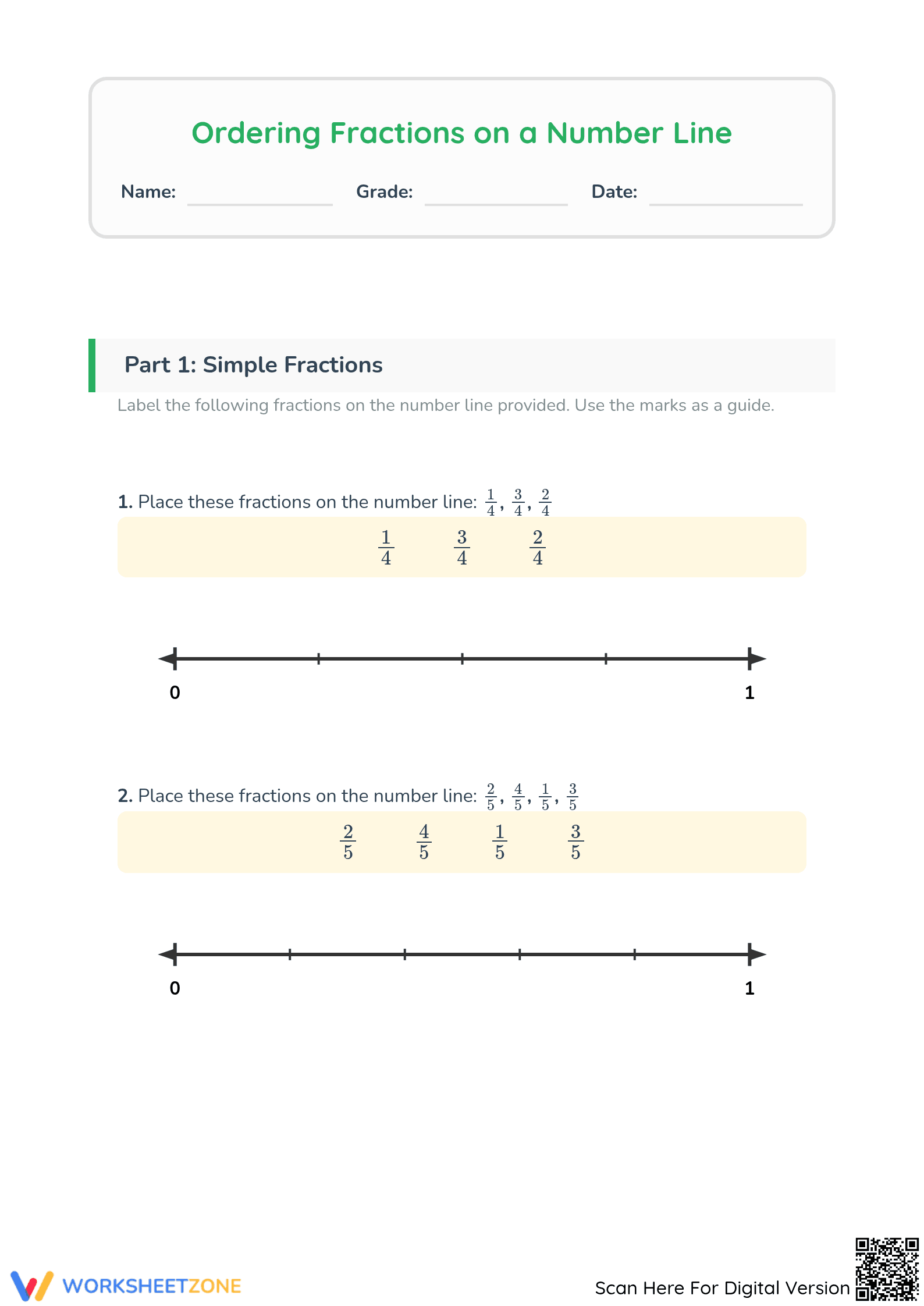


Printable Ordering Fractions on a Number Line Worksheet
Paste this activity's link or code into your existing LMS (Google Classroom, Canvas, Teams, Schoology, Moodle, etc.).
Students can open and work on the activity right away, with no student login required.
You'll still be able to track student progress and results from your teacher account.
This essential worksheet guides students through the visualization of fraction values by placing them accurately on a number line. By mapping fractions from simple parts to improper values and mixed numbers, learners develop a deep spatial understanding of numerical relationships and magnitude. Students will confidently compare and order fractions with both like and unlike denominators through structured practice.
At a Glance
- Grade: 3–5 · Subject: Math (Fractions)
- Standard:
CCSS.MATH.CONTENT.3.NF.A.2— Represent a fraction on a number line diagram by defining the interval from 0 to 1- Skill Focus: Ordering and Comparing Fractions
- Format: 3 pages · 6 problems · Answer key included · PDF
- Best For: Fraction magnitude visualization and comparison practice
- Time: 20–30 minutes
This 3-page PDF document is partitioned into three logical sections that increase in complexity. It contains six multi-part tasks featuring clear, pre-marked number lines to reduce student frustration. The set includes a comprehensive answer key for quick grading and supports independent work through visual cues and clear instructions for identifying equivalent positions on the line.
Skill Progression
- Guided Practice: The first two tasks focus on simple fractions with like denominators (fourths and fifths), using pre-segmented lines to build foundational placement skills. (2 tasks)
- Supported Practice: Tasks 3 and 4 introduce mixed denominators and equivalent fractions, requiring students to think critically about how different parts map to the same whole. (2 tasks)
- Independent Practice: The final sections challenge students with improper fractions and mixed numbers beyond one whole, culminating in a direct comparison task. (2 tasks)
This progression follows the gradual-release model, moving from basic identification to higher-order comparison and evaluation of fraction magnitude.
Standards Alignment
The primary focus is CCSS.MATH.CONTENT.3.NF.A.2, which requires students to understand a fraction as a number on the number line and represent fractions on a number line diagram. The worksheet also supports CCSS.MATH.CONTENT.4.NF.A.2 by requiring comparison of fractions with different denominators using visual models. Both standard codes can be copied directly into lesson plans, IEP goals, or district curriculum mapping tools.
How to Use It
Assign this worksheet during the "You Do" portion of a lesson on fraction magnitude to assess student understanding of relative value. It serves as an excellent formative assessment tool; teachers should observe if students are counting tick marks or using benchmark fractions (like 1/2) to place values. Expect most students to complete the full 3-page set in approximately 25 minutes.
Who It's For
Designed for Grade 3-5 students, this resource is ideal for general education classrooms, small group intervention, or as a scaffolded review for upper elementary learners. It pairs naturally with physical number line manipulatives or an anchor chart demonstrating the relationship between proper and improper fractions.
According to a 2024 analysis by ScienceDirect TpT Analysis, visual representation tools like number lines are critical for transitioning students from rote calculation to conceptual fraction mastery. This worksheet aligns with the "Building Powerful Numeracy" framework by Fisher & Frey (2014), emphasizing the importance of spatial reasoning in mathematical development. By requiring students to place CCSS.MATH.CONTENT.3.NF.A.2 aligned fractions on a physical line, the resource reinforces the connection between abstract symbols and concrete magnitude. Research indicates that students who regularly engage with number line models show significantly higher accuracy in fraction comparison tasks compared to those using circle models alone. This resource provides the structured repetition necessary to move students from emerging placement skills to fluent comparison across diverse denominator sets.


