


























Views
Downloads
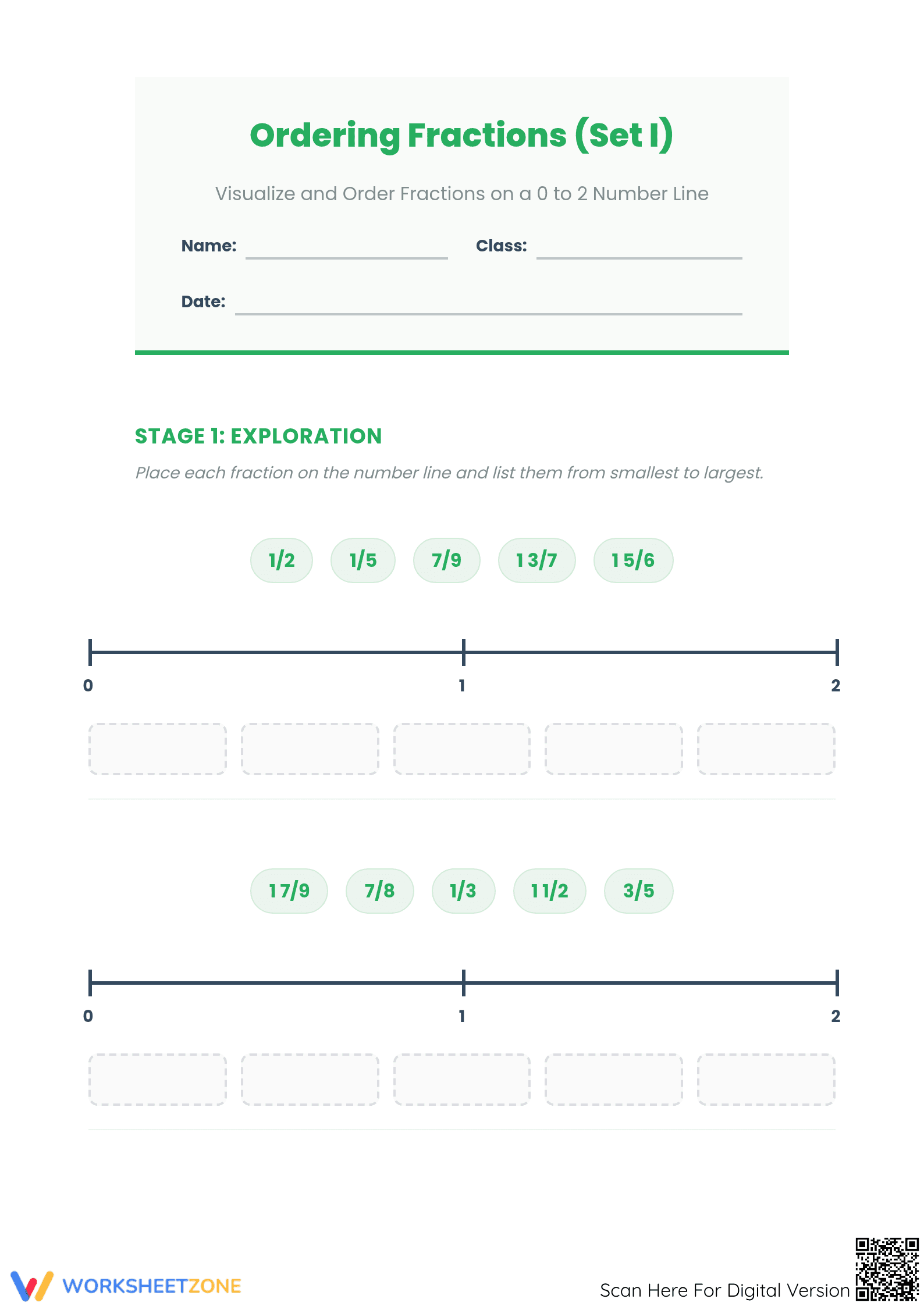

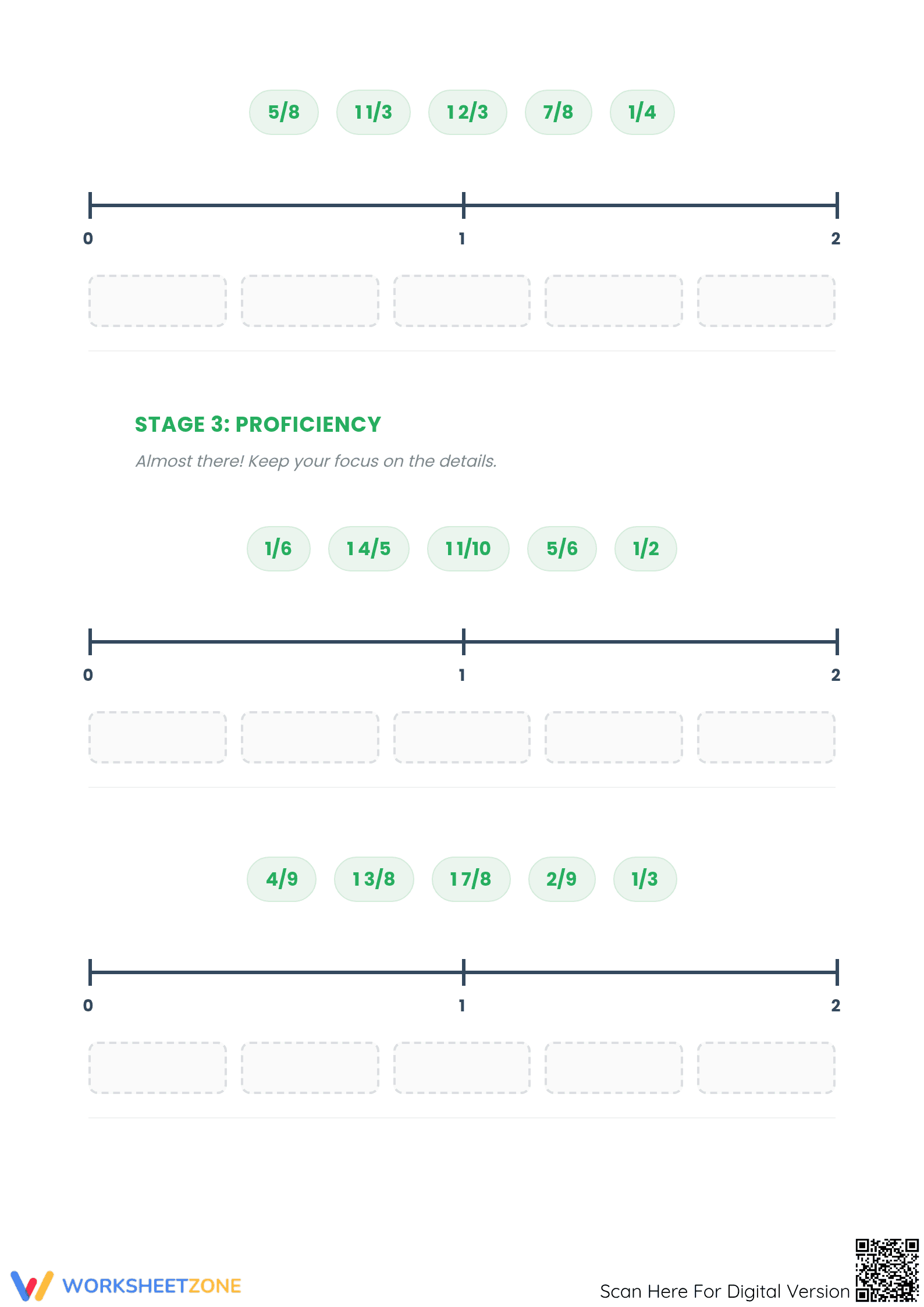
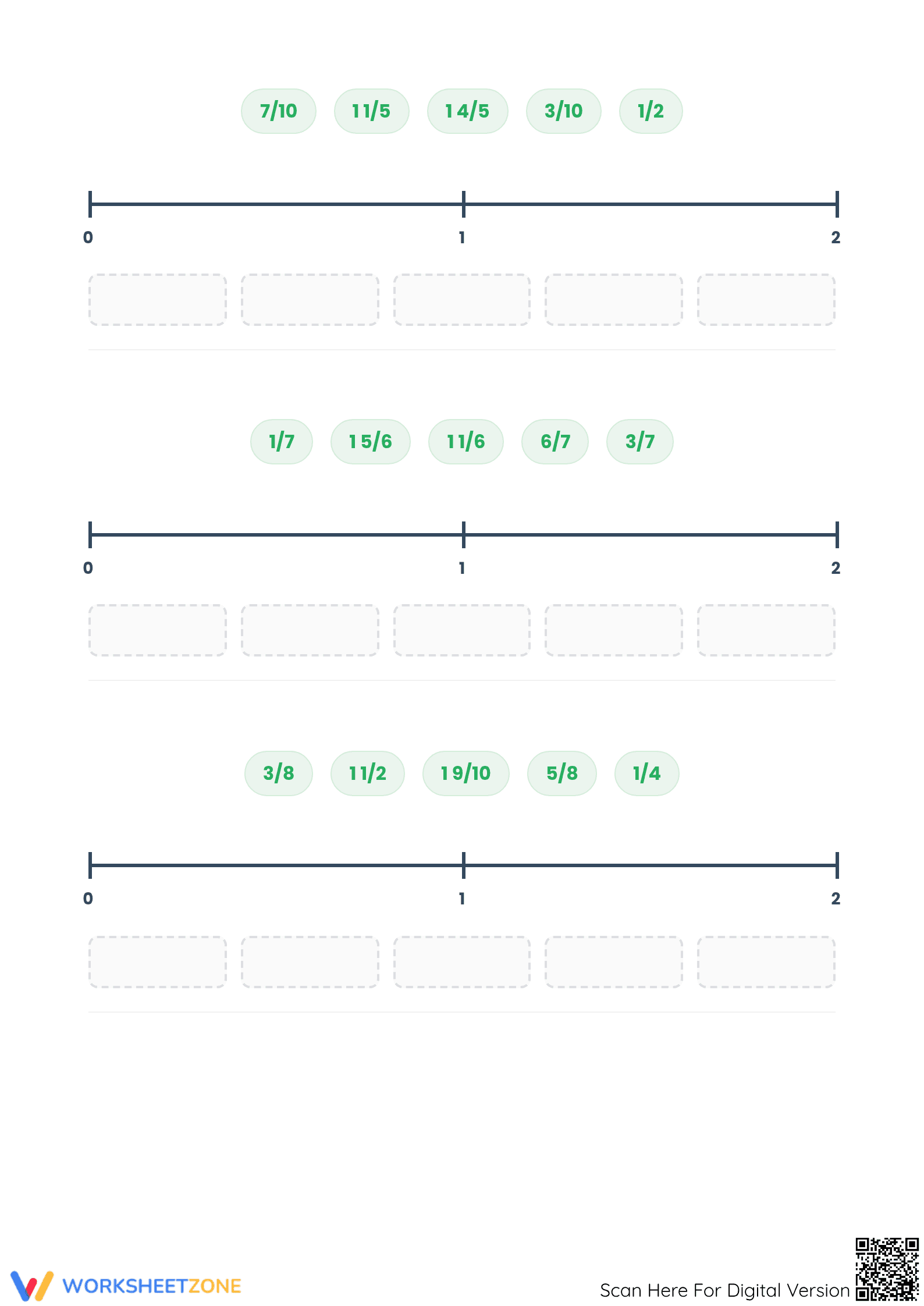
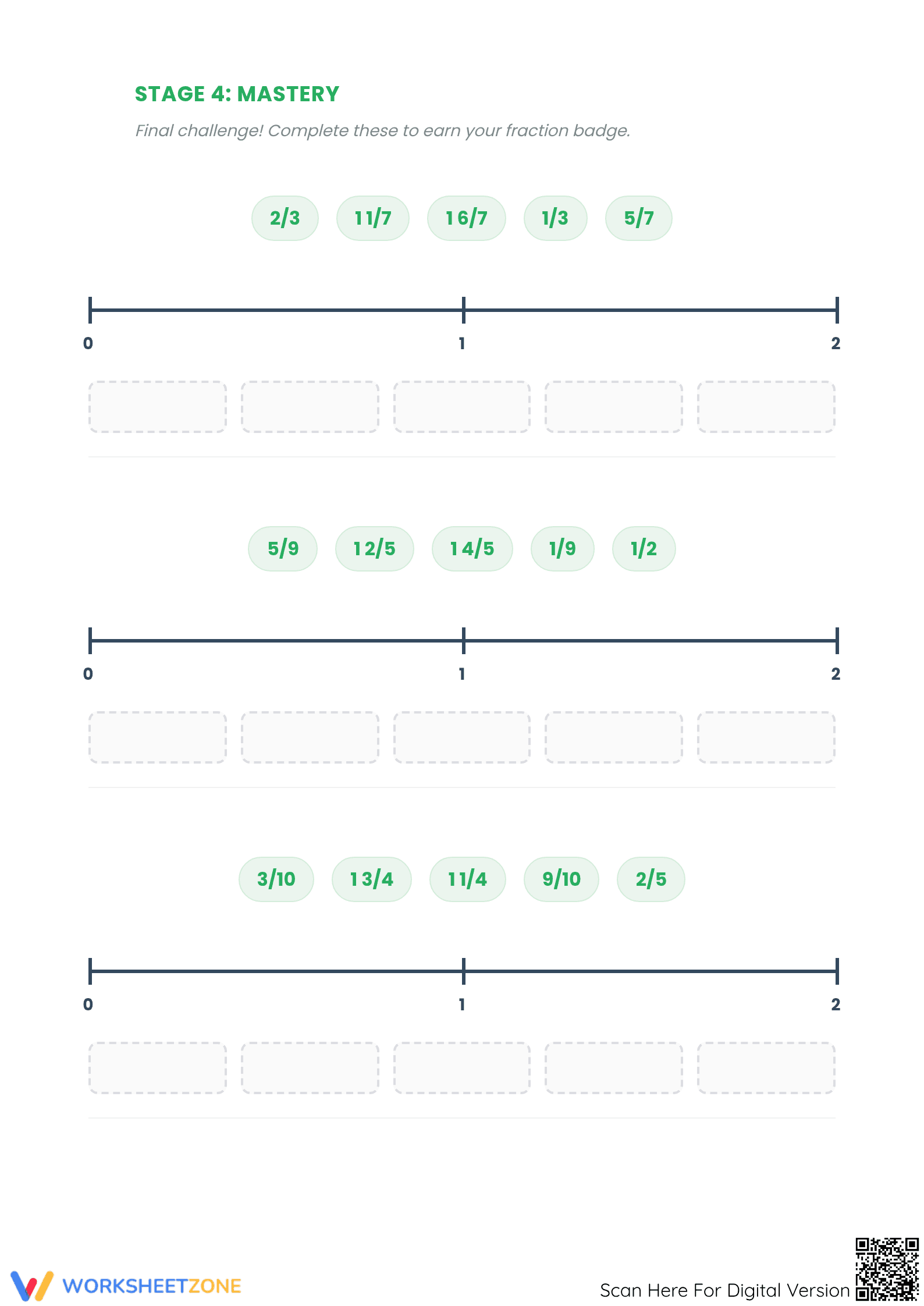

Printable Ordering Fractions on a Number Line Worksheet
Paste this activity's link or code into your existing LMS (Google Classroom, Canvas, Teams, Schoology, Moodle, etc.).
Students can open and work on the activity right away, with no student login required.
You'll still be able to track student progress and results from your teacher account.
Master the spatial relationship between fractions and whole numbers with this ordering fractions on a number line worksheet. By visualizing values on a 0 to 2 line, learners develop a conceptual understanding of fraction magnitude, improper fractions, and equivalent values. This resource transforms abstract comparison into a concrete, observable skill.
At a Glance
At a Glance
- Grade: 4–6 · Subject: Math / Fractions
- Standard:
4.NF.A.2— Compare and order fractions with different numerators and denominators on a number line- Skill Focus: Ordering fractions (0 to 2)
- Format: 5 pages · 14 task sets · Answer key included · PDF
- Best For: Small group instruction and independent mastery
- Time: 30–45 minutes
What's Inside
This five-page PDF package includes 14 task blocks. Each block presents five fractions—from simple proper fractions to improper values—that students must plot on a 0 to 2 number line before listing them chronologically. The clear layout and included answer key make this a complete instructional tool for any classroom.
Skill Progression
- Exploration Stage: Students begin with foundational fractions, focusing on placement relative to 0, 1, and 2.
- Development Stage: Learners navigate mixed denominators, finding common grounds for accurate positioning.
- Proficiency & Mastery: Final sets challenge students with complex denominators (7ths, 9ths), ensuring generalized ordering skills.
This scaffolded design follows the gradual-release model, moving from guided exploration to independent mastery of fraction density and order.
Standards Alignment
Aligned with 4.NF.A.2: "Compare two fractions with different numerators and denominators." It also supports Grade 3 representation and Grade 5 operations. Both standard codes can be copied directly into lesson plans, IEP goals, or district curriculum mapping tools.
How to Use It
Use this during direct instruction to model how benchmark fractions help determine placement. Alternatively, use specific pages as formative assessment; observe if students correctly place improper fractions past the whole number 1. Expected completion for the full packet is 40 minutes.
Who It's For
Ideal for 4th and 5th-grade students, this also serves as an intervention for middle schoolers. It pairs well with a visual anchor chart or a physical number line classroom activity.
According to the RAND AIRS 2024 report on mathematics instructional materials, visual models like number lines are critical for bridging the gap between symbolic fraction manipulation and true numerical fluency. Research by Fisher & Frey (2014) emphasizes that scaffolded practice—moving from exploration to mastery—significantly improves student retention of complex mathematical concepts. This worksheet leverages these evidence-based strategies by providing 14 sets of repetitive yet increasingly difficult tasks, ensuring students don't just memorize rules but develop a robust mental number line. By requiring students to plot 70 individual fraction points across 5 pages, the resource aligns with EdReports 2024 recommendations for high-quality, focused practice in elementary mathematics. The inclusion of a 0 to 2 range specifically targets common misconceptions regarding improper fractions, providing the benchmark support necessary for students to excel in later algebraic reasoning and rational number operations.


