


























Views
Downloads
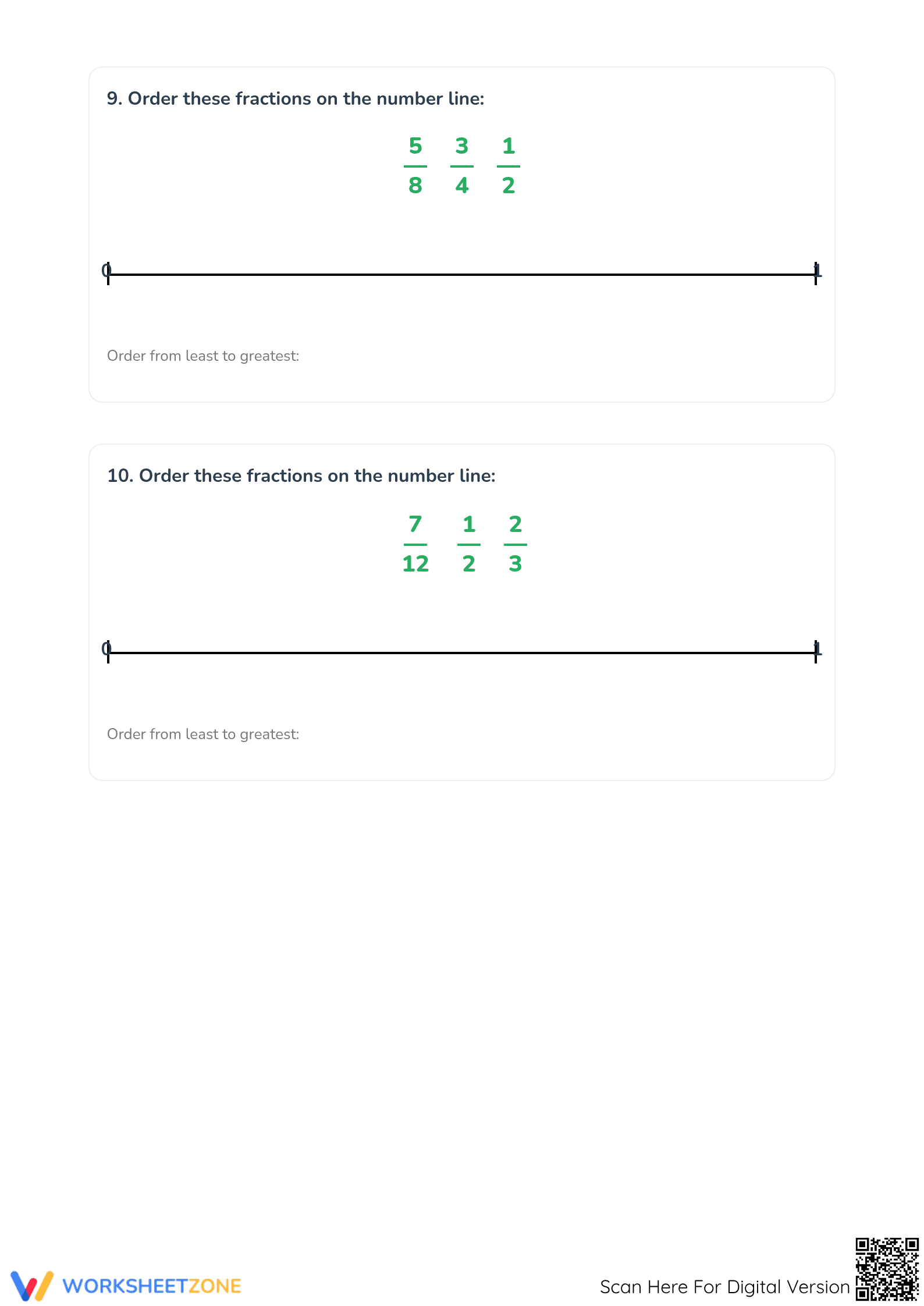

Printable Ordering Fractions on a Number Line Worksheet
Paste this activity's link or code into your existing LMS (Google Classroom, Canvas, Teams, Schoology, Moodle, etc.).
Students can open and work on the activity right away, with no student login required.
You'll still be able to track student progress and results from your teacher account.
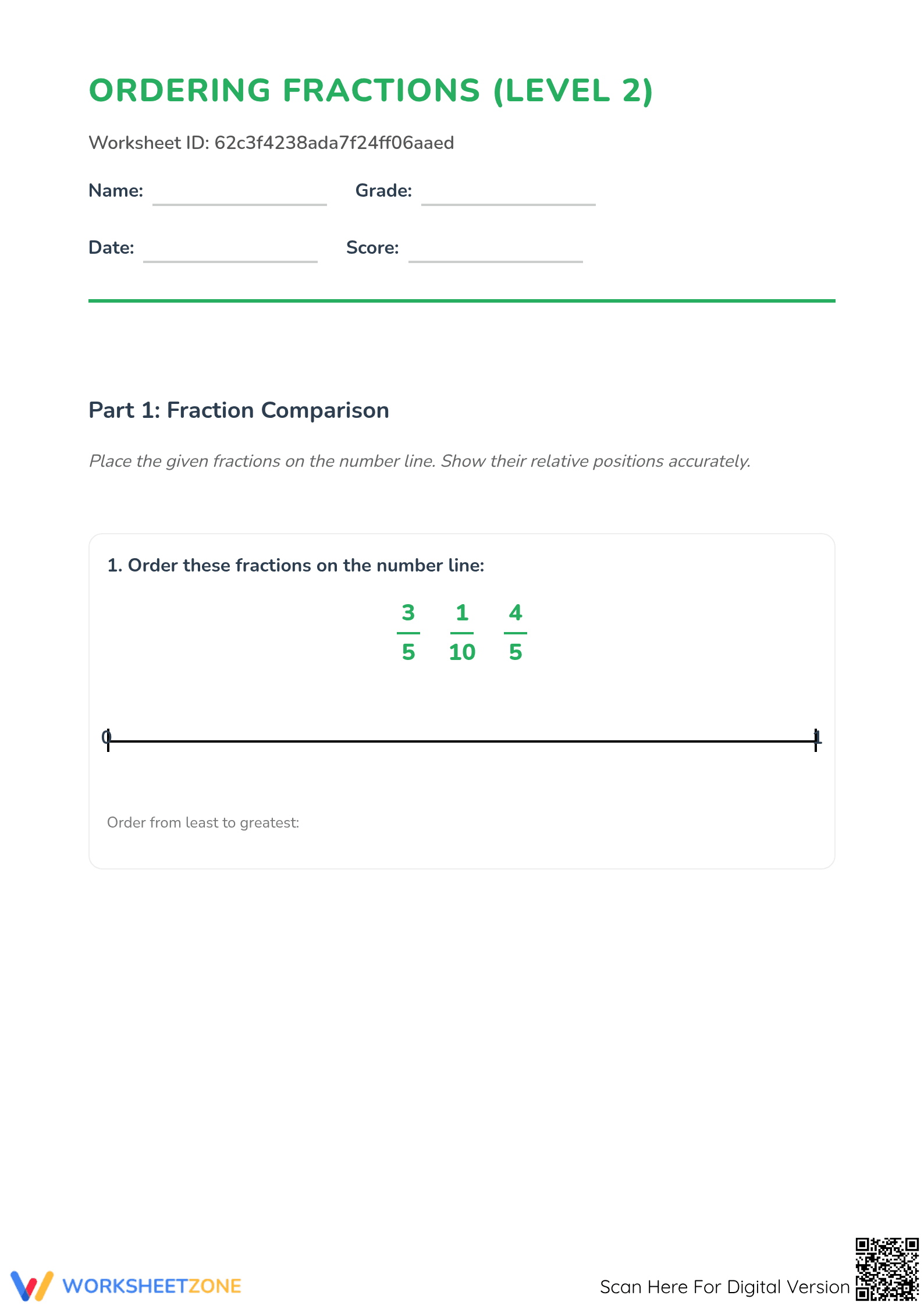
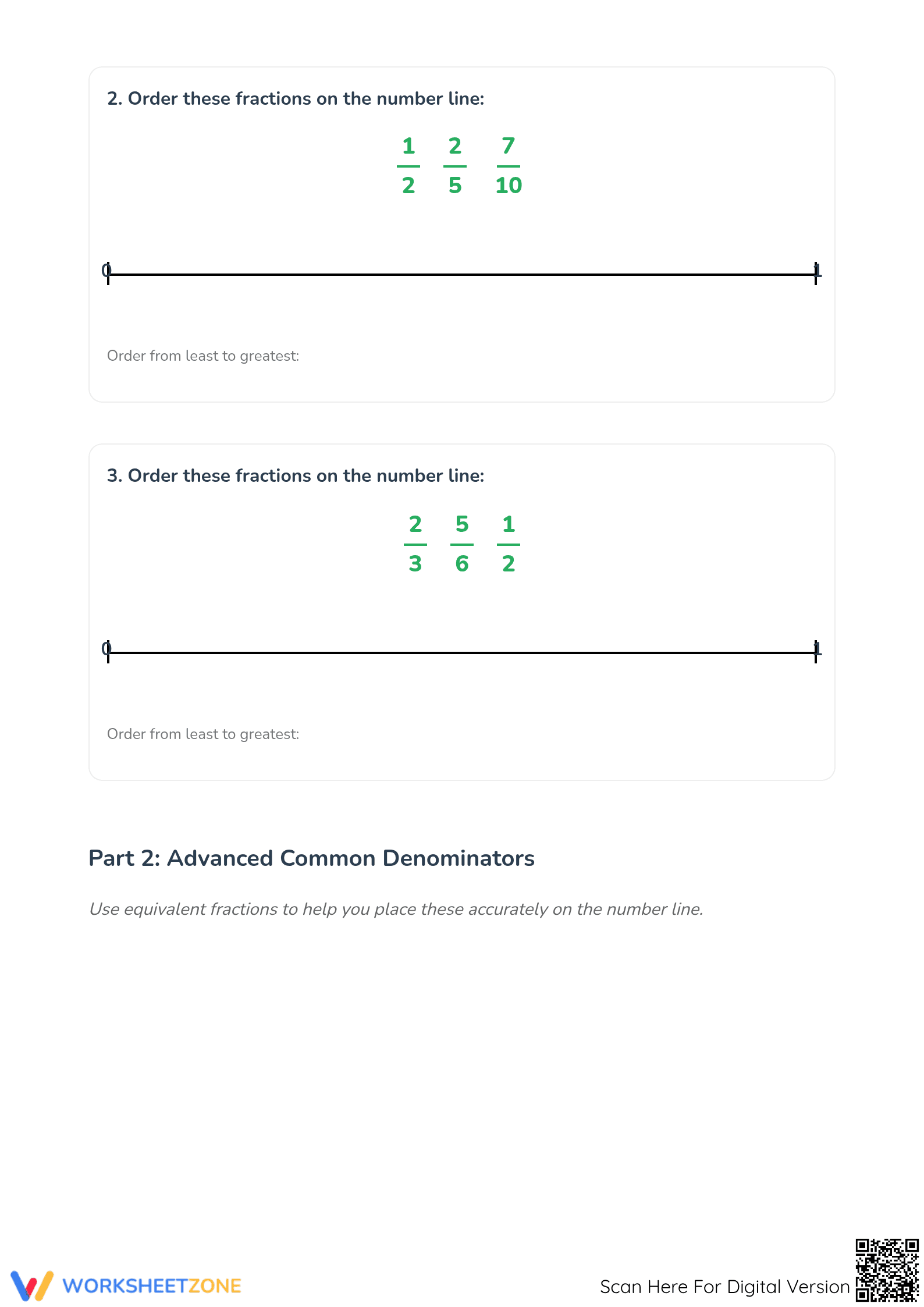
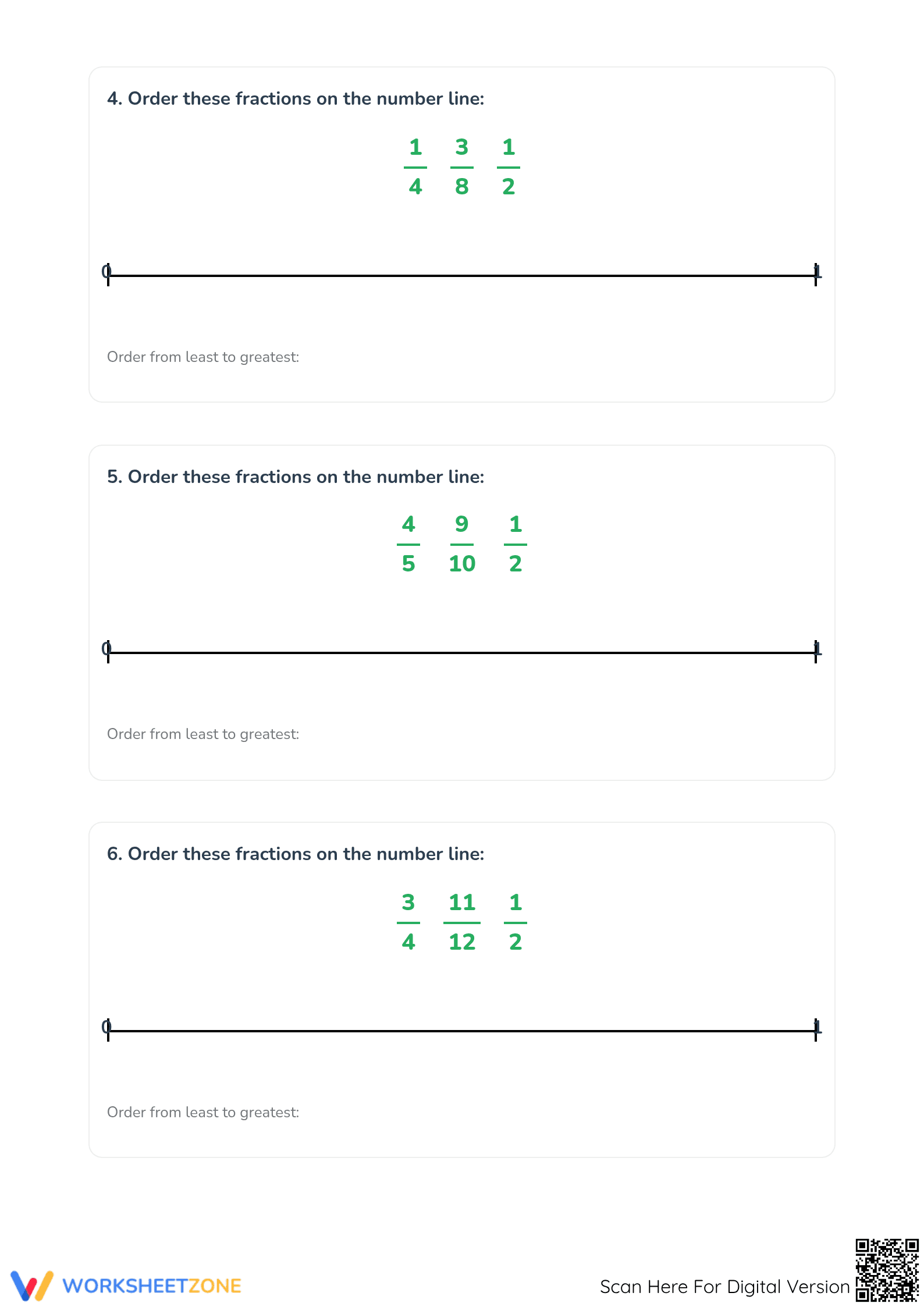
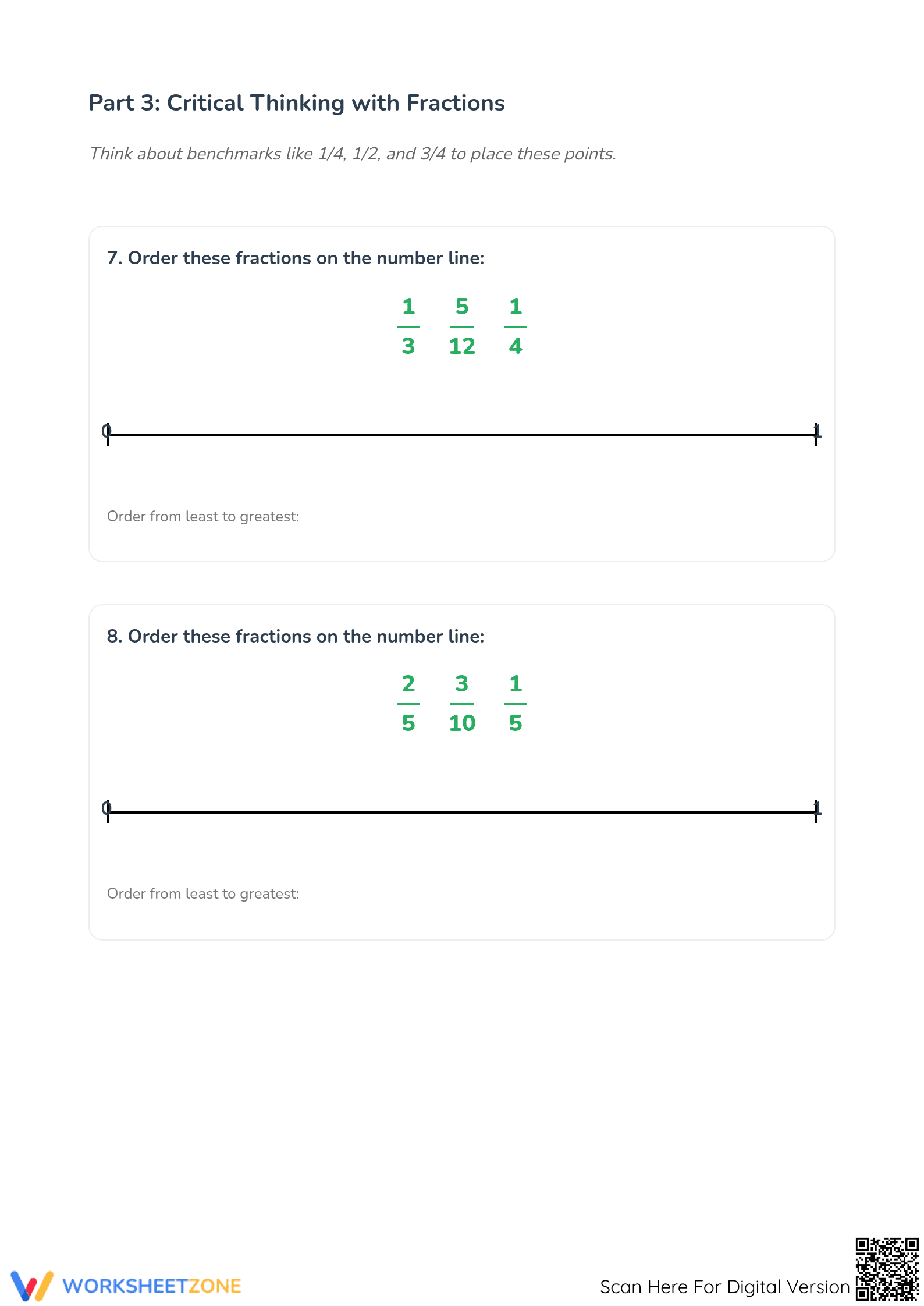
Order fractions accurately with this comprehensive 5-page practice packet. Students visualize relationships between parts of a whole by placing fractions on a number line, moving from basic comparisons to advanced critical thinking with benchmarks. This resource builds the conceptual bridge between numerical values and spatial representation through structured practice.
At a Glance
- Grade: 4 · Subject: Math
- Standard:
CCSS.MATH.CONTENT.4.NF.A.2— Compare and order fractions with different denominators using benchmarks or common denominators.- Skill Focus: Ordering fractions on number lines
- Format: 5 pages · 10 problems · Answer key included · PDF
- Best For: Grade 4 fraction units and review
- Time: 30–45 minutes
This multi-page packet contains 10 structured problems across three distinct sections. Students encounter fraction comparison, advanced common denominator tasks, and critical thinking exercises using benchmarks. Each page features clear number line diagrams and dedicated space for students to write their finalized order from least to greatest, ensuring a neat and organized workflow for self-correction or teacher grading.
Zero-Prep Workflow
- Print the 5-page PDF for your class or individual students (1 minute).
- Distribute to students for independent practice, small-group centers, or as a comprehensive sub plan (1 minute).
- Review answers using the included full-size answer key to identify misconceptions (5 minutes).
Total teacher prep time is under 2 minutes, making this an essential tool for busy classrooms requiring high-quality, standards-aligned materials.
Standards Alignment
Aligned to CCSS.MATH.CONTENT.4.NF.A.2. This standard requires students to compare two fractions with different numerators and different denominators by creating common denominators or comparing to a benchmark fraction. This worksheet extends that skill by requiring students to order three fractions simultaneously on a visual number line. Both standard codes can be copied directly into lesson plans, IEP goals, or district curriculum mapping tools.
How to Use It
Use this worksheet during the independent practice phase of a lesson on fraction equivalence. Teachers can observe students as they plot points to see if they are using benchmarks like 1/2 correctly. It also serves as a strong formative assessment to identify students who struggle with finding common denominators for ordering. Expected completion time is 35 minutes for the full packet.
Who It's For
Designed for Grade 4 students, but also suitable for Grade 5 review or Grade 3 advanced learners. It provides scaffolded support through visual number lines while challenging students with unlike denominators. It pairs naturally with fraction tiles or anchor charts displaying common benchmarks to support students who need additional visual cues during the ordering process.
According to RAND AIRS 2024, visual models like number lines are critical for developing a "mental number line" which correlates strongly with overall mathematical achievement in upper elementary grades. This worksheet targets CCSS.MATH.CONTENT.4.NF.A.2, moving students beyond rote calculation toward spatial fraction reasoning. By requiring students to order multiple fractions on a single line, the resource enforces the principle of relative magnitude. Fisher & Frey (2014) emphasize that such guided practice allows students to transition from simple comparisons to complex ordering with diverse denominators. This 5-page resource provides the necessary volume of practice to ensure that Grade 4 learners can accurately represent fraction values in a linear context, which is a foundational skill for later work with decimals and negative numbers. By grounding abstract numerical symbols in physical space, educators can mitigate common misconceptions regarding denominator size.


