


























Views
Downloads

Essential Fractions: Number Line Worksheet (Grades 3-4)
Paste this activity's link or code into your existing LMS (Google Classroom, Canvas, Teams, Schoology, Moodle, etc.).
Students can open and work on the activity right away, with no student login required.
You'll still be able to track student progress and results from your teacher account.
Visualizing fractions on a number line is a critical milestone for developing numerical fluency. This printable math worksheet provides a structured approach to identifying, placing, and comparing fractions through a series of increasingly complex tasks. By mapping abstract values onto a physical line, students build a concrete understanding of fraction magnitude and spatial relationships.
At a Glance
- Grade: Grade 3 · Subject: Math (Fractions)
- Standard:
CCSS.MATH.CONTENT.3.NF.A.2— Represent a fraction on a number line diagram by defining the interval from 0 to 1- Skill Focus: Placing and ordering fractions on number lines
- Format: 5 pages · 12 problems · Answer key included · PDF
- Best For: Fractions unit practice and formative assessment
- Time: 20–30 minutes
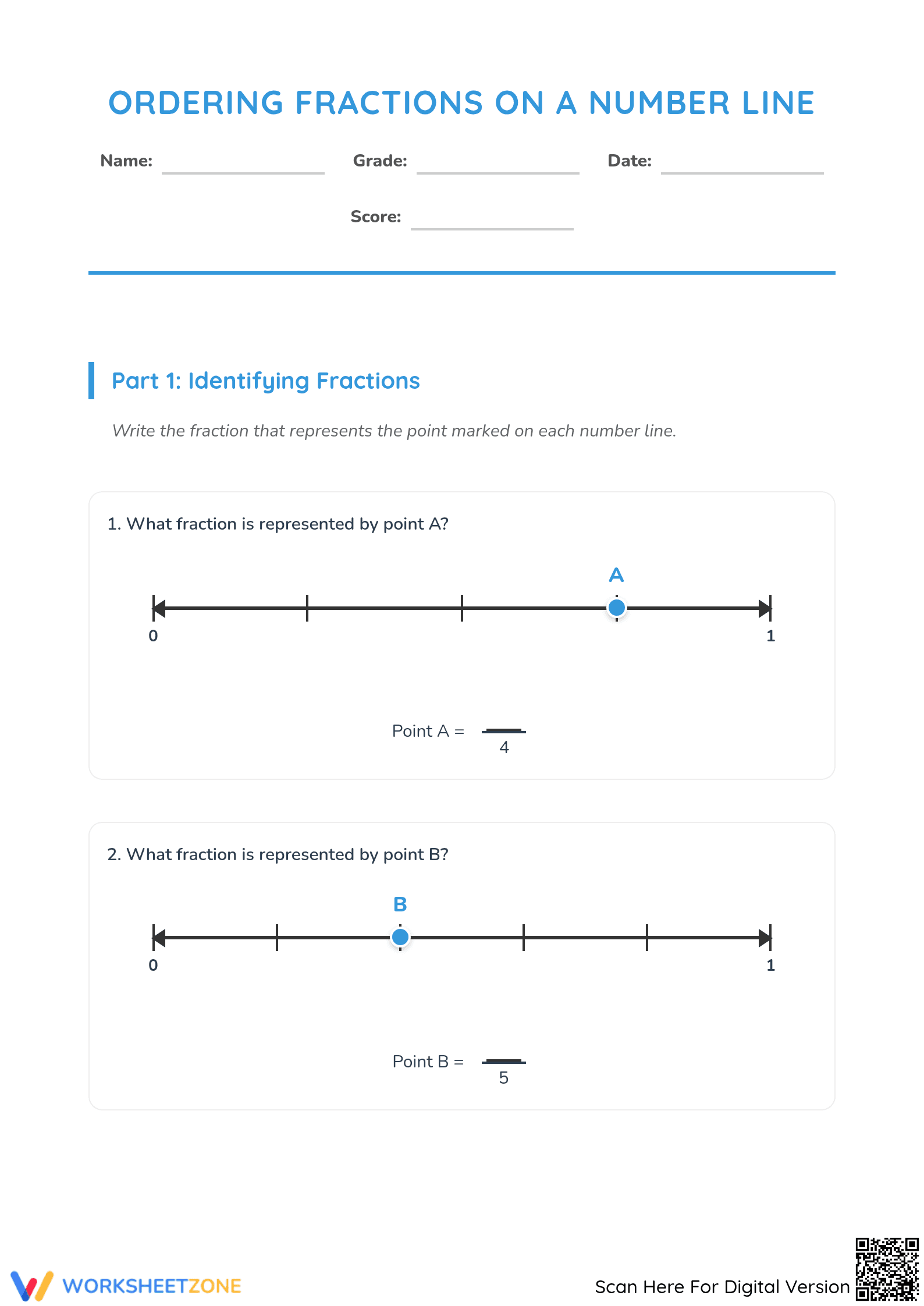
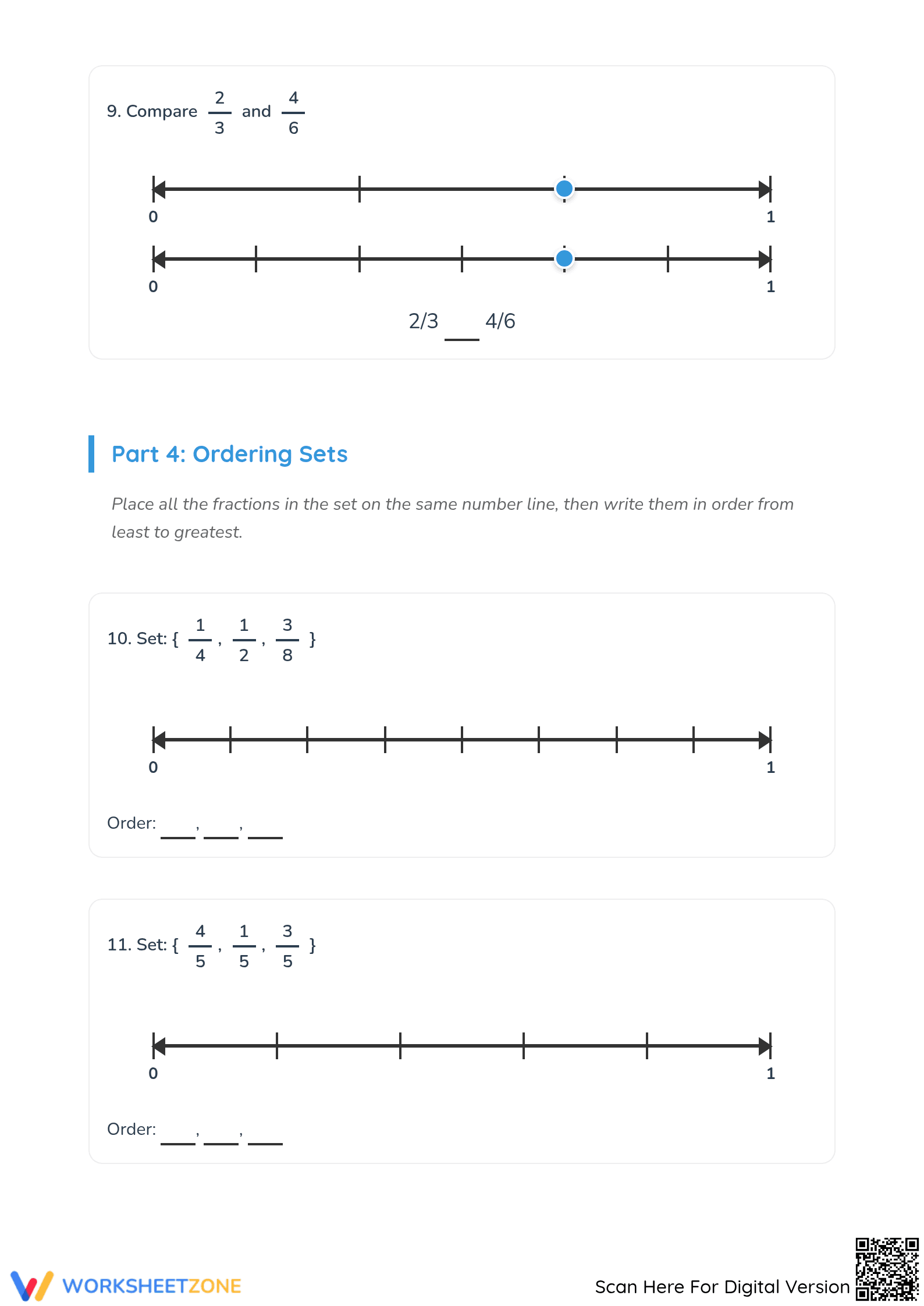
This comprehensive 5-page PDF includes twelve diverse problems organized into four parts. Students identify points, then transition to placing their own fractions, including improper values. The final sections challenge students to compare pairs and order complete sets from least to greatest. A detailed answer key is included for grading.
Skill Progression
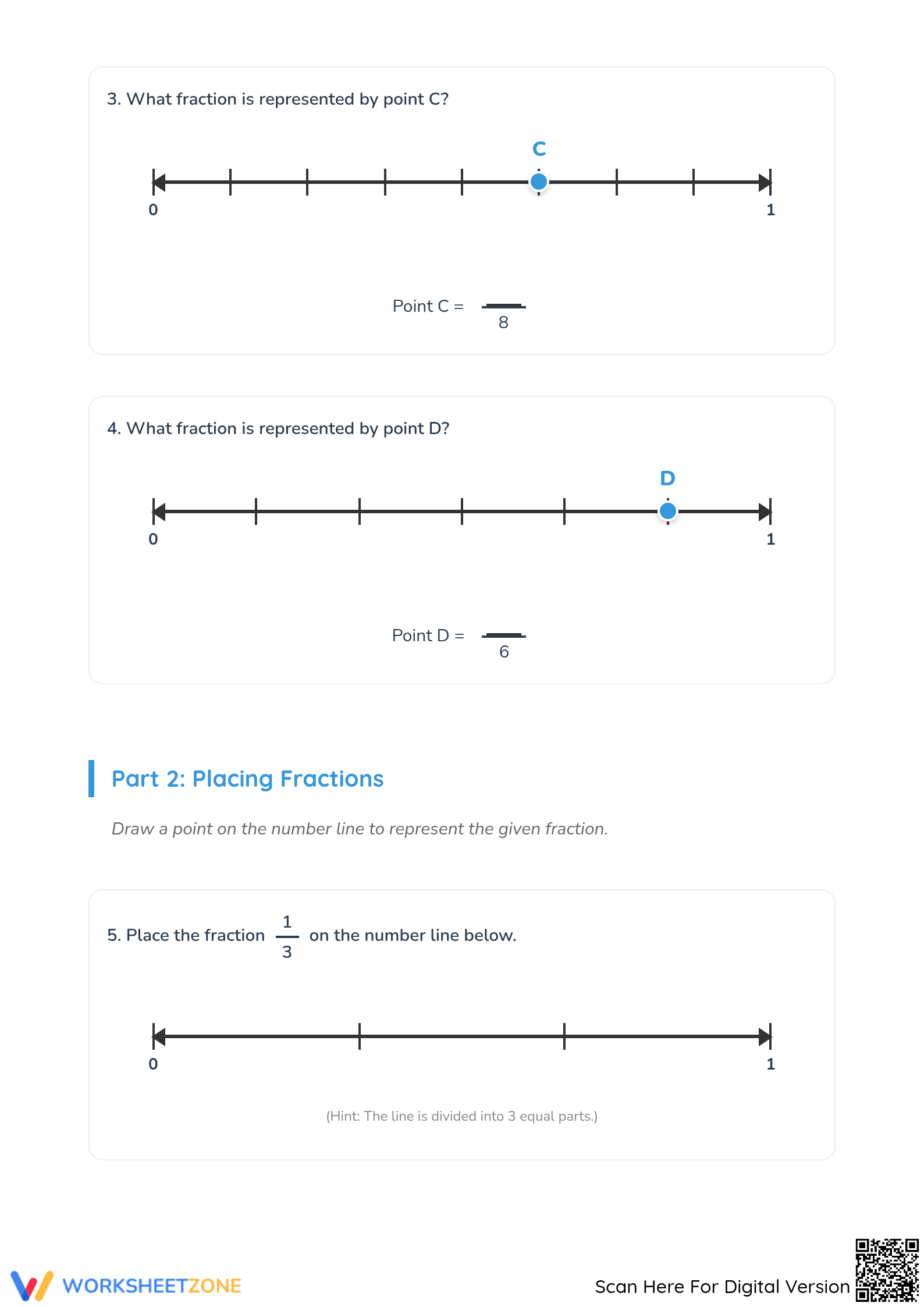
- Guided Identification (Tasks 1-4): Students examine number lines with marked points and identify the corresponding fraction based on the provided denominator intervals.
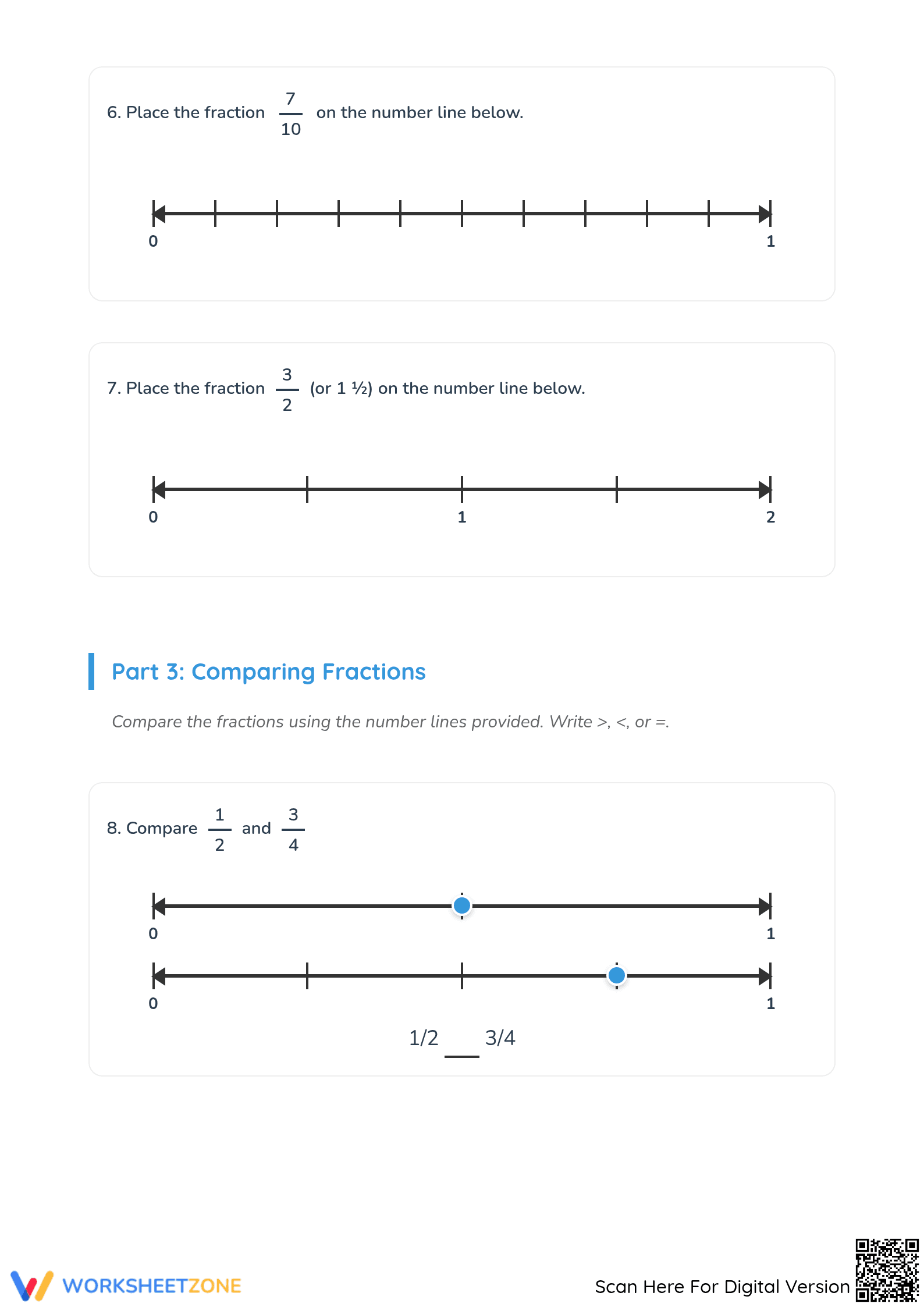
- Supported Placement (Tasks 5-7): Learners are given specific fractions and must accurately draw points on a partitioned line, moving from simple fractions to improper values.
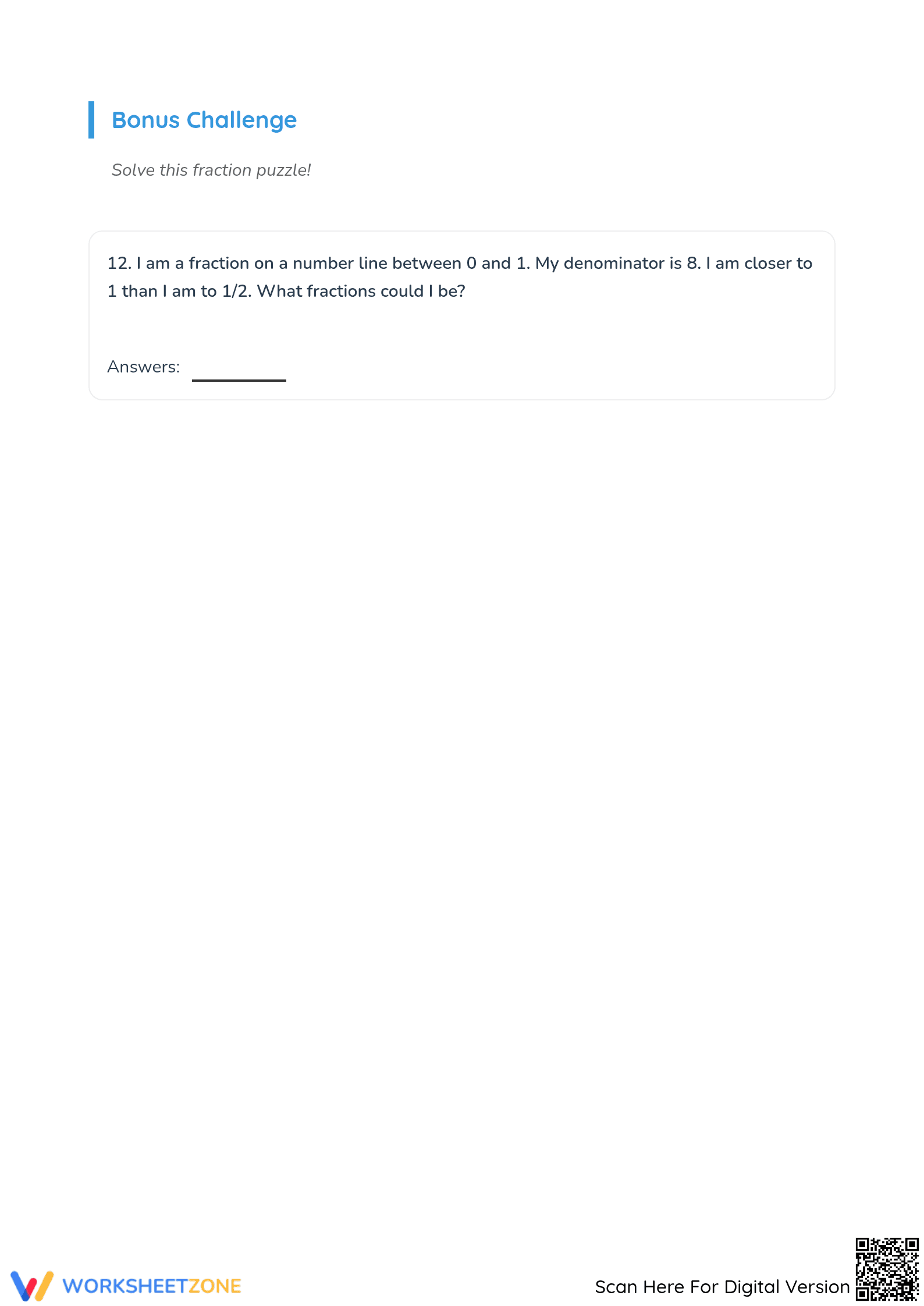
- Independent Comparison and Ordering (Tasks 8-12): Students synthesize their knowledge by comparing two values and ordering sets of three fractions, concluding with a critical thinking puzzle.
This sequence follows the gradual-release model, moving from observation to creation and finally to analytical comparison across multiple representations of numeric value.
Standards Alignment
This resource is primarily aligned with CCSS.MATH.CONTENT.3.NF.A.2, which requires students to represent a fraction on a number line diagram. It also supports CCSS.MATH.CONTENT.4.NF.A.2 through the comparison and ordering tasks found in the latter half of the packet. Both standard codes can be copied directly into lesson plans, IEP goals, or district curriculum mapping tools.
How to Use It
Use this worksheet as a mid-unit check during your fractions module to gauge understanding. During instruction, project the first page and model counting spaces between zero and one. For a formative assessment tip, observe whether students count tick marks or spaces to identify interval logic errors. Most students will complete tasks within 25 minutes.
Who It's For
This packet is designed for Grade 3 and Grade 4 students who are transitioning from area models to linear models of fractions. It is particularly helpful for learners requiring the visual support of a 0-1 scale. This resource pairs naturally with an anchor chart or a hands-on lesson using physical fraction strips.
According to the instructional framework established by Fisher & Frey (2014), the use of number lines provides a unique cognitive bridge that allows students to perceive fractions as numbers rather than just parts of a circle. This worksheet leverages that research by requiring students to interact with the number line in three distinct ways: decoding (identifying), encoding (placing), and evaluating (ordering). By moving beyond simple shading exercises, students develop the mathematical precision required for later work with decimals and coordinate planes. The inclusion of a bonus puzzle further aligns with NAEP recommendations for incorporating higher-order thinking into routine math practice. Educators can confidently utilize this CCSS.MATH.CONTENT.3.NF.A.2 aligned resource to ensure that students are not merely memorizing procedures, but are building a robust mental number line. This foundational skill is a statistically significant predictor of middle-school algebraic success in the long term.


