


























Views
Downloads
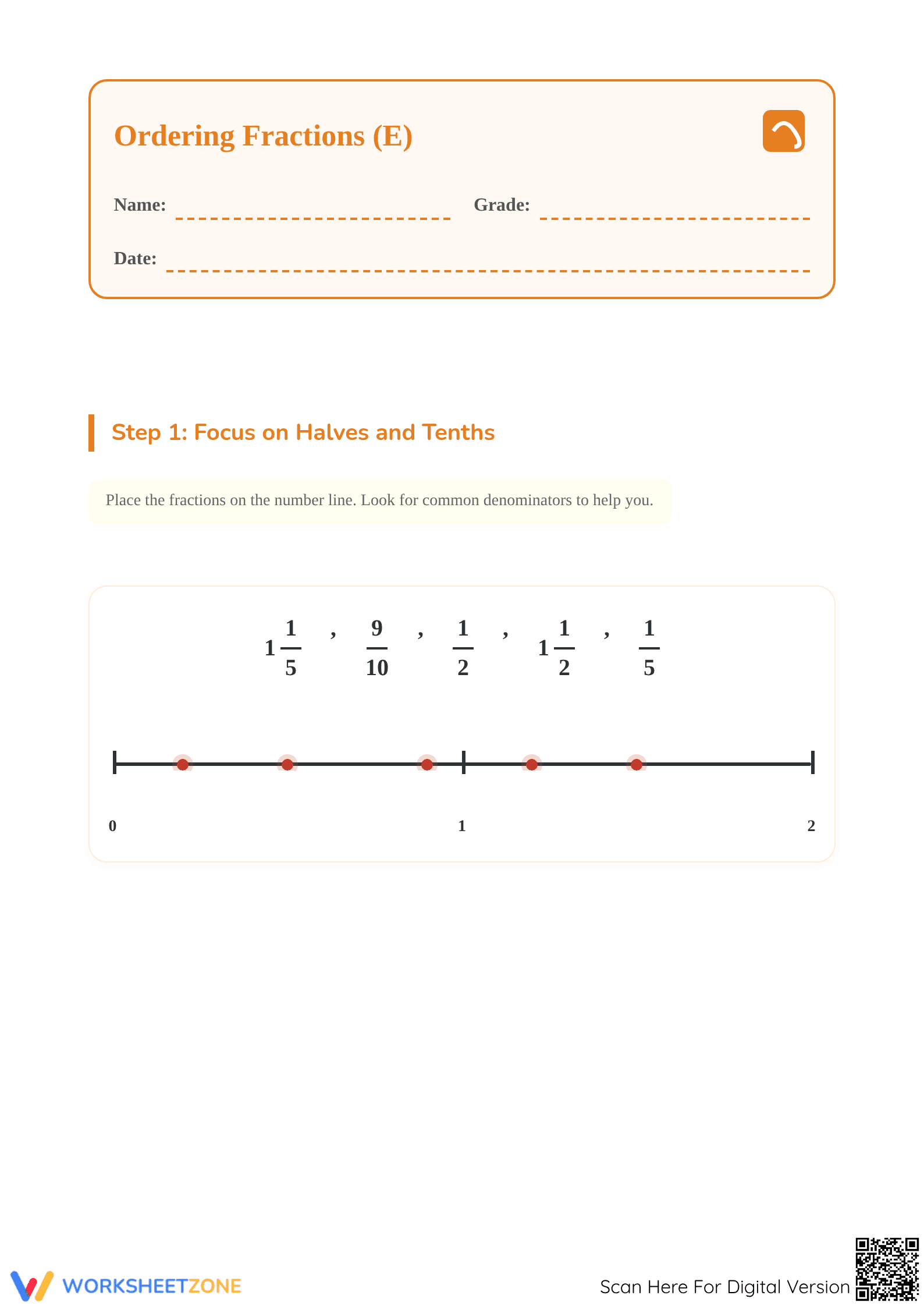
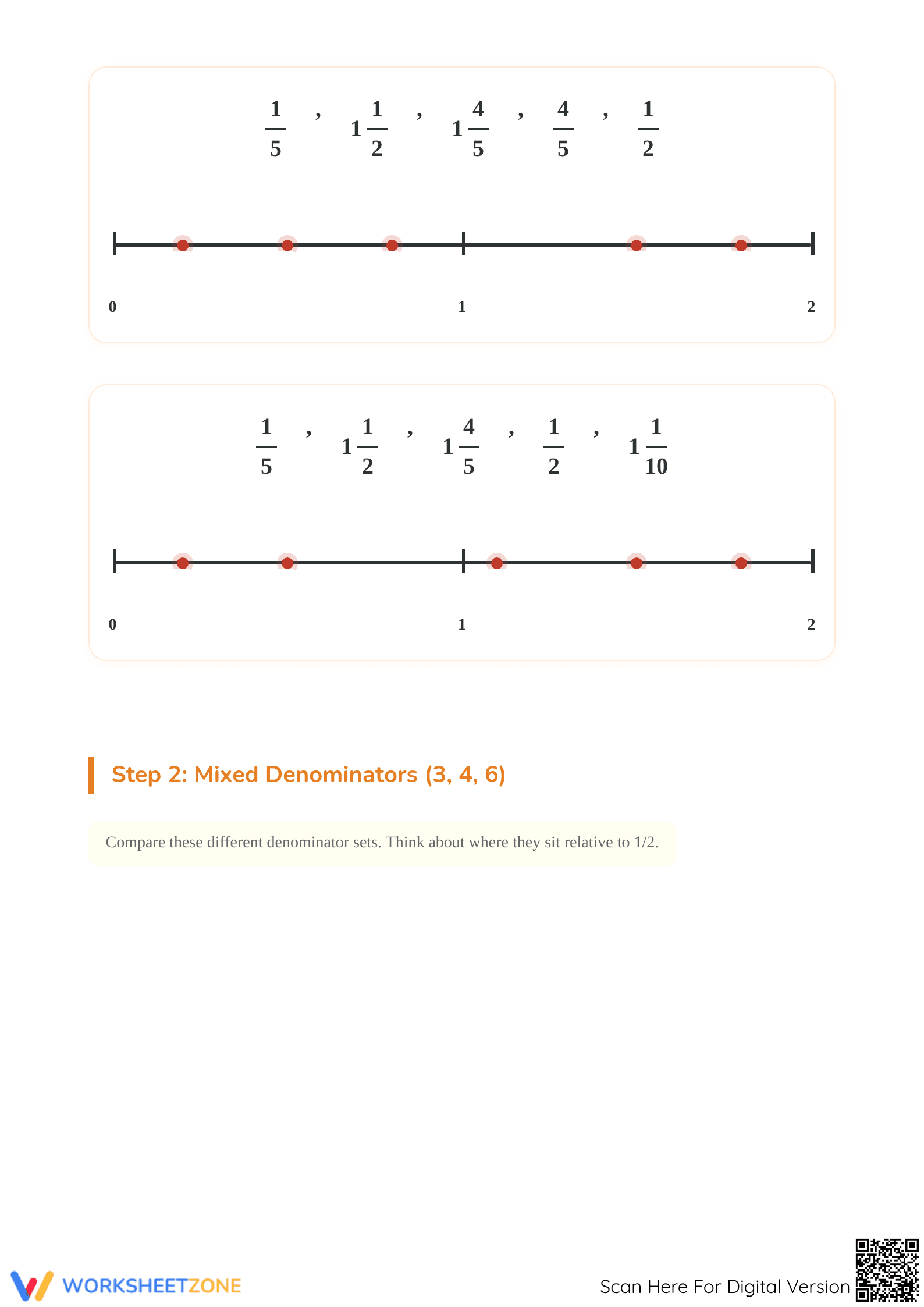
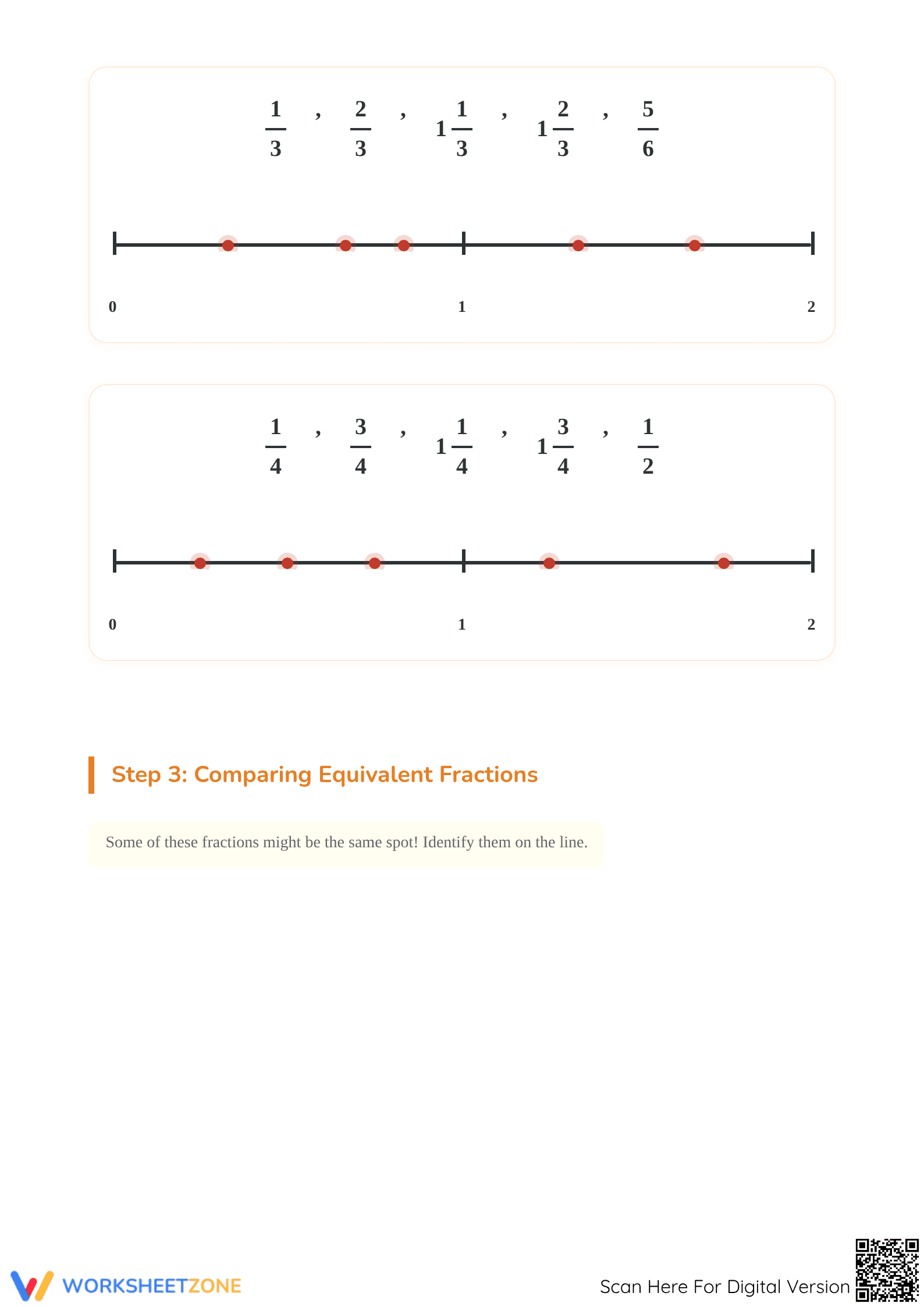

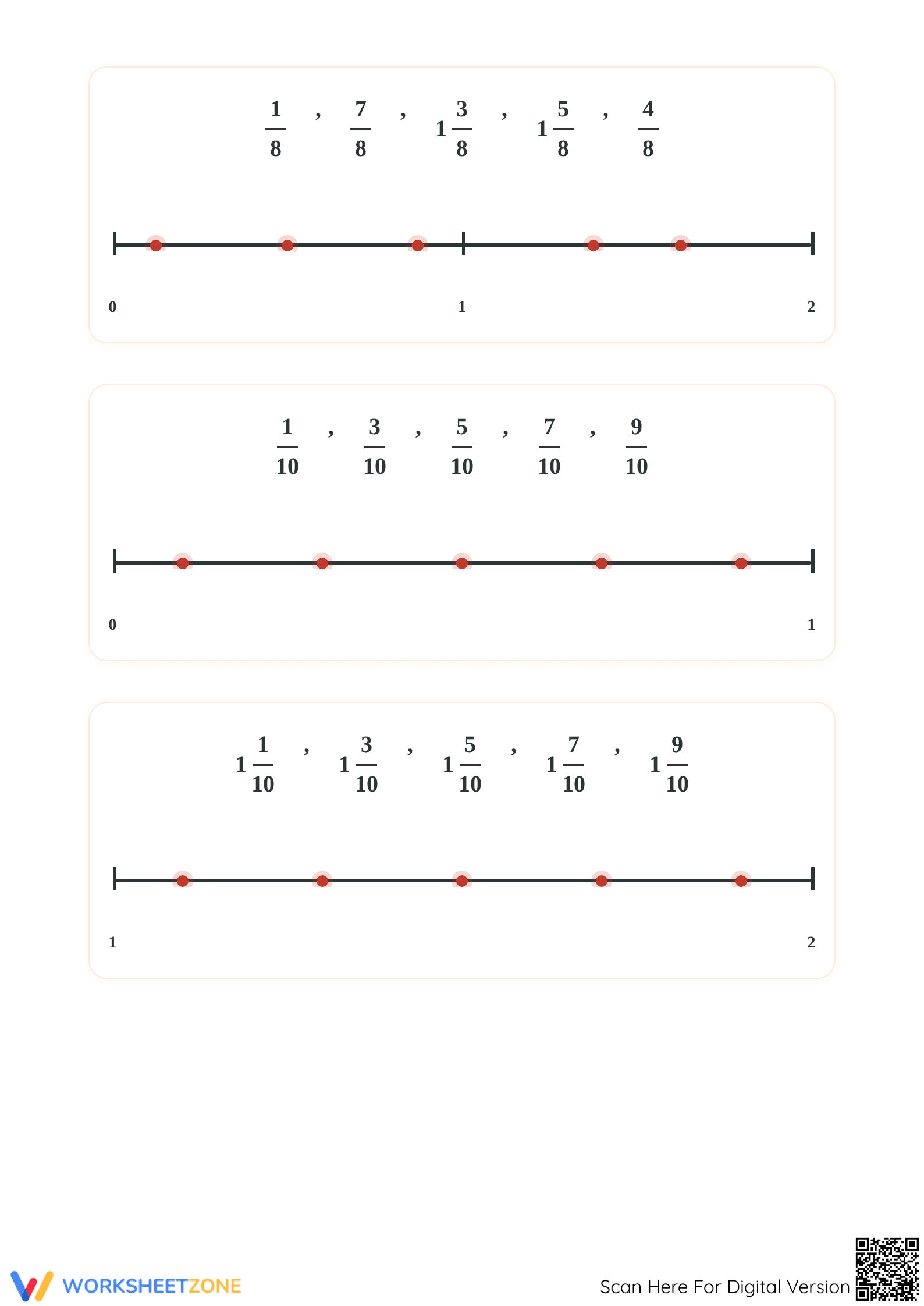

Essential Ordering Fractions on a Number Line Worksheet
Paste this activity's link or code into your existing LMS (Google Classroom, Canvas, Teams, Schoology, Moodle, etc.).
Students can open and work on the activity right away, with no student login required.
You'll still be able to track student progress and results from your teacher account.
This comprehensive math worksheet provides targeted practice for students learning to visualize and order fractions and mixed numbers. By placing numerical values on a structured number line, learners develop a concrete understanding of fractional magnitude and the relationship between parts and wholes. This multi-page resource ensures students move beyond rote memorization toward true conceptual mastery of rational numbers.
At a Glance
- Grade: 3–8 · Subject: Math
- Standard:
CCSS.MATH.CONTENT.3.NF.A.2— Represent a fraction on a number line diagram by defining the interval- Skill Focus: Ordering mixed and proper fractions
- Format: 5 pages · 10 problems · Answer key included · PDF
- Best For: Guided practice and formative assessment
- Time: 30–45 minutes
Inside this 5-page PDF, you will find a series of graduated number line tasks designed to build student confidence. The worksheet includes 10 distinct problem sets covering halves, tenths, mixed denominators (3, 4, 6, and 8), and equivalent fractions. Each page features clear visual intervals from 0 to 2 and 2 to 3, providing ample space for students to mark points and label their findings. A full answer key is included to facilitate quick grading or student self-correction.
Skill Progression
- Guided Practice: The first section focuses on halves and tenths, providing 5 initial points to place on a number line with clear benchmark labels.
- Supported Practice: Students transition to mixed denominators including thirds, fourths, and sixths, requiring them to think critically about relative size and magnitude.
- Independent Practice: The final challenges involve equivalent fractions and real-world measurement scenarios, such as measuring ribbon lengths, without relying on identical denominators.
This sequence follows a gradual-release model, moving from highly scaffolded visual benchmarks to independent application of fractional logic.
Standards Alignment
This resource is strictly aligned to CCSS.MATH.CONTENT.3.NF.A.2, which requires students to understand a fraction as a number on the number line and represent fractions on a number line diagram. It also supports CCSS.MATH.CONTENT.4.NF.A.2 by requiring the comparison of two fractions with different numerators and different denominators. Both standard codes can be copied directly into lesson plans, IEP goals, or district curriculum mapping tools.
How to Use It
Use this worksheet during the "We Do" or "You Do" phase of a lesson on rational numbers. It serves as an excellent tool for small-group instruction where teachers can observe how students determine intervals. For formative assessment, assign Page 3 (Equivalent Fractions) to see if students can identify that different numerical representations occupy the same physical spot on the line. Expect completion in approximately 35 minutes.
Who It's For
This worksheet is ideal for 3rd and 4th-grade students first encountering number lines, as well as middle school students requiring intervention or a refresher on fractional magnitude. The clear visuals make it accessible for English Language Learners and students with IEPs who benefit from spatial representations of abstract math concepts. Pair this with a physical meter stick or an interactive whiteboard fraction bar for maximum impact.
Aligning with CCSS.MATH.CONTENT.3.NF.A.2, this resource develops students' spatial representation of numerical values, crucial for algebraic readiness. Research highlights visual models like number lines as critical for understanding fractional magnitude. This worksheet builds conceptual scaffolding for complex rational number operations through a structured progression from common to mixed denominators, fostering flexible mental models. Educators can use these tasks to identify misconceptions before computation, providing clear evidence of mastery in placing fractions accurately within the 0-2 and 2-3 ranges. This foundational skill is essential for higher-level mathematics.


