


























Views
Downloads
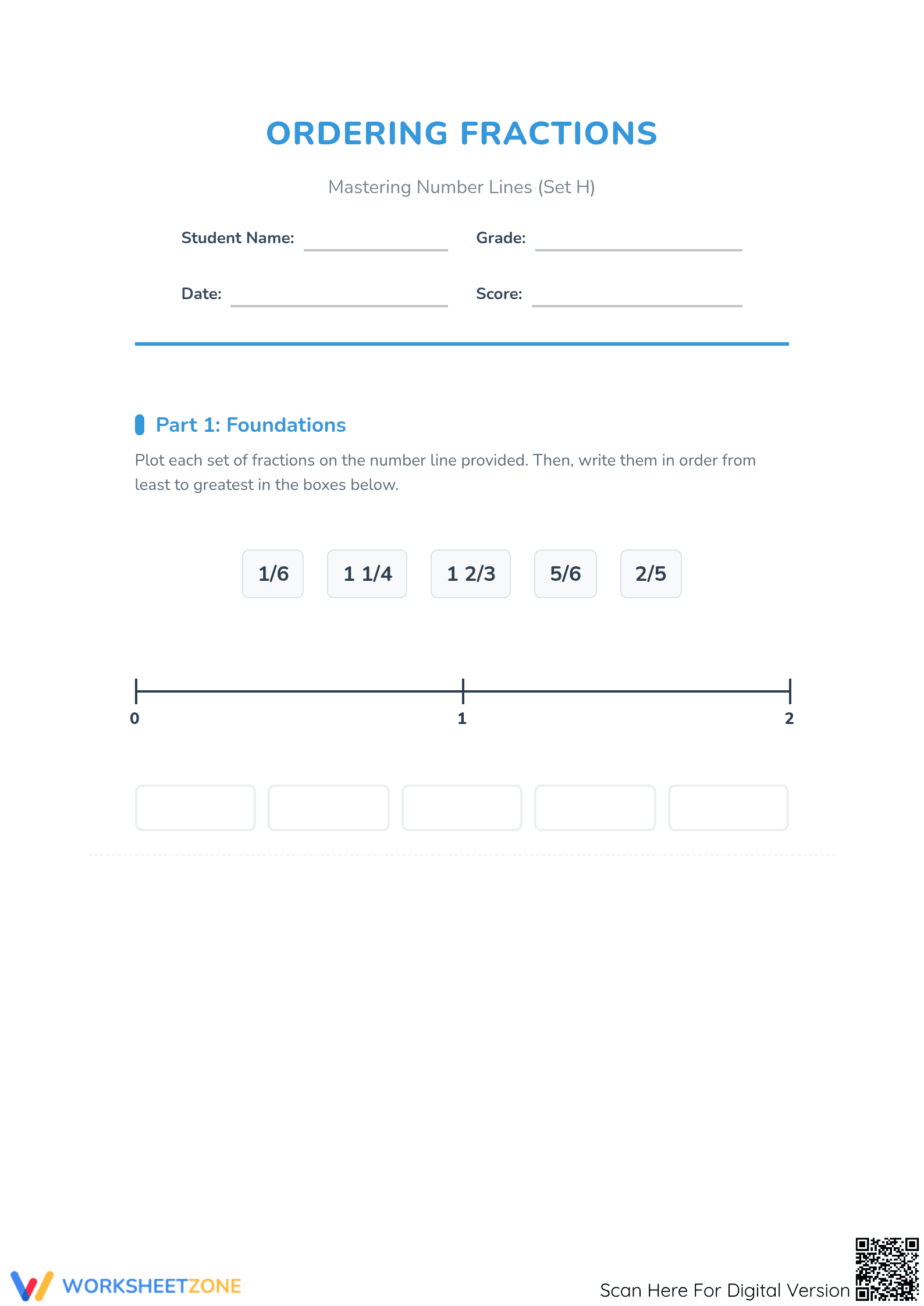


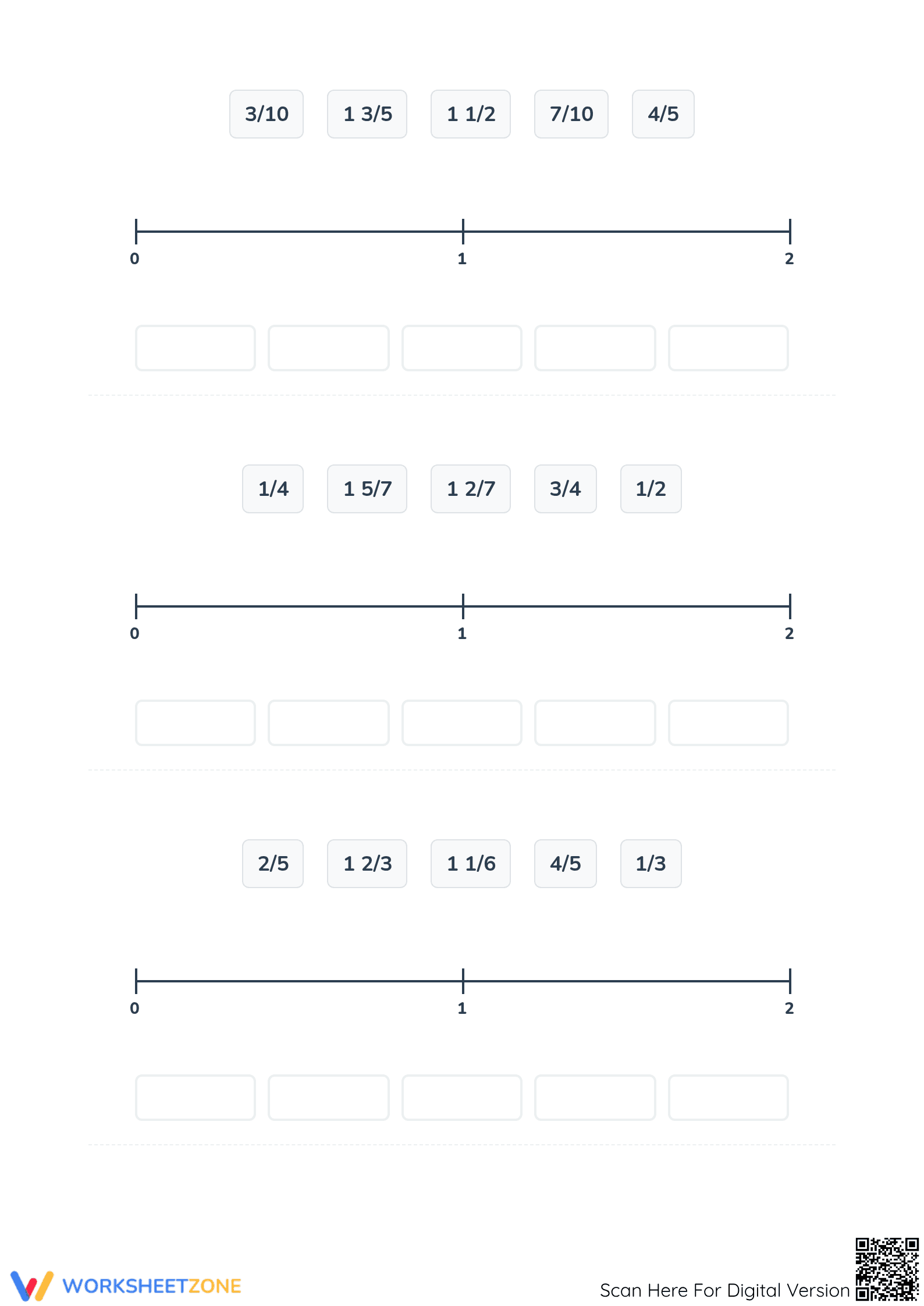

Printable Worksheet: Ordering Fractions on a Number Line
Paste this activity's link or code into your existing LMS (Google Classroom, Canvas, Teams, Schoology, Moodle, etc.).
Students can open and work on the activity right away, with no student login required.
You'll still be able to track student progress and results from your teacher account.
Master the essential skill of fraction comparison with this comprehensive plotting and ordering worksheet. Students will visualize the value of various fractions and mixed numbers by placing them accurately on a 0–2 number line. This exercise bridges the gap between abstract numerical values and concrete spatial representation, ensuring a deeper conceptual understanding of fraction magnitude.
At a Glance
- Grade: 4 · Subject: Math (Fractions)
- Standard:
CCSS.MATH.CONTENT.4.NF.A.2— Compare two fractions with different numerators and denominators by creating common denominators- Skill Focus: Ordering fractions and mixed numbers
- Format: 5 pages · 11 problems · Answer key included · PDF
- Best For: Independent practice or small group remediation
- Time: 25–40 minutes
What's Inside
This 5-page instructional packet contains 11 distinct sets of fractions, including proper fractions, improper fractions, and mixed numbers. Each set features five values that students must plot on a provided number line marked from 0 to 2. Below each number line, dedicated boxes facilitate the final ordering from least to greatest, providing a structured workflow for students to verify their visual estimates.
Skill Progression
- Guided Practice: Part 1: Foundations introduces simpler denominators (1/6, 5/6, 2/5) to build student confidence in spatial placement and basic comparison.
- Supported Practice: Part 2: Advanced Practice increases the cognitive load by incorporating mixed numbers (1 1/2, 1 7/8) alongside fractions with varied denominators, requiring more precise estimation.
- Independent Practice: Part 3: Mastery Level presents the most challenging sets where denominators are less intuitive, demanding a high level of accuracy and mastery.
This tiered structure follows the gradual-release model, moving students from basic conceptualization to independent fluency.
Standards Alignment
Aligned primarily to CCSS.MATH.CONTENT.4.NF.A.2: "Compare two fractions with different numerators and different denominators, e.g., by creating common denominators or numerators, or by comparing to a benchmark fraction such as 1/2." It also supports 3.NF.A.2 regarding number line representation. Both standard codes can be copied directly into lesson plans, IEP goals, or district curriculum mapping tools.
How to Use It
Deploy this worksheet during the independent practice phase of a lesson on fraction comparison. It serves as an excellent formative assessment tool; teachers should observe whether students use benchmark fractions (like 1/2 or 1) as anchors when plotting. The estimated completion time is 30 minutes, making it an ideal choice for a substantial seatwork assignment or a rigorous homework packet.
Who It's For
This resource is designed for Grade 4 students but is highly effective for Grade 5 and 6 students who require visual reinforcement of fraction values. It is particularly beneficial for visual learners who struggle with abstract comparison rules. Pair this with a physical or digital anchor chart showing benchmark fractions for maximum instructional impact.
According to the RAND AIRS 2024 analysis, visual models like number lines are critical for developing the numerical fluency required for middle school algebra. This CCSS.MATH.CONTENT.4.NF.A.2 resource provides the repeated, structured exposure necessary for students to internalize the relationship between numerators, denominators, and whole-number benchmarks. By requiring students to both plot and list fractions in order, the worksheet targets dual cognitive pathways: spatial reasoning and logical sequencing. Effective implementation of these 11 tasks ensures that students move beyond rote memorization of comparison algorithms toward a functional understanding of fraction magnitude. Such foundational mastery is identified by EdReports (2024) as a key indicator of future success in complex rational number operations. Teachers can confidently utilize this 5-page packet as a standalone assessment or a supplemental instructional tool to satisfy rigorous state and national standards.


