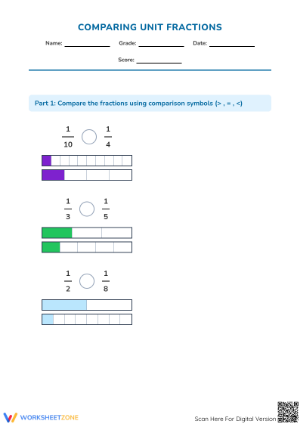
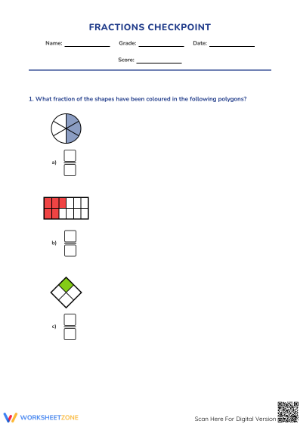
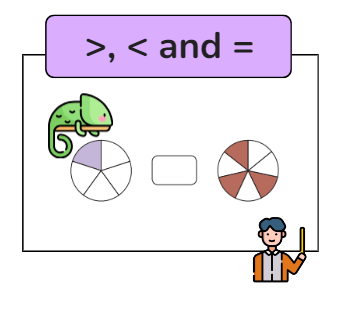
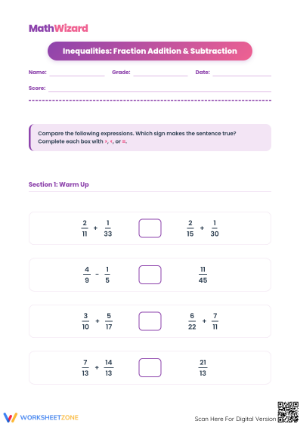
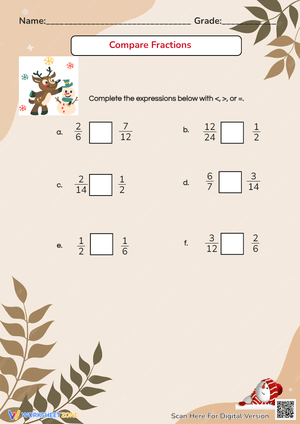
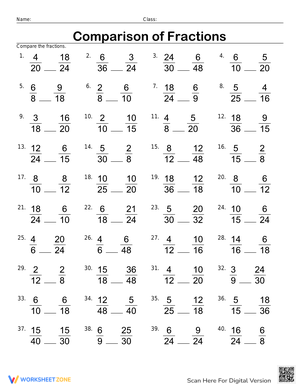
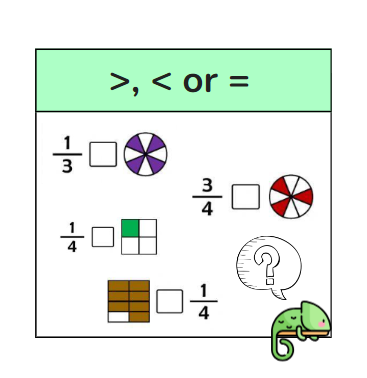
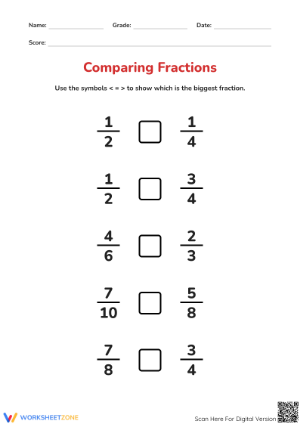
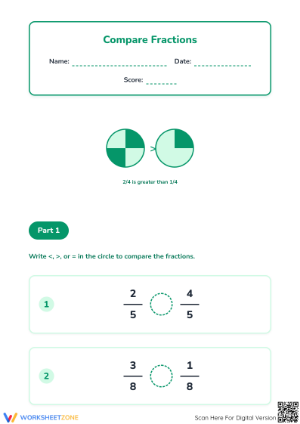
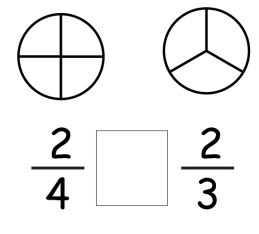
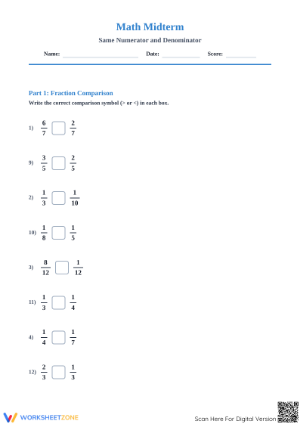
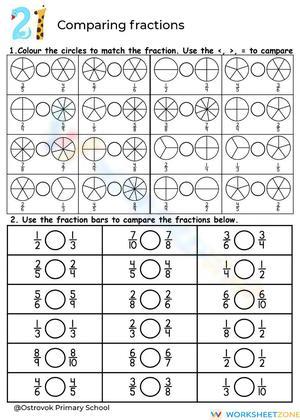
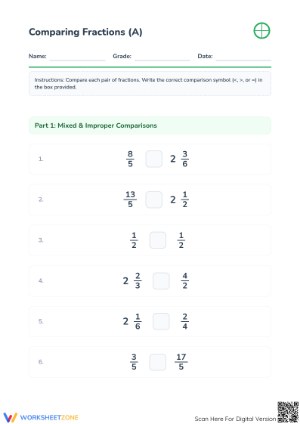
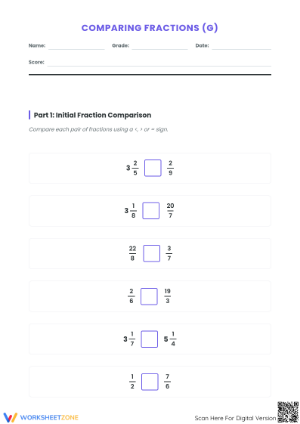
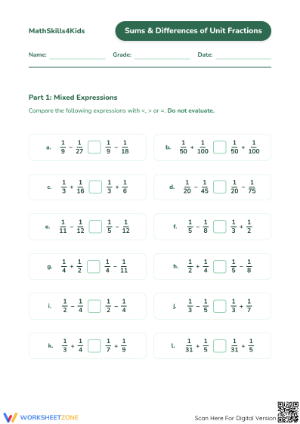
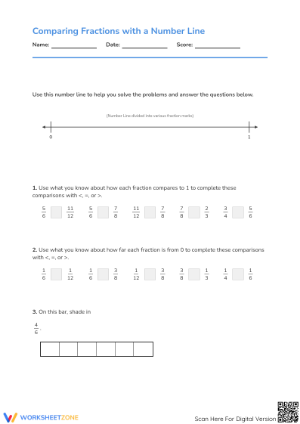
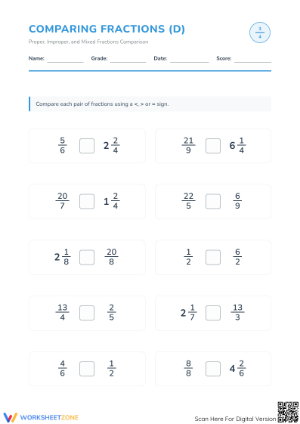
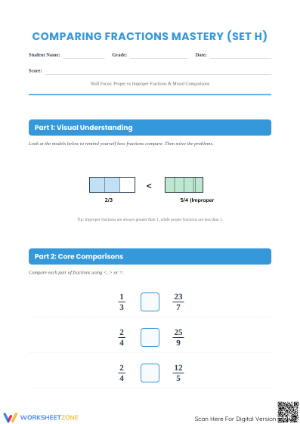
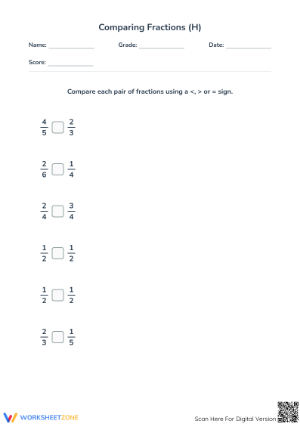
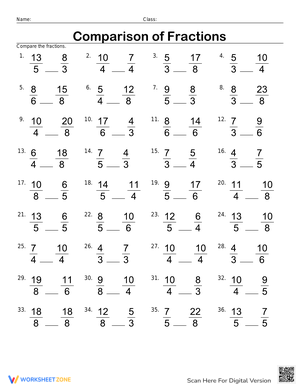
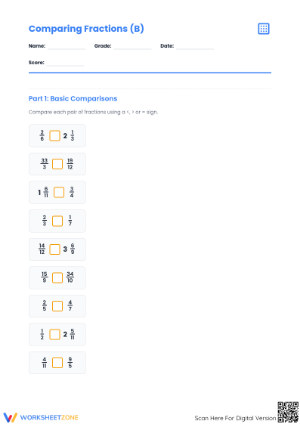
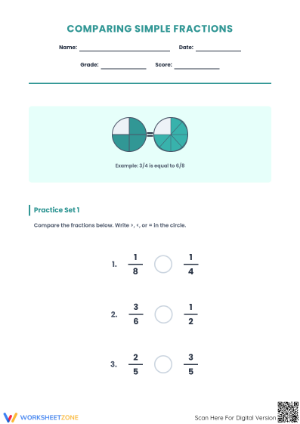
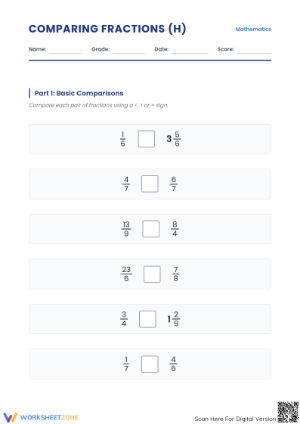
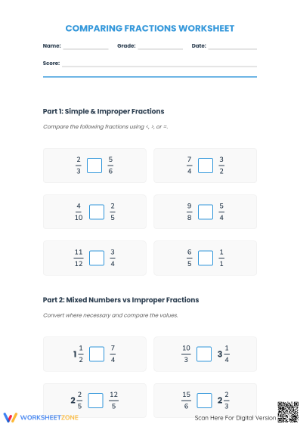
These comparing fractions pdf worksheets for 3rd grade give teachers a set of resources built around the two comparison strategies in the Grade 3 standard: fractions with like denominators and fractions with like numerators. Each worksheet requires students to complete a visual model before writing the comparison symbol, treating the drawing as mathematical evidence rather than a warmup exercise. The set also includes benchmark comparisons using 1/2, which gives students a practical estimation strategy without requiring equivalent fractions — a skill saved for later grades.
What Students Practice Across the Set
Five distinct skills run through these worksheets, sequenced to build both comparison strategies.
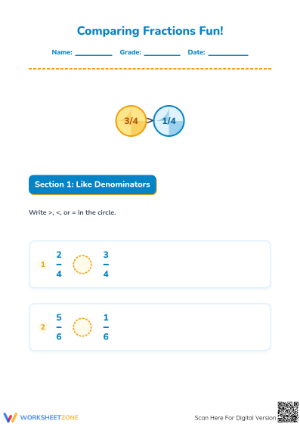
- Comparing fractions with like denominators — marking that 5/8 is greater than 3/8 because five same-sized pieces outnumber three
- Comparing fractions with like numerators, where students reason about piece size rather than piece count
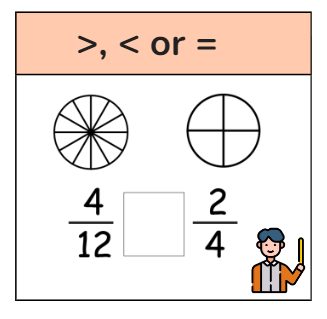
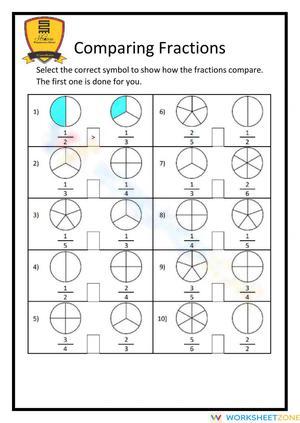
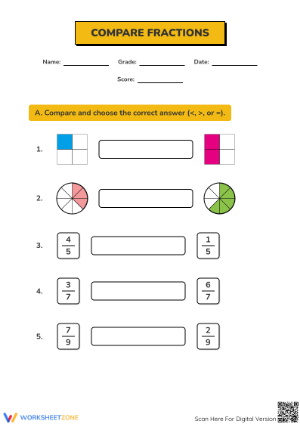
- Recording comparison symbols only after shading or drawing a visual model, not before
- Using 1/2 as a benchmark to simplify comparisons where one fraction sits clearly above half and the other below
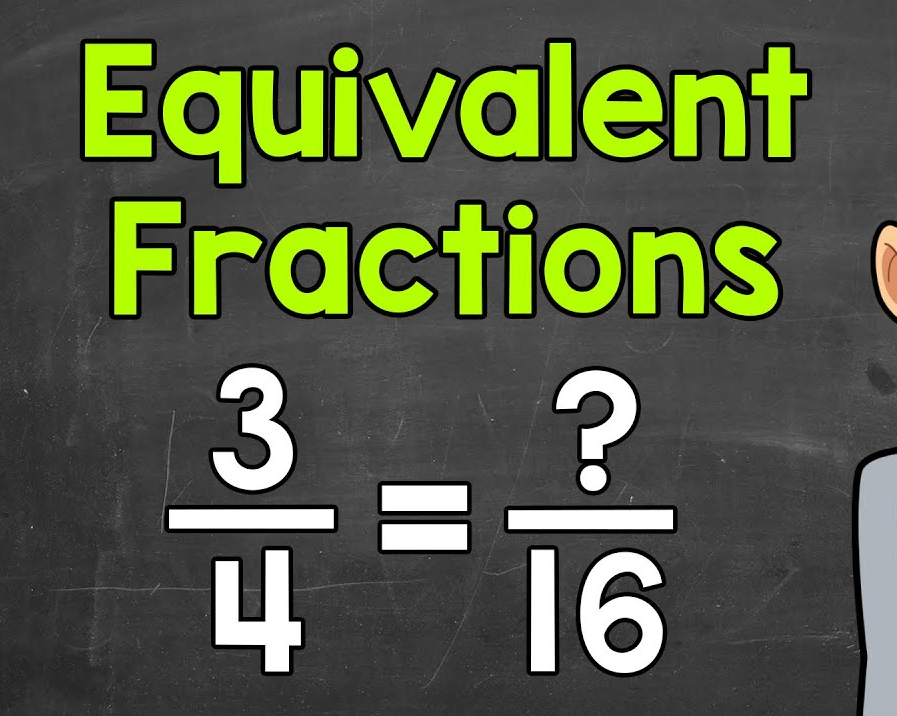
- Identifying equivalent fractions alongside unequal pairs, so the equal sign stays part of the comparison toolkit
The sequencing reflects a deliberate instructional choice. Like-denominator comparisons come first because the logic is an extension of whole-number counting — more same-sized pieces is simply more. Like-numerator comparisons follow because the reasoning runs in the opposite direction from whole-number intuition, and students need that first foundation before the second case makes sense to them.
The Same-Whole Requirement
One concept these worksheets build in structurally — and that deserves explicit attention in class before students use them independently — is the same-whole requirement. Fractions can only be compared fairly if they refer to identical wholes. Half of a small square is not the same as half of a large rectangle. Standard 3.NF.A.3 states this explicitly, and every comparison in the set uses pre-drawn models of matching size so the constraint is visible inside the problem itself. Students who never internalize this tend to fall apart on non-routine fraction tasks in 4th grade, especially when word problems describe fractions of different-sized objects without flagging the inconsistency.
Mistakes Students Make That These Worksheets Help You Catch
The most predictable error surfaces in the like-numerator section. Students read the denominator the way they read any whole number — 8 is larger than 3, so 1/8 must be larger than 1/3. This is not careless thinking; it's whole-number reasoning applied to a new context. A student who correctly marks 5/6 as greater than 2/6 on Monday will confidently write 1/8 as greater than 1/3 on Tuesday unless the visual model forces a direct confrontation with piece size. The worksheet format catches this by requiring students to shade both models before writing the symbol — the error shows up in the drawing before it gets recorded as a wrong answer.
The second error is subtler: comparing fractions without attending to the size of the whole. A student might draw a small circle for the halves model and a large circle for the fourths model, shade accordingly, and conclude that 1/4 is the larger fraction because the shaded region looks bigger. The worksheets prevent this by providing same-size pre-drawn models, but teachers should address the underlying reasoning directly, because it reappears in student explanations and word problem responses even when the drawn models are consistent.
Fitting These Worksheets Into Your Lesson Planning
The strongest placement for these resources is immediately after the class introduction lesson — not during it. The lesson is where students work with physical fraction tiles and talk through comparisons together; the worksheet is where individual understanding becomes visible. A short independent practice block following hands-on work reveals far more about who has the concept than whole-class discussion does, because quieter students are doing the reasoning rather than watching more confident peers answer.
For spiral review, pull individual worksheets from the set every few weeks after the fractions unit ends. The first 8 minutes of a math block after a long break, or a Friday warm-up before the weekend, both work well. Because the comparing fractions pdf worksheets for 3rd grade in this set separate the two comparison cases, teachers can target whichever one needs reinforcement without requiring students to redo work they've already consolidated.
Standard Alignment
These worksheets align to CCSS 3.NF.A.3, and more specifically to cluster 3.NF.A.3.D: "Compare two fractions with the same numerator or the same denominator by reasoning about their size. Recognize that comparisons are valid only when the two fractions refer to the same whole." This standard sits at the end of the 3rd-grade fractions progression deliberately — it assumes students have already developed a conceptual understanding of what fractions represent (3.NF.A.1) and how they appear on a number line (3.NF.A.2). Teachers who treat 3.NF.A.3.D as symbol-placement practice without the visual justification requirement are working against the standard's explicit intent. The comparison is only valid when students can articulate why, not just mark which symbol goes in the box.
Adjusting the Worksheets for Different Student Levels
For students who are still uncertain about what a fraction represents, provide fraction strip manipulatives alongside the worksheet and allow them to line up physical strips before marking the symbol. This keeps the comparison task intact without changing its cognitive demand — the adjustment is in the access, not the expectation.
Students working on level follow the standard format: shade the provided models, then write the comparison symbol. Students who have clearly internalized the like-denominator case can be asked to skip the model on those problems and write an explanation sentence instead — something like "3/8 is less than 7/8 because 3 pieces of that size is fewer than 7 pieces" — which is a stronger indicator of understanding than a correctly placed symbol. For the comparing fractions pdf worksheets for 3rd grade that focus on like-numerator comparisons, even confident students benefit from completing the model first; a correct symbol on those problems does not always reflect correct reasoning.
Frequently Asked Questions
Do 3rd graders need to compare fractions where both the numerator and denominator are different?
No. The Grade 3 standard (3.NF.A.3.D) limits fraction comparison to cases where either the numerator or the denominator matches across both fractions. Finding common denominators or using equivalent fractions to compare is a 4th-grade skill. Every worksheet in this set stays within the Grade 3 scope.
What's the most effective way to correct the misconception that a larger denominator means a larger fraction?
The sharing analogy tends to land quickly: ask students whether they'd rather divide a granola bar among 3 people or 10. They immediately recognize that more people means smaller individual shares. Connect that directly to the denominator — it names how many equal pieces the whole has been divided into, and more pieces means each one is smaller. Follow the conversation with a worksheet problem right away so students apply the reasoning before the analogy fades.
How do I help students reliably distinguish the greater-than and less-than symbols?
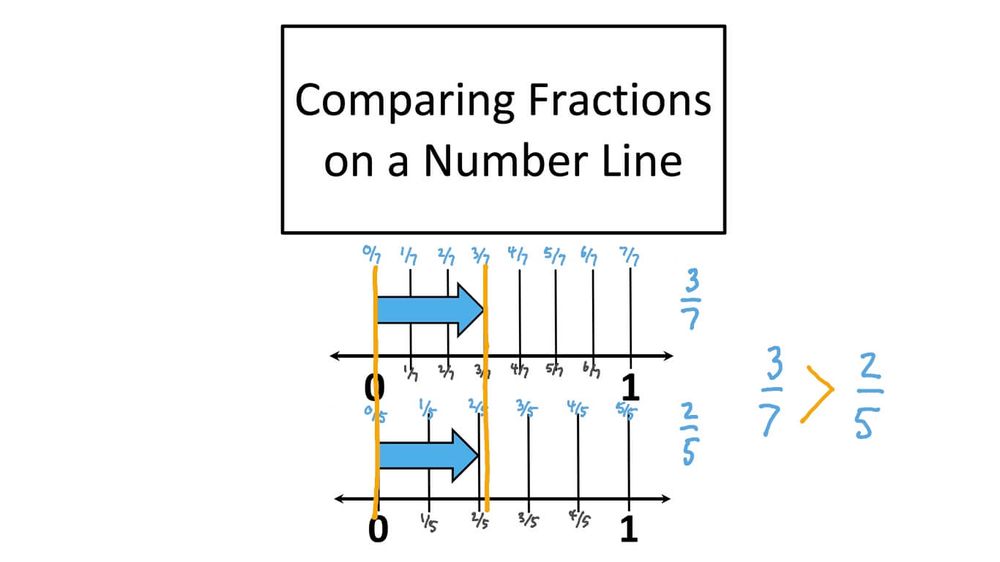
A more durable method than the alligator rhyme is the two-dot construction: students draw two dots beside the larger fraction and one dot beside the smaller one, then connect the dots to form the symbol naturally. This builds the symbol from logic rather than from a rhyme that students forget under pressure. Pairing it with the comparing fractions pdf worksheets for 3rd grade that include number line models reinforces the concept further — seeing which fraction sits farther from zero on a line connects symbol direction to spatial position.
Are these worksheets appropriate for formative or summative assessment?
They work well as formative assessment — exit tickets and small-group check-ins especially. For summative purposes, note that many worksheets include pre-drawn models, which reduces the evidence of independent reasoning. Reserve those for instructional practice, and use blank-model or no-model versions when you need students to demonstrate the full reasoning chain on their own.













 Interactive Worksheet Maker
 Quiz Maker
 Word Search Maker
 Crossword Puzzle Maker
 Word Scramble Generator
 Sentence Scramble Generator
 Handwriting Worksheet Generator
 Name Tracing Generator
 Fill In The Blank Generator