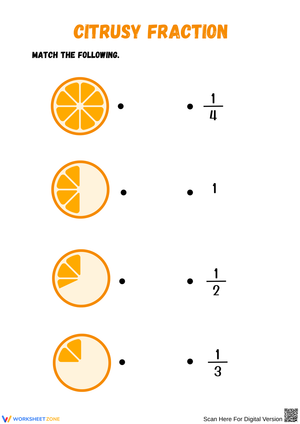
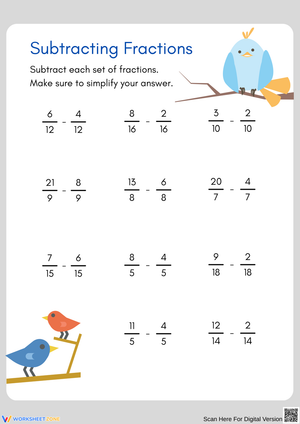
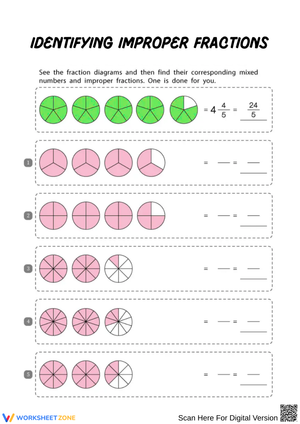
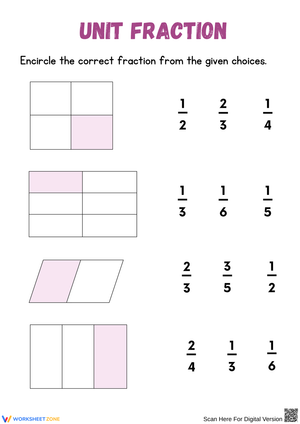
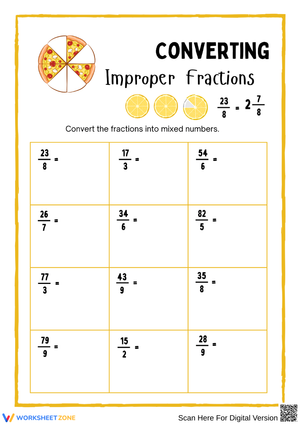
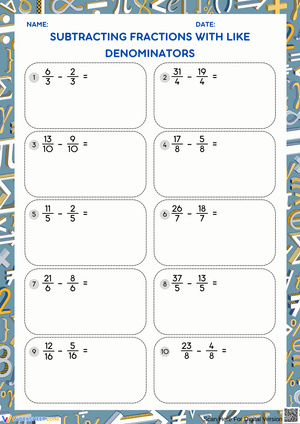
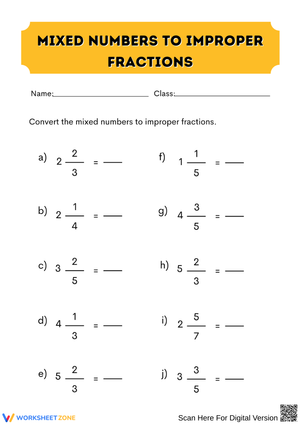
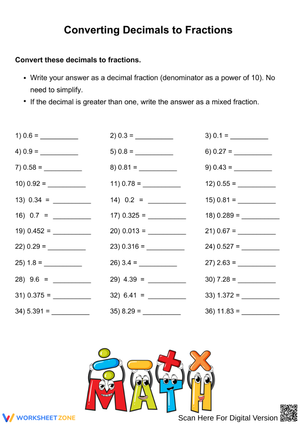
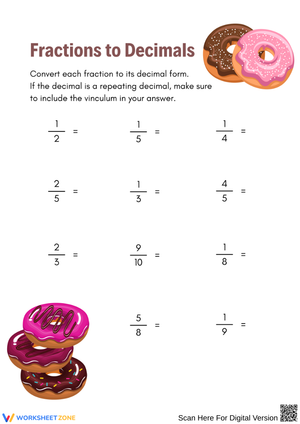
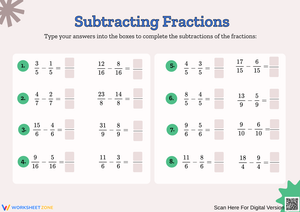
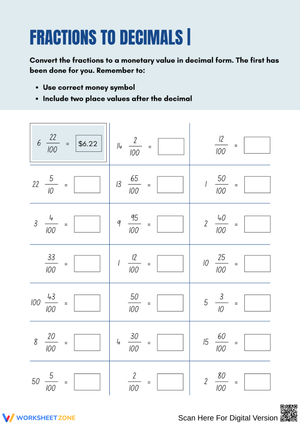
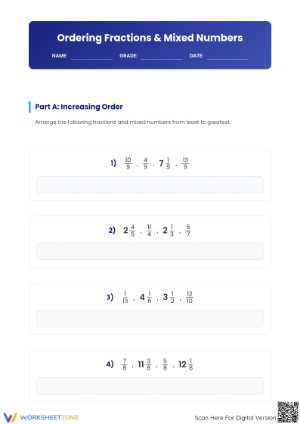
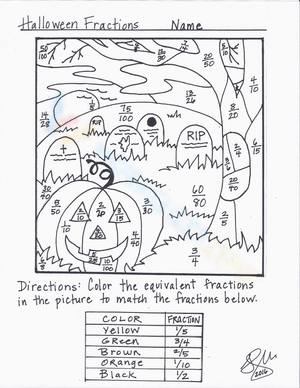
These 3rd grade fraction printable worksheets cover the full arc of the 3.NF.A domain — unit fractions, number line placement, equivalence, and comparison using greater than, less than, and equal to. Third grade is when fractions stop being shading exercises and become actual numbers on a number line, and that shift is harder for students than most pacing guides account for. The set gives teachers ready resources for whole-group instruction, center rotations, and focused review without requiring additional prep.
What Students Practice Across the Set
Each worksheet targets one of five skill areas, and the progression follows the instructional sequence most Grade 3 teachers recognize from the 3.NF domain.
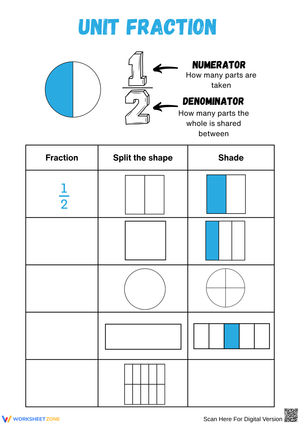
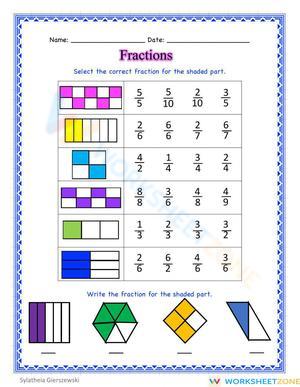
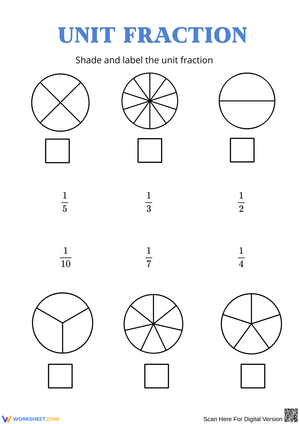
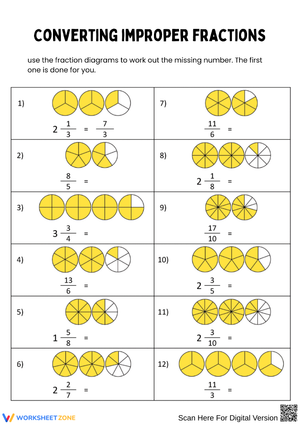
- Unit fractions with area models — Students identify and name fractions like one-third and one-eighth from shaded circles, rectangles, and fraction bars, then write the symbolic notation to match the visual.
- Non-unit fractions — Students shade and label fractions like three-fourths and five-sixths. These worksheets require students to verify equal parts before naming the fraction — a step that turns out to matter more than it looks.
- Fractions on a number line — Students partition number lines between 0 and 1, place given fractions at the correct position, and identify fractions from pre-marked lines.
- Equivalent fractions — Stacked fraction bar models show that one-half equals two-fourths. Students complete fill-in-the-blank equivalence equations using those visual aids before working with notation alone.
- Comparing fractions — Students apply greater than, less than, and equal to reasoning to same-denominator and same-numerator pairs, always anchoring the symbol to a model.
Visual models appear in every skill area, not just the introductory material. Even the comparison worksheets ask students to interpret or sketch a model before recording a symbol — keeping conceptual reasoning in the foreground rather than letting students guess from the numerals alone.
Number Lines as the Conceptual Bridge
The number line work here deserves specific attention because it represents the biggest cognitive leap in Grade 3 fraction instruction. Before third grade, students encounter fractions almost exclusively as parts of shapes. A number line asks a different question: not "how much of this shape is shaded?" but "where does this value live on a scale?" That is a genuinely new demand, and students need considerably more time with it than area model fluency would suggest.
Two specific errors emerge at this stage. The first is interval confusion — students count tick marks rather than the spaces between them, so on a number line partitioned into fourths, they place one-fourth at the second mark instead of the first. The second is a resistance to the idea that the entire segment from 0 to 1 can hold only fractional values; students try to anchor placements to whole-number logic, estimating "about half" without actually partitioning. The worksheets address both errors by mixing pre-partitioned lines with blank ones where students draw their own tick marks — a small but meaningful difference in what each student has to produce and defend.
Student Errors That Show Up Repeatedly
The most persistent error in this unit predates fractions: it's the equal parts requirement. Students who correctly identify three-fourths on a cleanly divided shape will still accept an unequally divided rectangle as "halves" if the shaded region looks approximately right. Worksheets in the set include irregular or unequally divided shapes as deliberate traps, training students to check the parts before naming the fraction rather than labeling on instinct.
The comparison section surfaces a different pattern. When students compare same-numerator fractions — say, one-third and one-sixth — a significant number choose one-sixth as larger because six is a bigger number than three. That logic is entirely consistent with two years of whole-number instruction; larger numerals have always meant larger quantities. Pairing the comparison task with a visual model is what breaks the pattern, because students can see that one sixth-sized piece is smaller than one third-sized piece rather than reading symbols and guessing.
Building These Worksheets Into Your Week
The worksheets follow a natural instructional sequence — visual-only tasks first, then bridging tasks that connect models to notation, then symbolic reasoning on its own — that maps onto a roughly three-week unit. Individual worksheets can be pulled out of that sequence for targeted review without losing anything. A practical approach in many third-grade rooms is to use the unit fraction and area model worksheets as Monday warm-ups during morning meeting, then move to number line and comparison work mid-week once whole-group instruction is in place.
For center time, 3rd grade fraction printable worksheets work well inside clear plastic sleeves with dry-erase markers. Students complete the worksheet, a quick scan during a rotation check shows you who is placing fractions correctly and who is still counting tick marks, and the sleeve wipes clean for the next group. The comparing fractions worksheets are especially effective here because students can erase and revise after a brief partner discussion — that back-and-forth before committing to an answer does more for understanding than writing it once and moving on.
Standard Alignment
These worksheets align to the 3.NF.A domain of the Common Core State Standards for Mathematics. The unit fraction and area model worksheets address 3.NF.A.1, which asks students to understand a fraction 1/b as the quantity formed by one part when a whole is divided into b equal parts. Number line work targets 3.NF.A.2, which positions fractions explicitly as numbers on a number line rather than purely visual representations. Equivalence and comparison tasks address 3.NF.A.3, including substandard 3.NF.A.3d, which calls for comparing fractions with the same numerator or same denominator by reasoning about the size of the parts. In instructional terms, 3rd grade fraction printable worksheets fit most naturally in the spring semester of Grade 3, after multiplication and division foundations are in place and before the end-of-year review window closes.
Adapting the Set for Mixed-Ability Classes
Students who are still working on the equal-parts concept benefit from the area model worksheets with one added step: before shading, they trace each part of the shape with a finger and count aloud to confirm the parts are equal. That physical check slows down the impulsive labeling that causes most errors at this level. Pairing those students with pre-partitioned number line worksheets — rather than blank ones — gives them a clearer entry point without removing the core task.
For students who move through the foundational material quickly, the equivalence and comparison worksheets extend naturally by asking them to write a second equivalent fraction beyond what the model shows, or to generate their own same-numerator comparison pair and explain the reasoning in a sentence. Neither extension requires additional materials — just a written prompt alongside the worksheet they already have.
Frequently Asked Questions
What fraction skills should third graders have solidly in place by the end of the year?
By the close of Grade 3, students should understand fractions as numbers, place unit and non-unit fractions accurately on a number line between 0 and 1, recognize and produce simple equivalent fractions using visual models, and compare fractions that share either the same numerator or the same denominator. Critically, they should be able to explain comparisons by referring to the size of the parts — not just the numerals.
My students struggle with equal parts even after repeated shading practice. What else can I try?
Equal-parts understanding tends to deepen when students switch from identifying pre-divided shapes to creating their own divisions. Have them fold paper strips or draw and divide rectangles themselves, then assess whether all parts match before applying a fraction name. That construction step reveals whether students grasp the constraint or are simply pattern-matching on printed shapes.
How do I decide which worksheets belong in class versus homework?
Reserve number line and equivalence worksheets for in-class use, where you can catch misconceptions before they solidify — particularly the interval-counting error, which students will rehearse incorrectly at home if sent there without prior instruction. Area model identification and basic comparison tasks, once introduced through direct instruction, are appropriate for independent home practice. The 3rd grade fraction printable worksheets in this set include answer keys so students can check straightforward identification work without waiting for teacher feedback.
Can I use these worksheets with students who have area model fluency but are brand new to number lines?
Yes. Because each worksheet targets a single skill area, teachers can move directly to the number line worksheets without students working through the area model material first. Each number line worksheet functions as self-contained practice and opens with a small fraction bar reference that connects the new model to the familiar one — enough to orient students without requiring a full re-teach of prior concepts.













 Interactive Worksheet Maker
 Quiz Maker
 Word Search Maker
 Crossword Puzzle Maker
 Word Scramble Generator
 Sentence Scramble Generator
 Handwriting Worksheet Generator
 Name Tracing Generator
 Fill In The Blank Generator