


























Views
Downloads



Printable Ordering Fractions on a Number Line Worksheet
Paste this activity's link or code into your existing LMS (Google Classroom, Canvas, Teams, Schoology, Moodle, etc.).
Students can open and work on the activity right away, with no student login required.
You'll still be able to track student progress and results from your teacher account.
Master the spatial relationship between numbers with this essential fractions practice. This worksheet helps students visualize fraction magnitude by plotting and comparing values on accurately scaled number lines. By moving beyond simple computation, learners gain a robust understanding of how fractions, mixed numbers, and even negative values occupy physical space in the number system. This leads to increased mathematical confidence.
At a Glance
- Grade: 3–6 · Subject: Math
- Standard:
CCSS.MATH.CONTENT.3.NF.A.2— Represent a fraction as a specific point on a number line diagram- Skill Focus: Plotting and ordering fractions
- Format: 5 pages · 11 problems · Answer key included · PDF
- Best For: Independent practice and small group instruction
- Time: 25–35 minutes
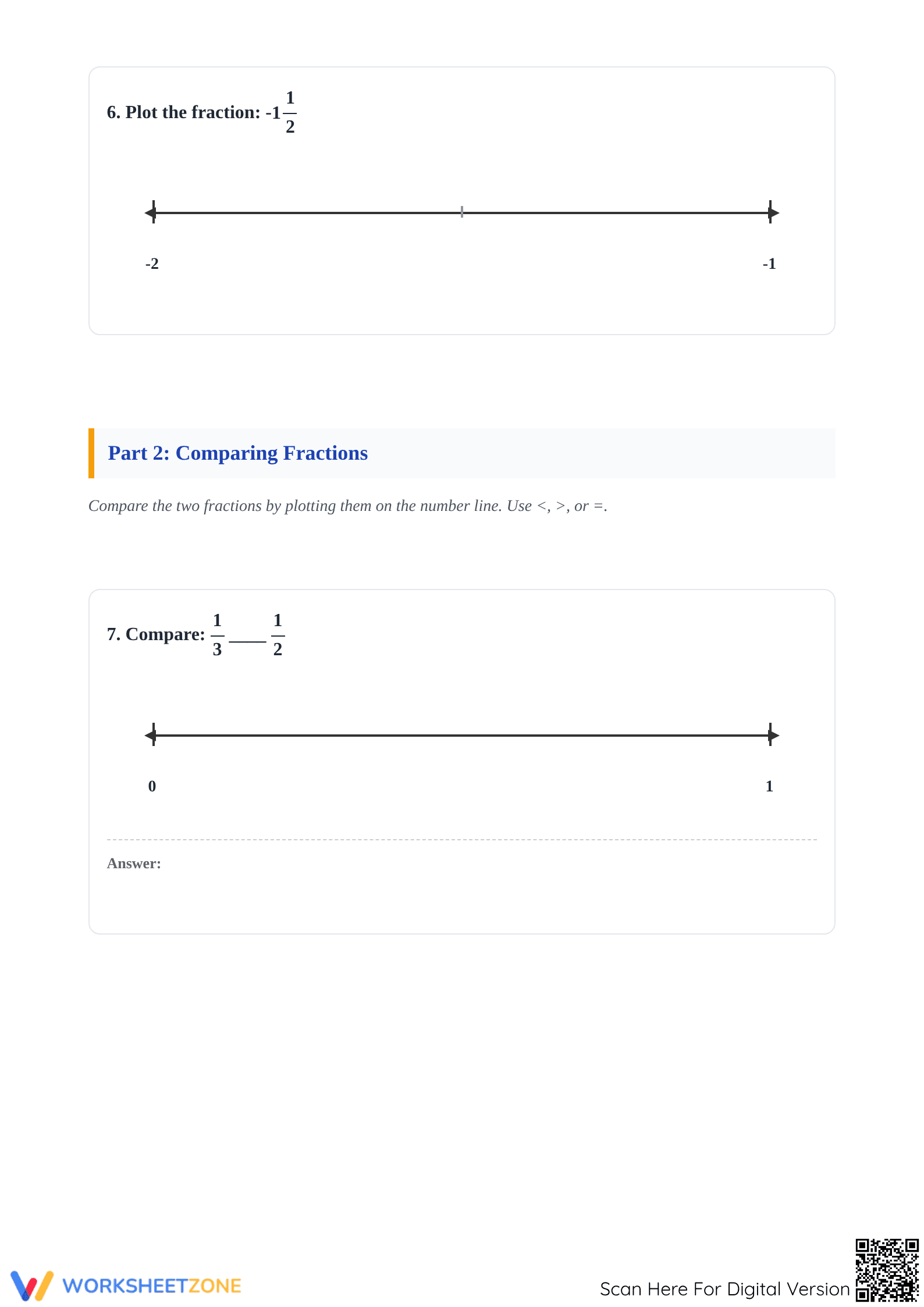
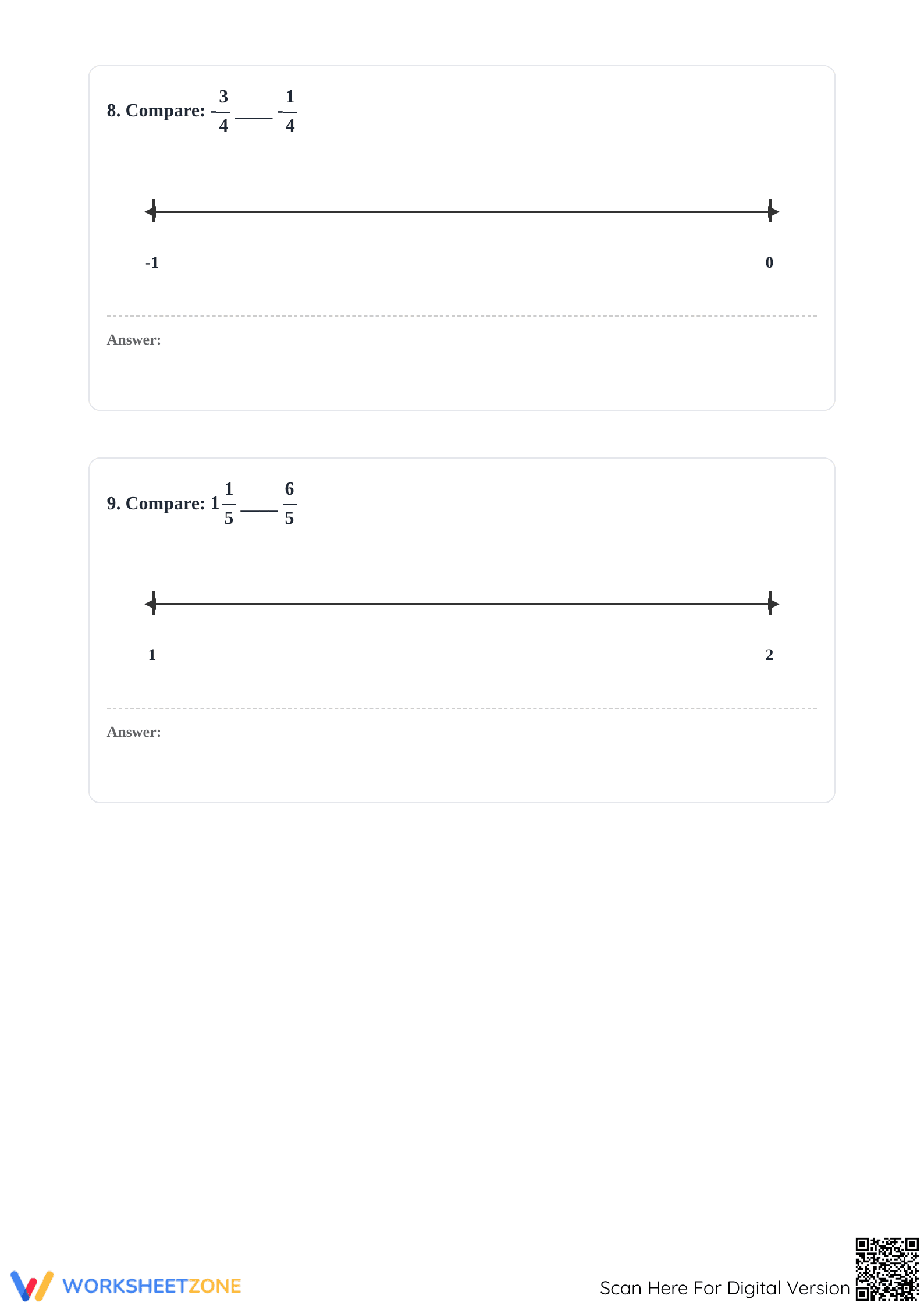
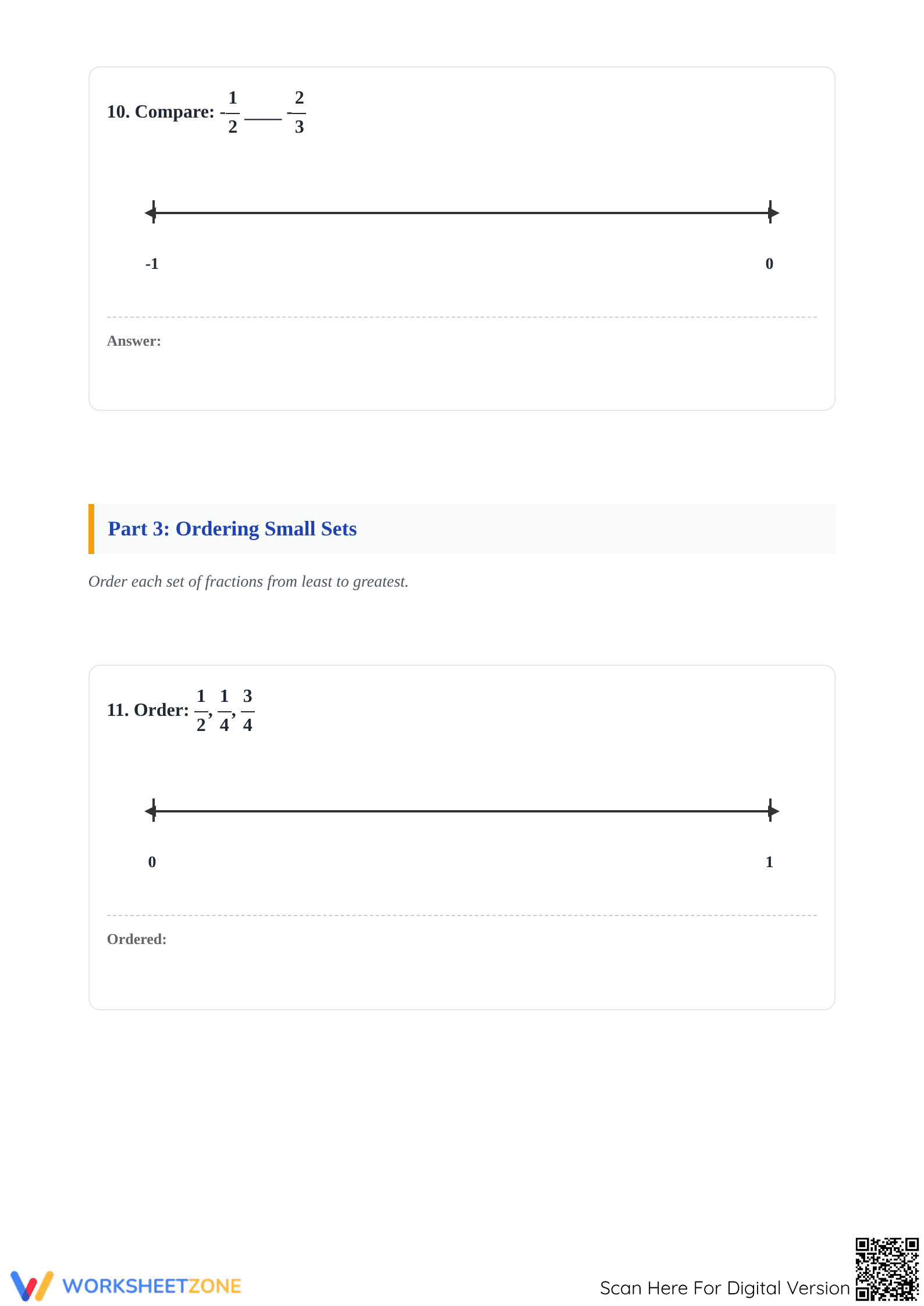
This comprehensive five-page resource contains eleven distinct problems designed to build fraction fluency. The layout includes large, clear number lines with labeled endpoints, providing ample space for students to mark their answers. Each page focuses on a specific sub-skill, ensuring a steady increase in difficulty. A complete answer key is included to facilitate quick grading or student self-correction.
Skill Progression
- Guided Plotting: Six initial tasks require students to identify and mark specific fractions like 3/4 or 1/2 on a pre-divided 0-1 or 1-2 scale.
- Supported Comparison: Four intermediate problems ask students to plot two different fractions on a single line to determine their relative values using inequality symbols.
- Independent Ordering: The final section challenges students to place a set of three fractions in correct order from least to greatest on a blank number line.
This sequence follows the gradual-release model, moving from basic identification to higher-order comparative analysis.
This resource is specifically aligned to CCSS.MATH.CONTENT.3.NF.A.2, which requires students to understand a fraction as a number on the number line. It also supports 4.NF.A.2 by providing a visual method for comparing fractions with different denominators. Both standard codes can be copied directly into lesson plans, IEP goals, or district curriculum mapping tools.
For best results, use this worksheet as a formative assessment after an initial lesson on fraction parts. It works well in a math center where students can use physical manipulatives alongside the paper tasks. Teachers should observe whether students correctly identify the denominator as the number of equal intervals between whole numbers. The 30-minute completion time makes it an ideal exit ticket or homework assignment.
This packet is designed for elementary and middle school students who are transitioning from concrete models to abstract number concepts. It includes scaffolds like mixed numbers and negative integers, making it suitable for 5th or 6th-grade review. This resource pairs naturally with an anchor chart demonstrating how to partition a number line into equal segments.
This instructional resource focuses on the foundational skill of representing fractions as points on a number line, a critical component of CCSS.MATH.CONTENT.3.NF.A.2. By visualizing the distance from zero, students develop a deep conceptual understanding of fraction magnitude and order. The worksheet extends this practice to include mixed numbers and negative rational numbers, bridging the gap between elementary fraction concepts and middle school number system requirements. According to Fisher & Frey (2014), the use of visual representations like number lines is essential for helping students move from concrete to abstract mathematical reasoning. Research suggests that students who struggle with fractions often lack a mental number line; this resource directly addresses that deficit through 11 targeted tasks. The structured format allows for formative assessment of plotting, comparing, and ordering skills. This comprehensive tool is ideal for ensuring students meet rigorous standards while building the fluency needed for higher-level algebra.


