


























Views
Downloads

Essential Letter G Phonics Worksheet | Grade 1 Aligned
Paste this activity's link or code into your existing LMS (Google Classroom, Canvas, Teams, Schoology, Moodle, etc.).
Students can open and work on the activity right away, with no student login required.
You'll still be able to track student progress and results from your teacher account.
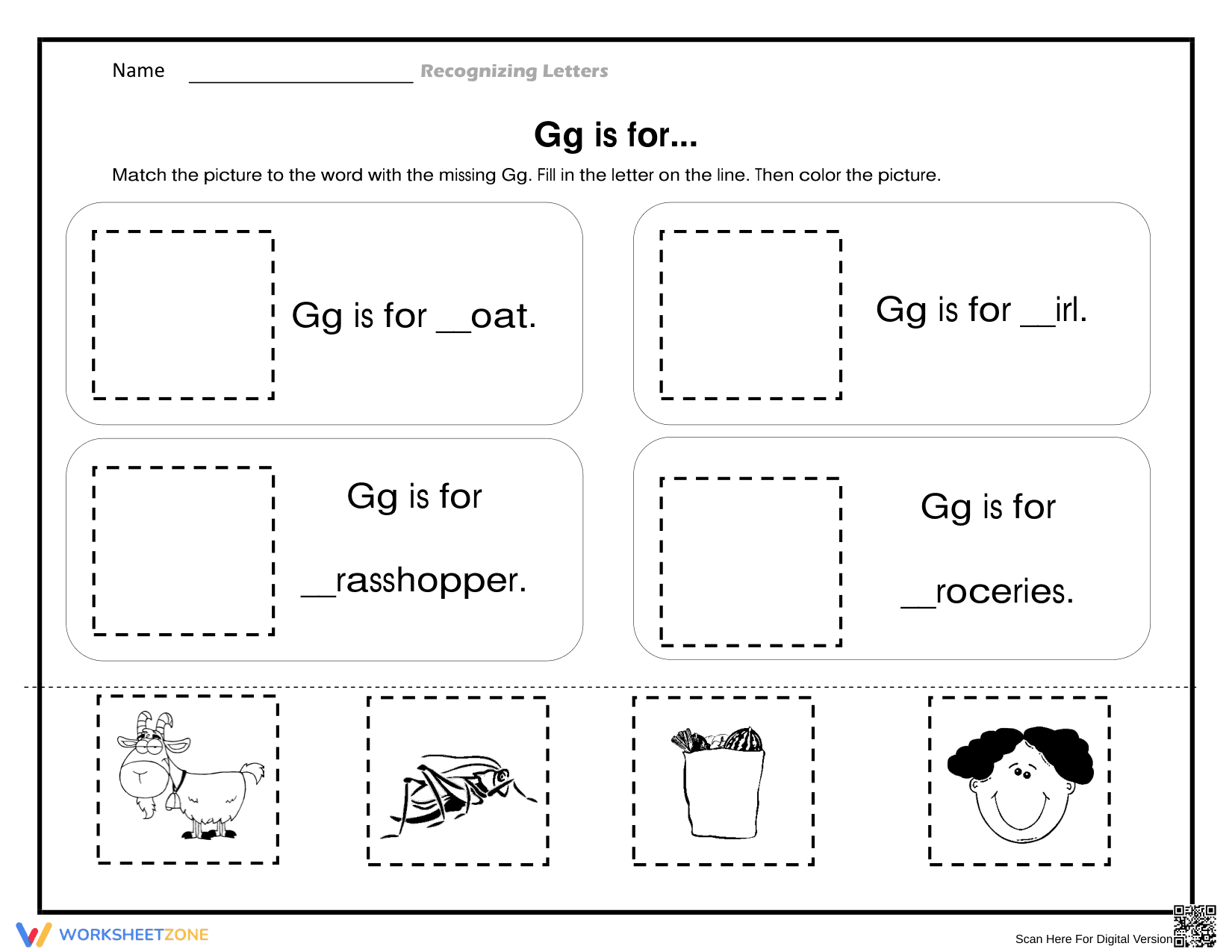
This essential Grade 1 alphabet worksheet provides focused practice on the letter G through interactive matching and writing. Students develop phonemic awareness by identifying the initial "g" sound in familiar words like goat and grasshopper. By combining handwriting with visual discrimination, this resource ensures students master both the form and sound of this critical consonant.
At a Glance
- Grade: 1 · Subject: Alphabet
- Standard:
CCSS.ELA-LITERACY.RF.K.3.A— Identify and produce the primary sound for the letter G- Skill Focus: Letter G Recognition
- Format: 1 page · 4 problems · Answer key included · PDF
- Best For: Initial phonics instruction and morning work
- Time: 10–15 minutes
What's Inside
This single-page PDF features four distinct matching boxes designed for young learners. Each box presents a word with a missing initial letter ("__oat", "__irl", "__rasshopper", "__roceries") and a corresponding space for a picture. The worksheet includes a cut-and-paste section at the bottom and a coloring component to engage students' fine motor skills while reinforcing their vocabulary.
Zero-Prep Workflow
The zero-prep workflow for this resource is designed for maximum efficiency in the classroom. 1. Print: Select the "Fit to Page" setting and print enough copies for your group (less than 1 minute). 2. Distribute: Provide students with the sheet, scissors, and glue (30 seconds). 3. Review: Use the completed sheets for a quick whole-class check or individual formative assessment (30 seconds). This makes it a perfect solution for emergency sub plans or transition periods.
Standards Alignment
This activity aligns directly with CCSS.ELA-LITERACY.RF.K.3.A, which requires students to demonstrate basic knowledge of one-to-one letter-sound correspondences for each consonant. By filling in the missing "G" and matching the correct image, students reinforce their understanding of the relationship between the written grapheme and its spoken phoneme. This standard code can be copied directly into lesson plans, IEP goals, or district curriculum mapping tools.
How to Use It
Use this worksheet as a formative assessment after a direct instruction lesson on the letter G. Alternatively, it works effectively as a center activity where students can practice independently. Observe how students say the word aloud before writing the letter; this provides an immediate insight into their phonological processing speed and letter-sound retrieval accuracy during early literacy blocks.
Who It's For
This resource is ideal for first-grade students who are solidifying their letter-sound knowledge or second-graders needing targeted intervention. The inclusion of coloring and matching makes it accessible for English Language Learners (ELL) who benefit from visual cues paired with text. It pairs naturally with a shared reading passage or an alphabet anchor chart during literacy blocks.
According to the standards-based research analyzed by Fisher & Frey (2014), the integration of visual matching with letter production is a cornerstone of early literacy development. This worksheet addresses the CCSS.ELA-LITERACY.RF.K.3.A standard by requiring students to actively retrieve the phoneme /g/ and associate it with its written representation in various lexical contexts. Research from the NAEP highlights that students who master these fundamental letter-sound correspondences early in Grade 1 are significantly more likely to achieve reading fluency by the end of primary school. By providing structured, scaffolded practice with 4 specific tasks, this resource reduces cognitive load, allowing students to focus on the specific phonemic goal. The inclusion of fine motor tasks like coloring further supports neuro-motor development, which is linked to better handwriting outcomes in older elementary grades. This worksheet serves as a reliable tool for teachers seeking evidence-based methods for reinforcing alphabet mastery.


