


























Views
Downloads
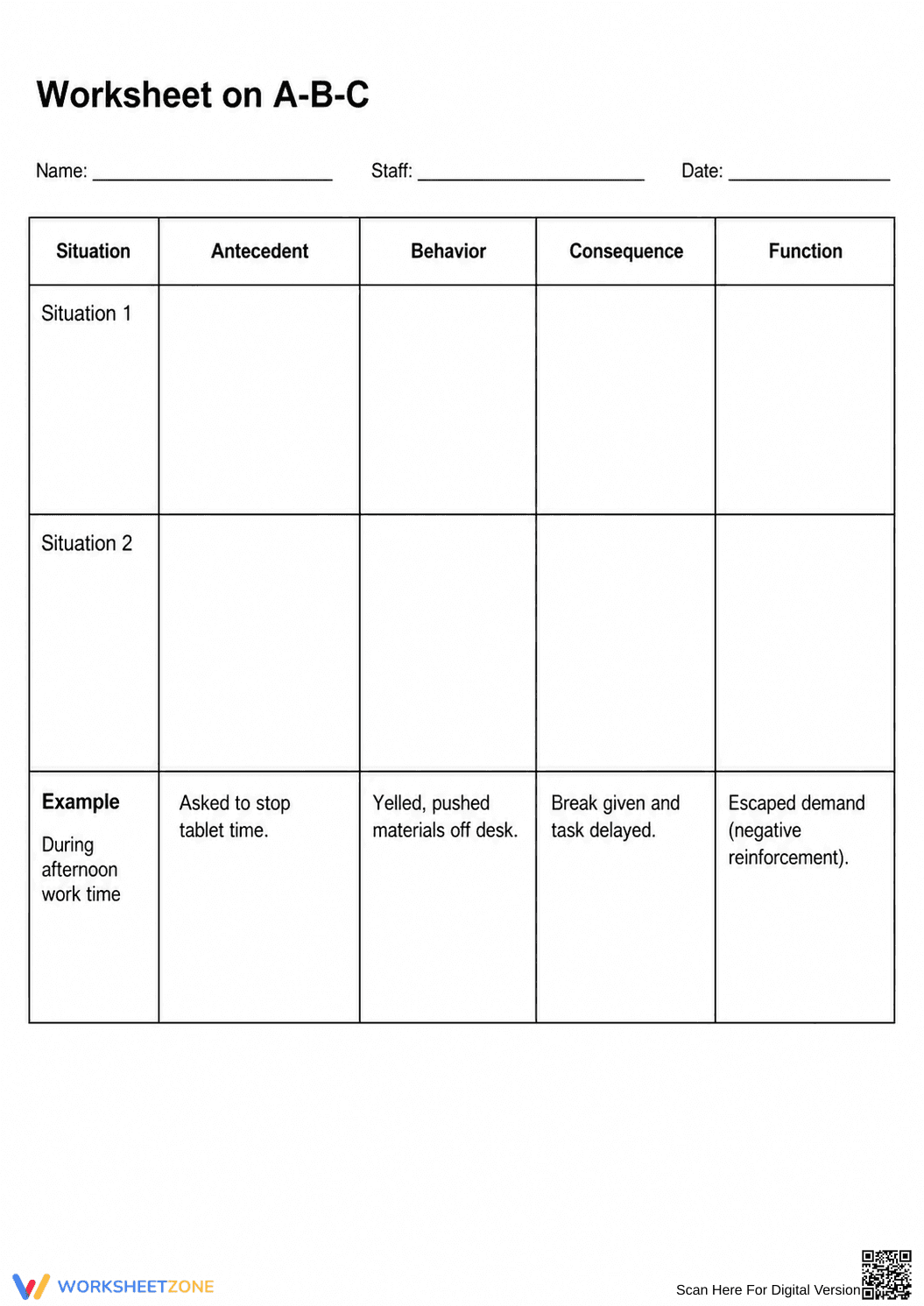

Essential ABC Behavior Analysis Worksheet | Grade 12+
Paste this activity's link or code into your existing LMS (Google Classroom, Canvas, Teams, Schoology, Moodle, etc.).
Students can open and work on the activity right away, with no student login required.
You'll still be able to track student progress and results from your teacher account.
This professional ABC behavior analysis worksheet provides a structured framework for identifying the underlying functions of specific actions. By documenting the sequence of events, students and staff can determine if a behavior is driven by a desire for attention, escape, or tangible rewards. This tool ensures objective data collection for effective behavioral intervention planning.
At a Glance
- Grade: 12 · Subject: Behavior Activities
- Standard:
CCSS.ELA-LITERACY.RI.12.3— Analyze how a complex sequence of events or interactions develop- Skill Focus: ABC Behavior Analysis
- Format: 1 page · 2 tracking rows · Example included · PDF
- Best For: Functional behavior assessment and IEP data
- Time: 5–15 minutes
What’s Inside: This single-page PDF features a comprehensive five-column tracking table. It includes dedicated sections for the Situation, Antecedent, Behavior, Consequence, and Function. To ensure accuracy, the worksheet provides a pre-filled example row demonstrating a medication-refusal scenario, which serves as a model for staff or advanced students. The layout is clean and optimized for rapid data entry during or immediately after an observation.
Zero-Prep Workflow
- Print (1 minute): Generate as many copies as needed for your observation period or student portfolio.
- Distribute (30 seconds): Provide the sheet to paraprofessionals, teachers, or students practicing self-monitoring techniques.
- Review (1 minute): Quickly scan the completed rows to identify patterns in the "Function" column for immediate instructional adjustments.
This streamlined process makes the worksheet an ideal resource for busy classrooms, clinical settings, or as a reliable sub-plan component for special education environments.
Standards Alignment: This resource aligns with `CCSS.ELA-LITERACY.RI.12.3`, which requires the analysis of a complex set of ideas or sequence of events and explaining how specific individuals, ideas, or events interact and develop. By breaking down a behavioral episode into its constituent parts, users engage in high-level analytical reasoning. Both standard codes can be copied directly into lesson plans, IEP goals, or district curriculum mapping tools.
How to Use It: Use this worksheet during formative assessment periods to gather baseline data on new student behaviors. It is particularly effective when used as a collaborative tool between staff members to ensure inter-rater reliability. For best results, record data within 10 minutes of the behavioral incident to maintain the highest level of descriptive accuracy and detail.
Who It's For: This tool is designed for high school students, transition-age young adults, and professional staff including BCBAs and special education teachers. It pairs naturally with a functional behavior assessment (FBA) manual or a direct instruction lesson on social-emotional self-regulation and the mechanics of reinforcement.
According to the RAND AIRS 2024 report on behavioral interventions, structured data collection tools like the ABC chart are vital for identifying the environmental variables that maintain challenging behaviors. By documenting the Antecedent, Behavior, and Consequence, practitioners can move beyond subjective descriptions to objective analysis of the behavior's function. This worksheet aligns with CCSS.ELA-LITERACY.RI.12.3 by requiring students or staff to analyze a complex set of ideas or a sequence of events and explain how specific individuals, ideas, or events interact and develop over the course of a behavioral episode. Research indicates that consistent use of functional behavior assessments leads to more effective individualized education programs and better student outcomes in social-emotional learning environments. This printable resource provides the necessary structure for high-fidelity data entry, ensuring that behavioral interventions are rooted in observable evidence rather than anecdotal assumptions.


