


























Views
Downloads

Grade 6 ABCs of Behavior — Printable No-Prep Worksheet
Paste this activity's link or code into your existing LMS (Google Classroom, Canvas, Teams, Schoology, Moodle, etc.).
Students can open and work on the activity right away, with no student login required.
You'll still be able to track student progress and results from your teacher account.
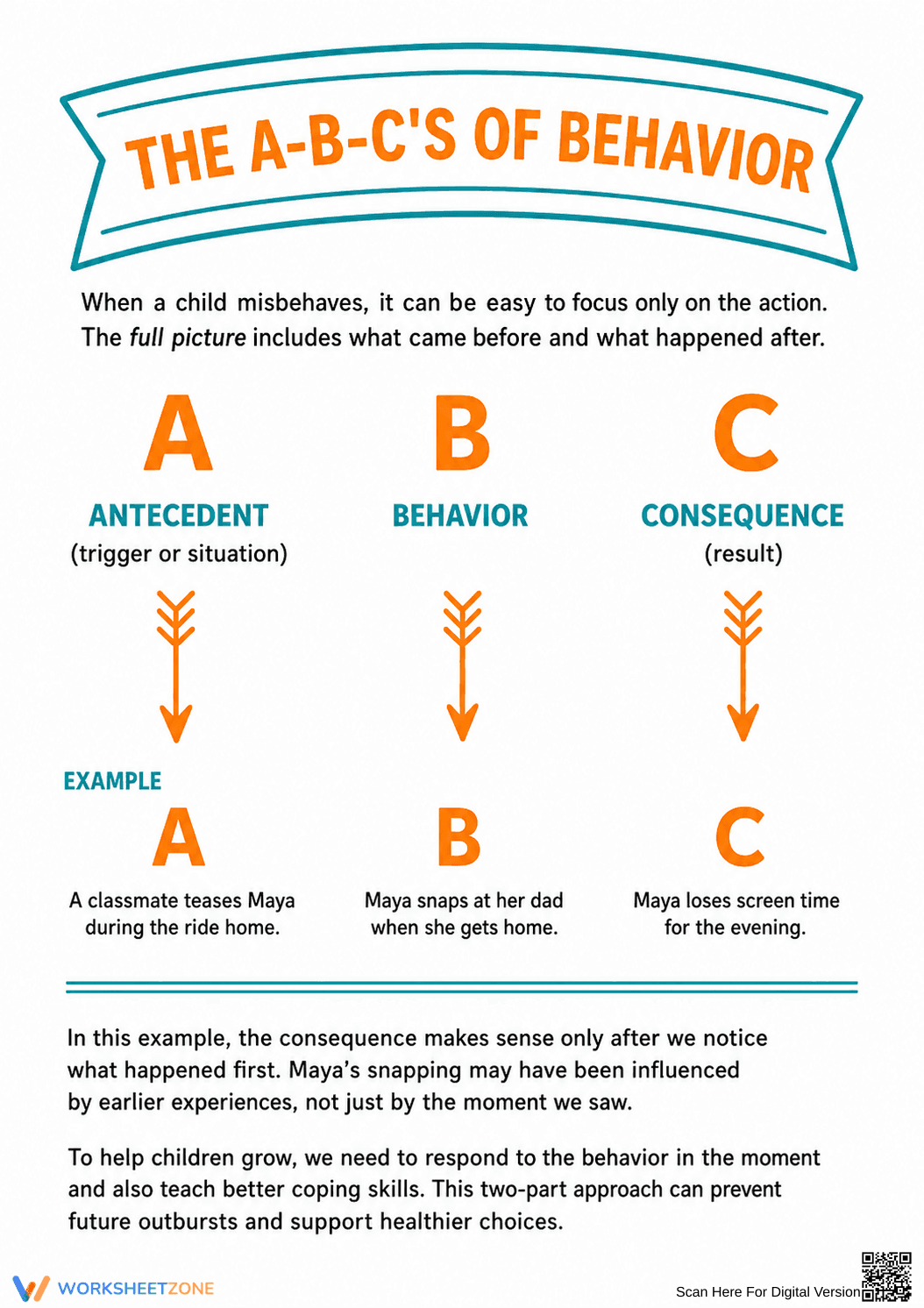
This Grade 6 social-emotional learning resource introduces the ABCs of behavior: Antecedent, Behavior, and Consequence. By breaking down a relatable scenario, this printable guide helps students analyze the root causes of actions and understand how triggers influence outcomes, fostering better self-regulation skills.
At a Glance
- Grade: 6 · Subject: English
- Standard:
CCSS.ELA-LITERACY.RI.6.3— Analyze how events and ideas interact- Skill Focus: Behavior Analysis
- Format: 1 page · 0 problems · No answer key needed · PDF
- Best For: Social skills instruction and counseling
- Time: 10–15 minutes
Inside this single-page handout, educators will find a visual breakdown of the Antecedent-Behavior-Consequence model. The page features straightforward definitions alongside a relatable worked example involving a student named Maya. By tracing Maya's experience from a peer conflict to a behavioral reaction, the guide provides a concrete framework for discussing cause and effect without requiring an answer key.
This resource offers a streamlined zero-prep workflow:
- Print (1 minute): Generate copies of this single-page PDF for your class.
- Distribute (1 minute): Hand out the guide as a reference tool during advisory periods.
- Review (5 minutes): Read the definitions and the Maya example together.
With teacher prep time under two minutes, this handout is perfect for any sub plan.
This resource aligns with CCSS.ELA-LITERACY.RI.6.3: "Analyze in detail how a key individual, event, or idea is introduced, illustrated, and elaborated in a text." Students practice critical cause-and-effect analysis. Both standard codes can be copied directly into lesson plans, IEP goals, or district curriculum mapping tools.
Use this guide before direct instruction on conflict resolution to establish shared vocabulary. Introduce the ABC model, then ask students to identify antecedents in fictional stories. Alternatively, use it during restorative circles to help students objectively map out incidents. As an observation tip, listen to see if students correctly distinguish between triggers and resulting actions. Expected completion time is 10 to 15 minutes.
Designed for Grade 6 students developing self-awareness, this guide is an excellent differentiation tool for those needing concrete frameworks to understand social concepts. Pair this handout with a direct instruction lesson on empathy or a narrative passage to analyze character motivations.
Integrating structured behavioral frameworks into middle school instruction significantly enhances students' capacity for self-regulation and social awareness. According to Fisher & Frey (2014), providing students with explicit, visual models for abstract concepts improves their ability to internalize and apply those skills in real-world contexts. This resource supports that pedagogical approach by breaking down complex emotional reactions into the manageable Antecedent-Behavior-Consequence model. Aligned with CCSS.ELA-LITERACY.RI.6.3, the guide challenges students to analyze how events and ideas interact, specifically focusing on the cause-and-effect relationship between environmental triggers and personal actions. By utilizing this evidence-based strategy, educators can foster a more supportive classroom environment where students are equipped to understand the root causes of their actions, ultimately leading to healthier choices and improved peer relationships across diverse social settings.


