


























Views
Downloads

Printable ABC Behavior Data Sheet | All Grades
Paste this activity's link or code into your existing LMS (Google Classroom, Canvas, Teams, Schoology, Moodle, etc.).
Students can open and work on the activity right away, with no student login required.
You'll still be able to track student progress and results from your teacher account.
This printable ABC data sheet provides educators and students with a structured tool to track behavior patterns. By documenting antecedents, behaviors, and consequences, users identify specific triggers, making it easier to develop effective intervention strategies and support positive growth.
At a Glance
- Grade: 5 · Subject: Social Skills
- Standard:
CCSS.ELA-LITERACY.W.5.8— Recall information from experiences and take categorized notes- Skill Focus: Behavior Tracking
- Format: 1 page · 4 problems · No answer key · PDF
- Best For: Behavior intervention and tracking
- Time: 5–10 minutes
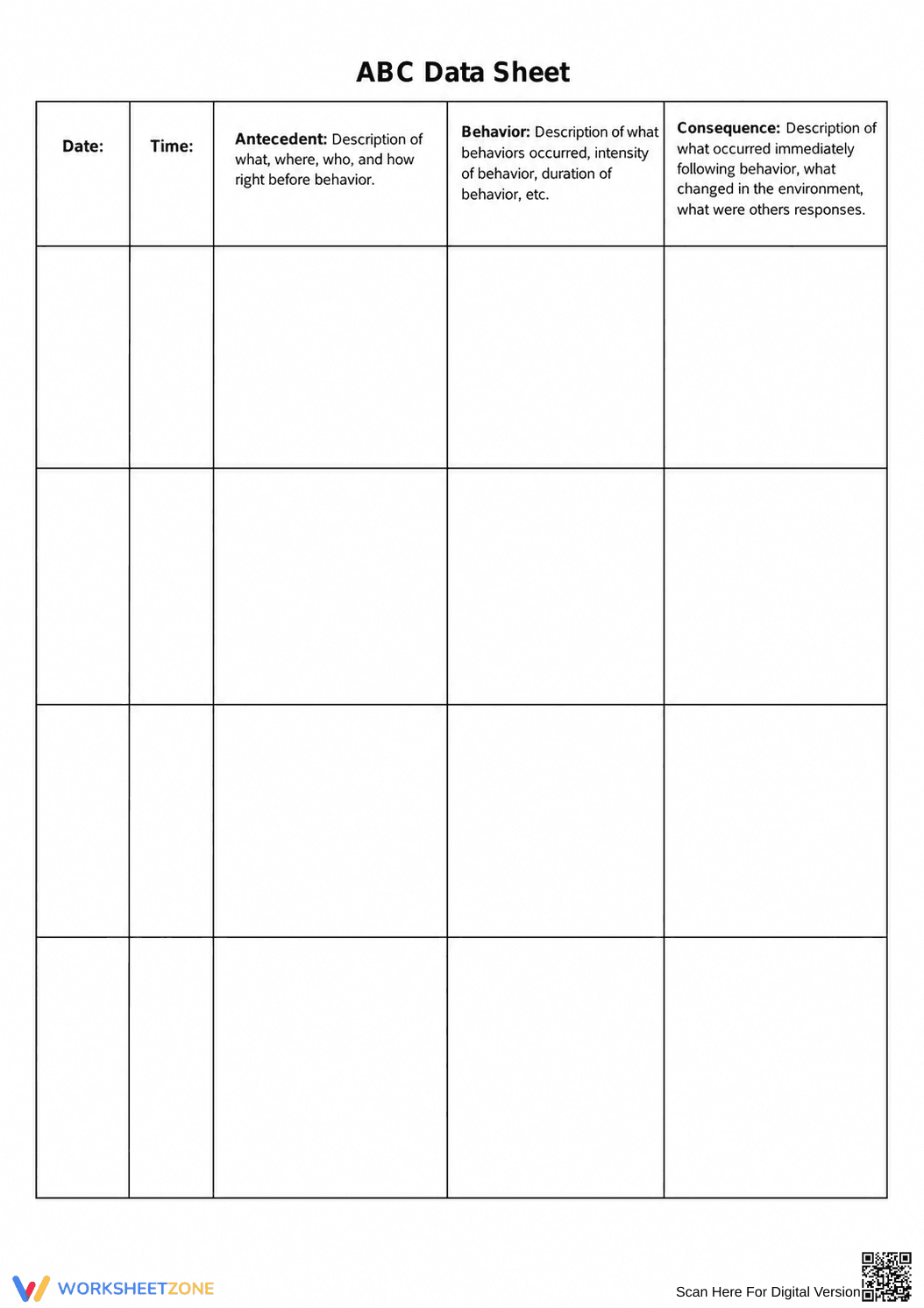
This single-page resource features a clean table designed for immediate classroom use. It includes columns for date, time, antecedent, behavior, and consequence. The sheet provides four blank rows per page for multiple entries. Clear prompts guide the user on exactly what details to record, ensuring accurate data collection without needing an answer key.
- Print (1 minute): Print multiple copies of this single-page PDF to keep on a clipboard.
- Distribute (1 minute): Hand out to co-teachers or students for self-monitoring with no prior setup.
- Review (3 minutes): Quickly scan the categorized notes to identify behavioral trends.
Total teacher prep time is under two minutes, making this an ideal, ready-to-use tool or sub plan resource.
Aligned to primary standard CCSS.ELA-LITERACY.W.5.8: Recall relevant information from experiences; summarize or paraphrase information in notes. This tool supports taking categorized notes based on real-world observations. Both standard codes can be copied directly into lesson plans, IEP goals, or district curriculum mapping tools.
Behavior Intervention: Use this sheet during independent work to quietly document specific student behaviors. The structured format helps staff objectively record what happens immediately before and after a target behavior.
Student Self-Monitoring: Introduce this tool before a challenging task, allowing students to track their own triggers. As a formative assessment tip, review the completed rows to see if they accurately identified environmental changes. Expected completion time is 5 to 10 minutes per incident.
This resource is designed for special education teachers, behavior interventionists, and general education staff. It can be differentiated by adjusting the required detail level or pairing it with a visual anchor chart defining common antecedents. It pairs perfectly with direct instruction on emotional regulation.
Effective behavior management relies heavily on accurate, objective data collection to identify underlying patterns and triggers in the classroom. By utilizing structured tools aligned with CCSS.ELA-LITERACY.W.5.8, educators help students recall information from experiences and take categorized notes effectively. According to a comprehensive EdReports 2024 analysis, structured observation frameworks significantly improve the consistency and success rate of behavioral interventions across diverse educational settings. The Antecedent, Behavior, Consequence (ABC) model provides a clear, evidence-based method for documenting these complex interactions, ensuring that subsequent interventions are highly targeted and effective. This systematic approach not only supports individualized education program (IEP) goals but also fosters a much more supportive and predictable learning environment for all students. Consistent use of standardized data sheets reduces subjective bias, allowing educational teams to make informed, data-driven decisions that directly benefit long-term student outcomes and overall classroom dynamics.


