


























Views
Downloads

Printable ABC Behavior Chart | K-5 Special Education
Paste this activity's link or code into your existing LMS (Google Classroom, Canvas, Teams, Schoology, Moodle, etc.).
Students can open and work on the activity right away, with no student login required.
You'll still be able to track student progress and results from your teacher account.
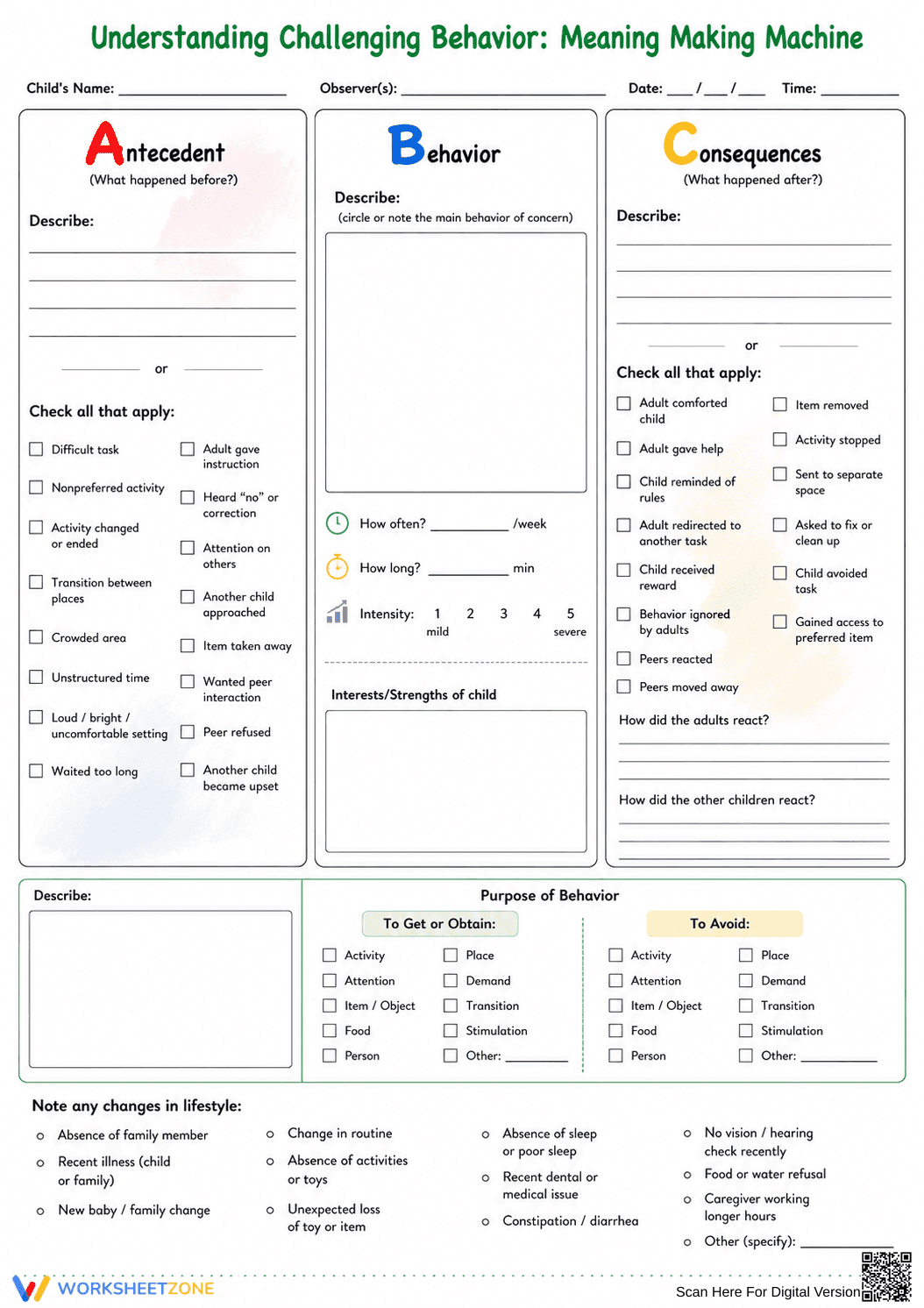
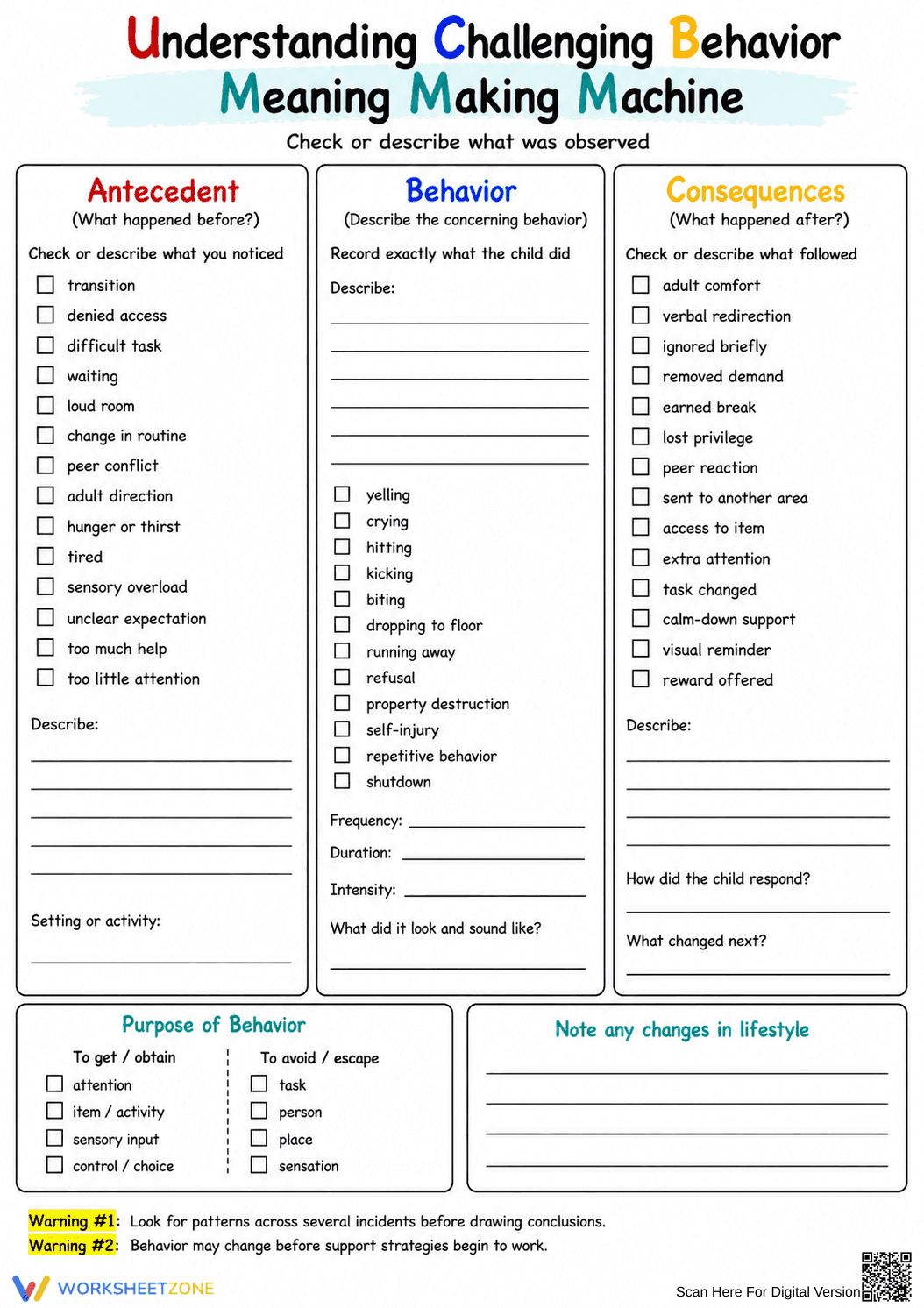
This comprehensive behavior tracking worksheet empowers educators and specialists to systematically observe and document student actions. By utilizing the Antecedent, Behavior, and Consequence (ABC) model, teachers can accurately identify triggers and patterns. This tool streamlines the data collection process, making it easier to develop effective, individualized intervention strategies.
At a Glance
- Grade: K-5 · Subject: Special Education
- Standard:
SPED.FBA.ABC— Collect and analyze behavioral data to determine function- Skill Focus: ABC Data Collection
- Format: 2 pages · 5 sections · No answer key · PDF
- Best For: Behavior observation and intervention planning
- Time: 5–15 minutes per observation
This resource includes two distinct pages of the observation form, offering flexible layouts for tracking behavior. Each page features five sections: Antecedent, Behavior, Consequences, Purpose, and Lifestyle Changes. The forms utilize quick-check boxes for common triggers and open-ended fields for detailed notes. This ensures observers can rapidly capture essential data during an incident while retaining the ability to add specific context.
Implementing this tool requires zero prep.
- Print (1 minute): Keep a stack of these PDFs on a clipboard.
- Distribute (0 minutes): No student distribution needed; this is a teacher-facing tool.
- Review (5 minutes): Quickly scan checked boxes to identify immediate patterns.
With total prep time under two minutes, this form is an essential asset for any classroom or substitute binder.
This observation tool aligns with SPED.FBA.ABC by providing a structured framework to collect and analyze behavioral data to determine function. It supports the foundational steps of creating a Functional Behavior Assessment (FBA) and subsequent Behavior Intervention Plan (BIP). Both standard codes can be copied directly into lesson plans, IEP goals, or district curriculum mapping tools.
Use this form as a primary data collection tool during initial behavior interventions. When a student exhibits challenging actions, quickly check antecedent triggers and consequence reactions to build a reliable data profile. Alternatively, use it during IEP meetings to present concrete patterns rather than subjective memory. As an observation tip, look for recurring checkboxes in the "Purpose" section to hypothesize if the student is seeking attention or avoiding tasks. Expect to spend 5 to 15 minutes completing the form per incident.
This resource is primarily designed for special education teachers, general educators, school psychologists, and behavior specialists working with K-5 students. It is highly adaptable for differentiating support, as the data collected directly informs individualized behavior plans for students with varying emotional and behavioral needs. It pairs perfectly with targeted social-emotional learning (SEL) direct instruction lessons.
Effective behavior management relies heavily on accurate, objective data collection within the natural classroom environment. Utilizing the SPED.FBA.ABC framework to collect and analyze behavioral data to determine function is a critical step in supporting long-term student success. According to Fisher & Frey (2014), structured observation tools that isolate specific antecedents and consequences significantly improve a teacher's ability to identify the root cause of disruptions, rather than merely reacting to surface-level symptoms. By systematically documenting these environmental variables, educators can successfully transition from subjective discipline to highly targeted, supportive interventions. This comprehensive ABC data collection worksheet provides the exact scaffolding needed to implement these evidence-based practices efficiently. Consistent use of this tool ensures that behavior intervention plans are grounded in reliable, actionable data, ultimately fostering a more inclusive and predictable learning environment.


