


























Views
Downloads
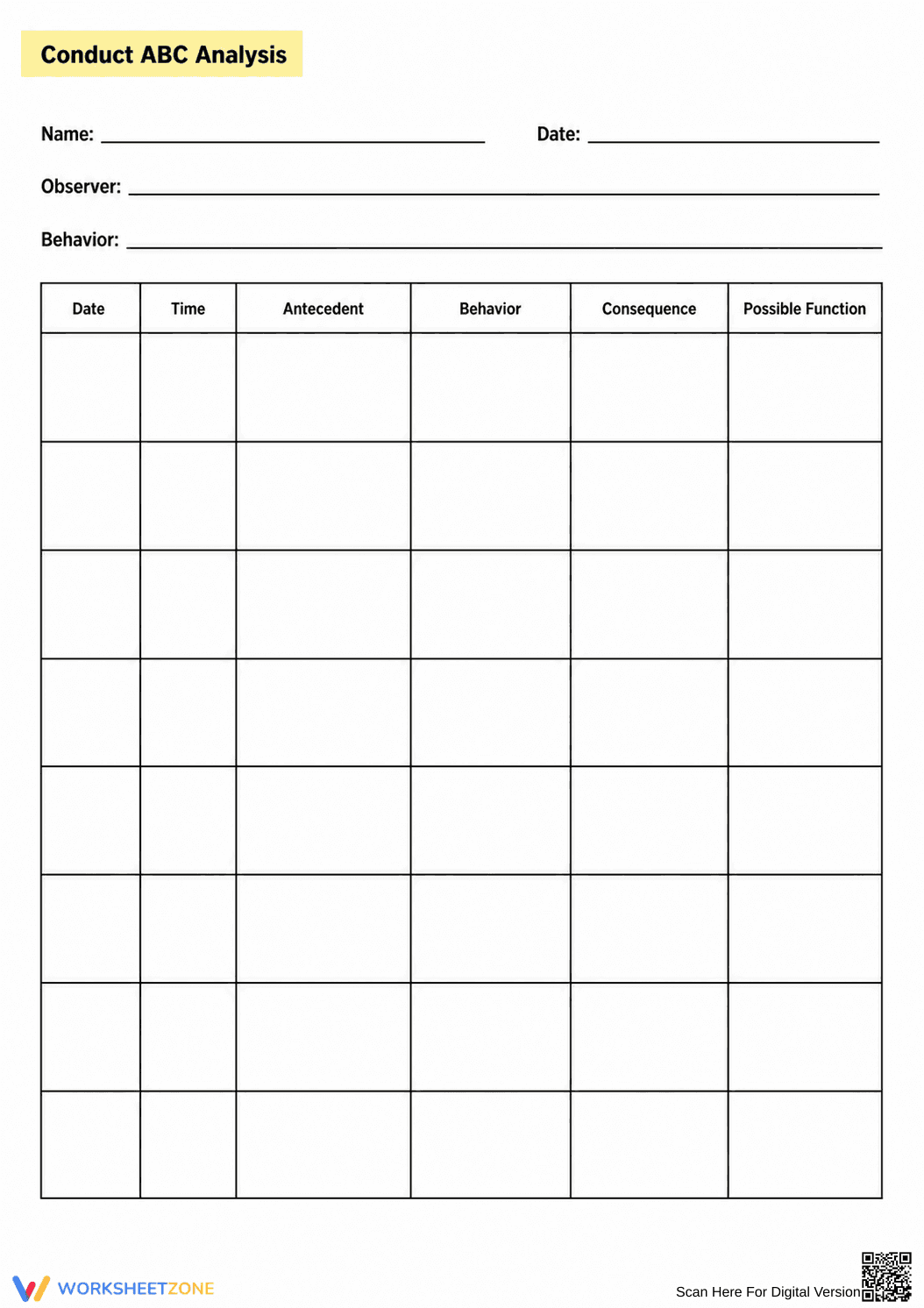

Essential ABC Analysis Worksheet | Behavior Tracking
Paste this activity's link or code into your existing LMS (Google Classroom, Canvas, Teams, Schoology, Moodle, etc.).
Students can open and work on the activity right away, with no student login required.
You'll still be able to track student progress and results from your teacher account.
This professional-grade ABC analysis worksheet provides a structured framework for observing and documenting behavioral patterns in educational or clinical settings. By isolating the antecedent, the behavior, and the resulting consequence, users can objectively determine the function of a specific action. This tool is vital for creating effective intervention plans and understanding the environmental triggers that influence student conduct.
At a Glance
- Grade: 9–12 · Subject: Behavior Activities
- Standard:
CCSS.ELA-LITERACY.W.11-12.2— Write informative texts to examine and convey complex ideas and information clearly and accurately- Skill Focus: Antecedent-Behavior-Consequence (ABC) data collection
- Format: 1 page · 10 observation rows · Data collection tool · PDF
- Best For: Functional Behavioral Assessments and IEP tracking
- Time: 15–60 minutes
The worksheet features a clean, one-page layout designed for rapid data entry during live observations. It includes header fields for the student's name, date, observer, and the target behavior. The primary recording area consists of a 10-row table with six distinct columns: Date, Time, Antecedent, Behavior, Consequence, and Possible Function. This comprehensive structure ensures that no critical context is missed during the observation period, allowing for a high-fidelity record of events.
Zero-Prep Workflow
- Print: Generate the required number of copies for your observation period in less than 30 seconds.
- Distribute: Hand the sheet to the designated observer or place it on a clipboard for immediate, mobile use in the classroom.
- Review: Spend 5 minutes at the end of the session synthesizing the "Possible Function" column to identify recurring behavioral triggers.
Total teacher preparation time is under 2 minutes, making this an ideal resource for busy special education departments and school counseling offices.
This resource is aligned to CCSS.ELA-LITERACY.W.11-12.2: Write informative/explanatory texts to examine and convey complex ideas, concepts, and information clearly and accurately through the effective selection, organization, and analysis of content. Both standard codes can be copied directly into lesson plans, IEP goals, or district curriculum mapping tools.
Use this as a primary data collection tool during a Functional Behavioral Assessment (FBA) to gather baseline data. It is also excellent for formative assessment of social skills progress during small group instruction. Expected completion time varies by the frequency of the behavior, typically ranging from 15 to 60 minutes of active observation.
This worksheet is designed for special education teachers, Board Certified Behavior Analysts (BCBAs), and school counselors working with students in high school or transition programs. It pairs naturally with a behavior intervention plan (BIP) or a social-emotional learning anchor chart that defines specific replacement behaviors.
According to Fisher & Frey (2014), structured observation tools like the ABC analysis worksheet are fundamental to the gradual release of responsibility, particularly when monitoring self-regulation skills. By utilizing the CCSS.ELA-LITERACY.W.11-12.2 framework, this worksheet ensures that behavioral data is recorded with the same academic rigor as informational texts. Research indicates that systematic data collection reduces observer bias and leads to more accurate identification of behavioral functions compared to anecdotal notes. This worksheet provides 10 specific entry points to establish a reliable baseline for intervention. The use of standardized columns facilitates clear communication between multidisciplinary teams, including therapists and parents. Implementing this evidence-based tracking method supports the development of targeted strategies that address the root causes of behavior rather than just the symptoms, aligning with modern pedagogical standards for student support and classroom management.


