




























Views
Downloads

Printable ABC Data Collection Worksheet | K-12 Behavior

Paste this activity's link or code into your existing LMS (Google Classroom, Canvas, Teams, Schoology, Moodle, etc.).
Students can open and work on the activity right away, with no student login required.
You'll still be able to track student progress and results from your teacher account.
This K-12 behavior management worksheet provides educators and therapists with a structured tool to track and analyze student actions. By utilizing the Antecedent-Behavior-Consequence (ABC) model, users can identify specific triggers and evaluate the effectiveness of management strategies to support positive behavioral outcomes in the classroom.
At a Glance
- Grade: K-12 · Subject: Behavior Management
- Standard:
CASEL.SEL.SM— Regulate emotions, thoughts, and behaviors in different situations- Skill Focus: ABC Data Collection
- Format: 1 page · 1 tracking table · No answer key · PDF
- Best For: Behavior tracking and IEP data
- Time: 5–10 minutes per entry
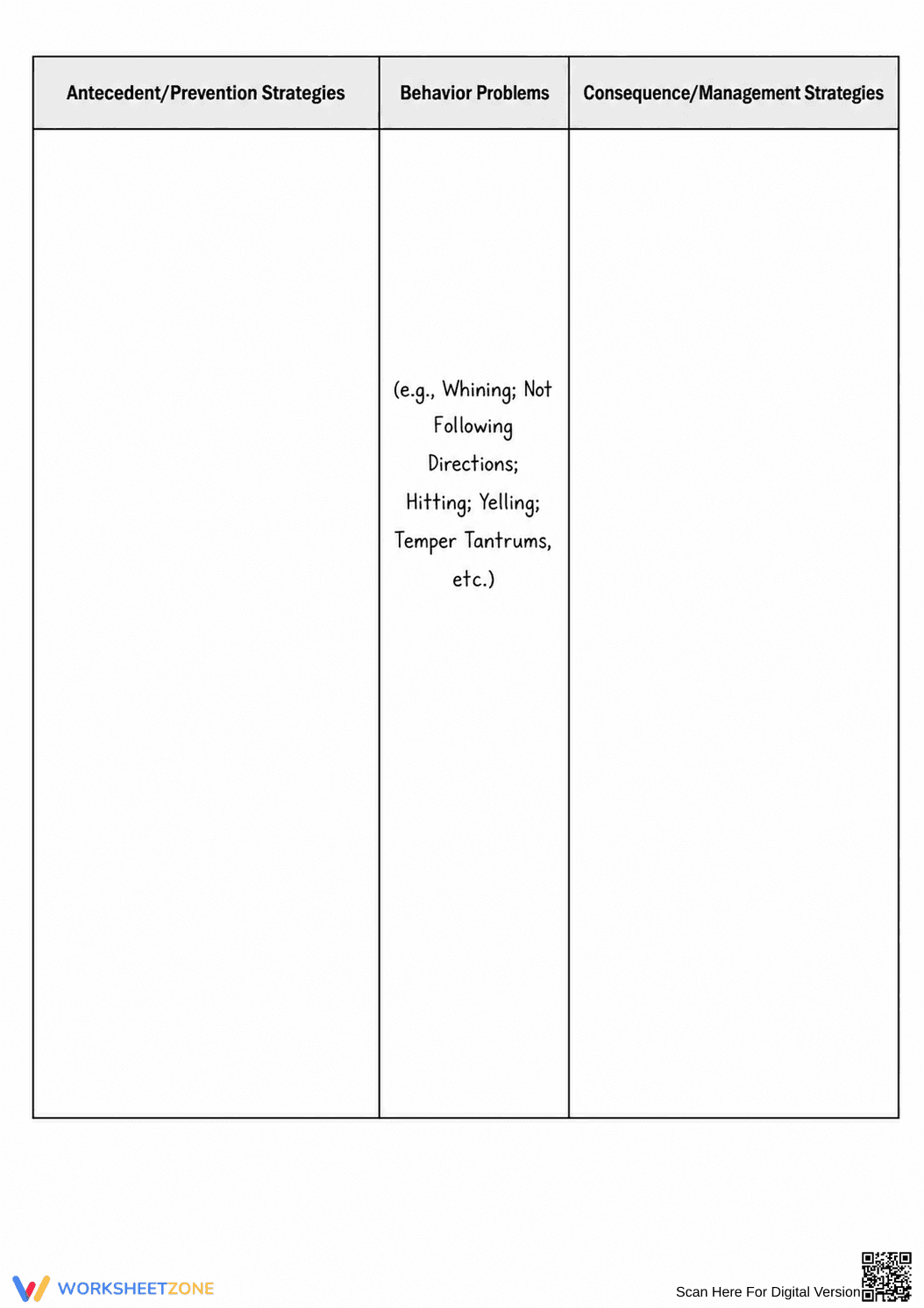
This resource features a clean, three-column tracking table designed for continuous behavioral observation. The first column prompts users to record antecedent or prevention strategies, capturing what occurs immediately before an incident. The middle column documents specific behavior problems, referencing common examples like whining or hitting. The final column logs the consequence or management strategies applied, creating a complete record of the event.
Implementing this tracking tool requires minimal setup, making it ideal for busy educators and behavior specialists.
- Print (1 minute): Generate copies for clipboards or student observation binders.
- Distribute (1 minute): Share templates with paraprofessionals or parents for consistent data collection across environments.
- Review (3 minutes): Analyze completed rows weekly to identify behavioral patterns and adjust intervention plans.
Total teacher prep time is under two minutes, ensuring you can immediately begin gathering critical behavioral data.
Aligned to CASEL.SEL.SM, this tool supports the core competency of Self-Management by helping educators and students identify triggers and regulate responses. It also serves as a foundational data collection instrument for developing individualized behavior intervention plans (BIPs). Both standard codes can be copied directly into lesson plans, IEP goals, or district curriculum mapping tools.
Use this worksheet during active instruction or unstructured times to document behaviors as they occur. A teacher can quickly jot down the antecedent when a student refuses a task, noting the exact environmental trigger. Alternatively, use it during a post-incident debriefing to collaboratively identify what led to the behavior and discuss better choices. Formative assessment tip: review the consequence column weekly to see if current management strategies are actually decreasing the target behavior. Expected completion time is 5 to 10 minutes per recorded incident.
This resource is designed for special education teachers, school counselors, and therapists working with students requiring targeted behavioral support. The blank format easily accommodates everything from minor classroom disruptions to severe incidents. Pair this tracking sheet with a visual schedule or a calm-down corner for comprehensive intervention.
Effective behavior management relies on accurate, objective data collection to identify the root causes of student actions in the classroom. Using the CASEL.SEL.SM framework to regulate emotions, thoughts, and behaviors in different situations ensures that interventions are targeted and meaningful for the student. According to Fisher & Frey (2014), structured observation tools that capture the full context of an incident—including exactly what happens immediately before and after—are critical for developing successful behavior intervention plans. By systematically recording antecedents and consequences, educators move away from reactive discipline and toward proactive, skill-building strategies. This ABC data collection worksheet provides the exact framework needed to spot behavioral patterns, adjust environmental triggers, and teach appropriate replacement behaviors effectively. Consistent use of this method bridges the gap between identifying a recurring problem and implementing a sustainable, evidence-based solution in any educational setting.


