


























Views
Downloads
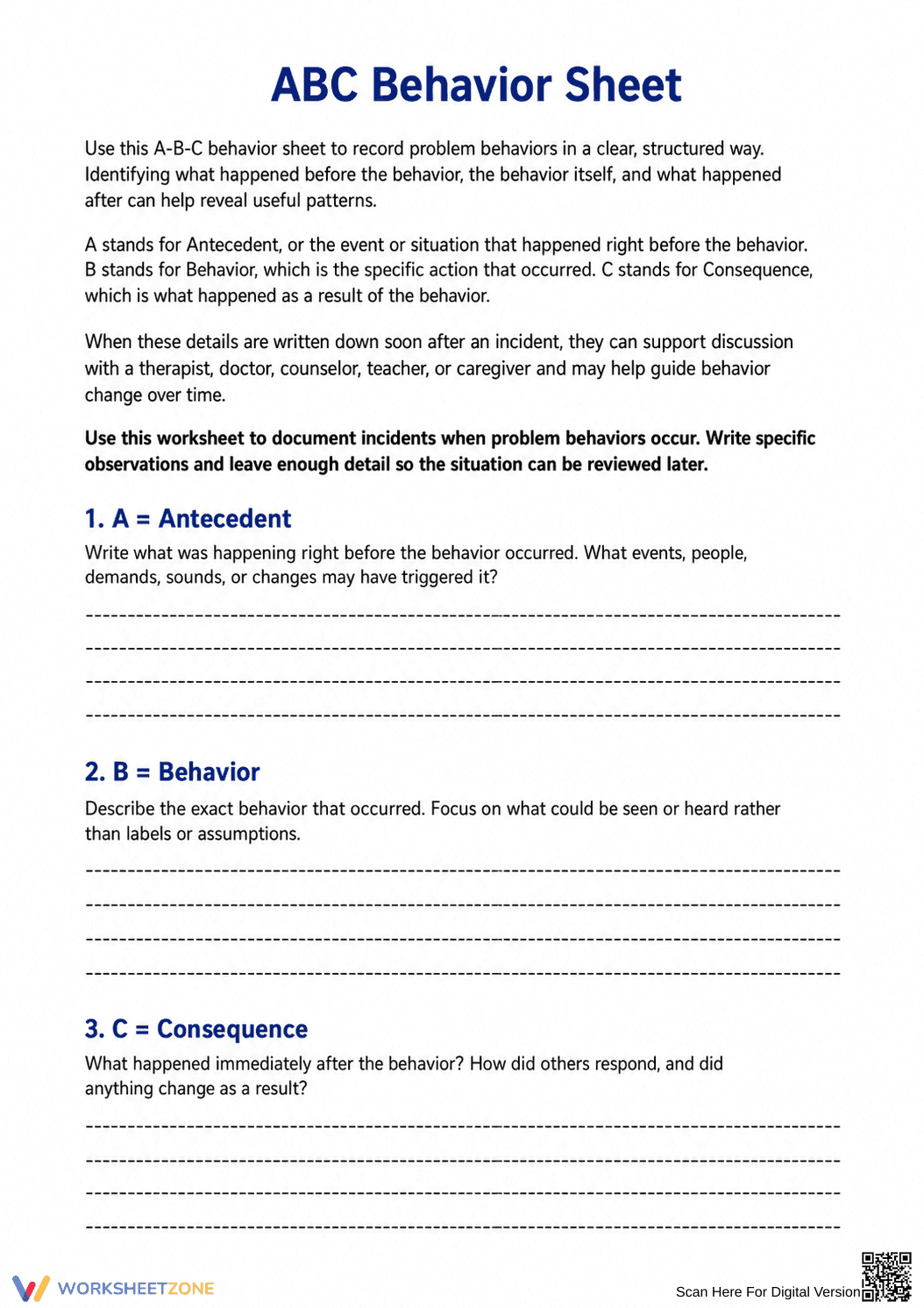

ABC Behavior Sheet: Essential Tracking Guide for Teens
Paste this activity's link or code into your existing LMS (Google Classroom, Canvas, Teams, Schoology, Moodle, etc.).
Students can open and work on the activity right away, with no student login required.
You'll still be able to track student progress and results from your teacher account.
This ABC Behavior Sheet provides a structured framework for identifying the triggers and outcomes of specific actions. By documenting the antecedent, behavior, and consequence, students develop the self-awareness necessary for behavior modification. This tool transforms responses into observable data points, allowing for objective analysis and targeted intervention strategies.
At a Glance
- Grade: 9–12 · Subject: Behavior Activities
- Standard:
CCSS.ELA-LITERACY.W.11-12.10— Write routinely for reflection and behavioral analysis tasks- Skill Focus: ABC Behavioral Analysis
- Format: 1 page · 3 sections · No answer key · PDF
- Best For: Behavioral intervention and self-reflection
- Time: 10–15 minutes
The worksheet features a clean layout divided into three documentation zones. Each section includes guiding prompts to help the user distinguish between triggers, the specific behavior, and the result. This one-page PDF is designed for high-stakes environments where clear documentation is required for IEP meetings or therapeutic reviews.
Zero-Prep Workflow
- Print: Generate the single-page PDF for immediate use (30 seconds).
- Distribute: Provide to the student immediately following a behavioral incident while details are fresh (30 seconds).
- Review: Analyze the completed sheet during a scheduled check-in to identify environmental patterns (1 minute).
This streamlined workflow makes it an ideal tool for busy special education classrooms or as a standard component of a crisis sub-plan.
Standards Alignment
This resource aligns with `CCSS.ELA-LITERACY.W.11-12.10`, which emphasizes the importance of writing routinely over extended time frames for a range of tasks, purposes, and audiences. It requires students to produce clear writing appropriate to the task. This standard code can be copied directly into lesson plans, IEP goals, or district curriculum mapping tools.
How to Use It
Use this sheet as a formative assessment tool during behavioral intervention. Educators should look for recurring antecedents—like specific transitions or environmental sounds—to adjust the classroom environment. Completion time typically ranges from 10 to 15 minutes. It is most effective when completed close to the event to ensure accuracy and provide a clear basis for restorative conversations.
Who It's For
This worksheet is tailored for Grade 9 through College students with the literacy skills for self-reflection. It is an excellent resource for students with 504 plans or IEPs. It works best when paired with a direct instruction lesson on identifying emotional triggers or a social-emotional learning anchor chart.
The ABC Behavior Sheet serves as a foundational tool for Functional Behavioral Assessment (FBA), a process supported by research from Fisher & Frey (2014) regarding the importance of structured reflection in student self-regulation. By isolating the antecedent, behavior, and consequence, users can objectively analyze the environmental triggers and reinforcing outcomes that maintain specific actions. This worksheet aligns with CCSS.ELA-LITERACY.W.11-12.10, requiring students to write routinely for specialized tasks and purposes. Research indicates that systematic documentation of behavioral patterns significantly increases the efficacy of intervention plans compared to anecdotal recall. This printable resource provides the necessary scaffolding for high school students and adults to engage in metacognitive analysis of their own behavioral choices. It is designed to be used within a multi-tiered system of supports (MTSS) to facilitate data-driven discussions between students and educators, ensuring that behavioral goals are measurable, observable, and grounded in consistent evidence-based practice.


