


























Views
Downloads
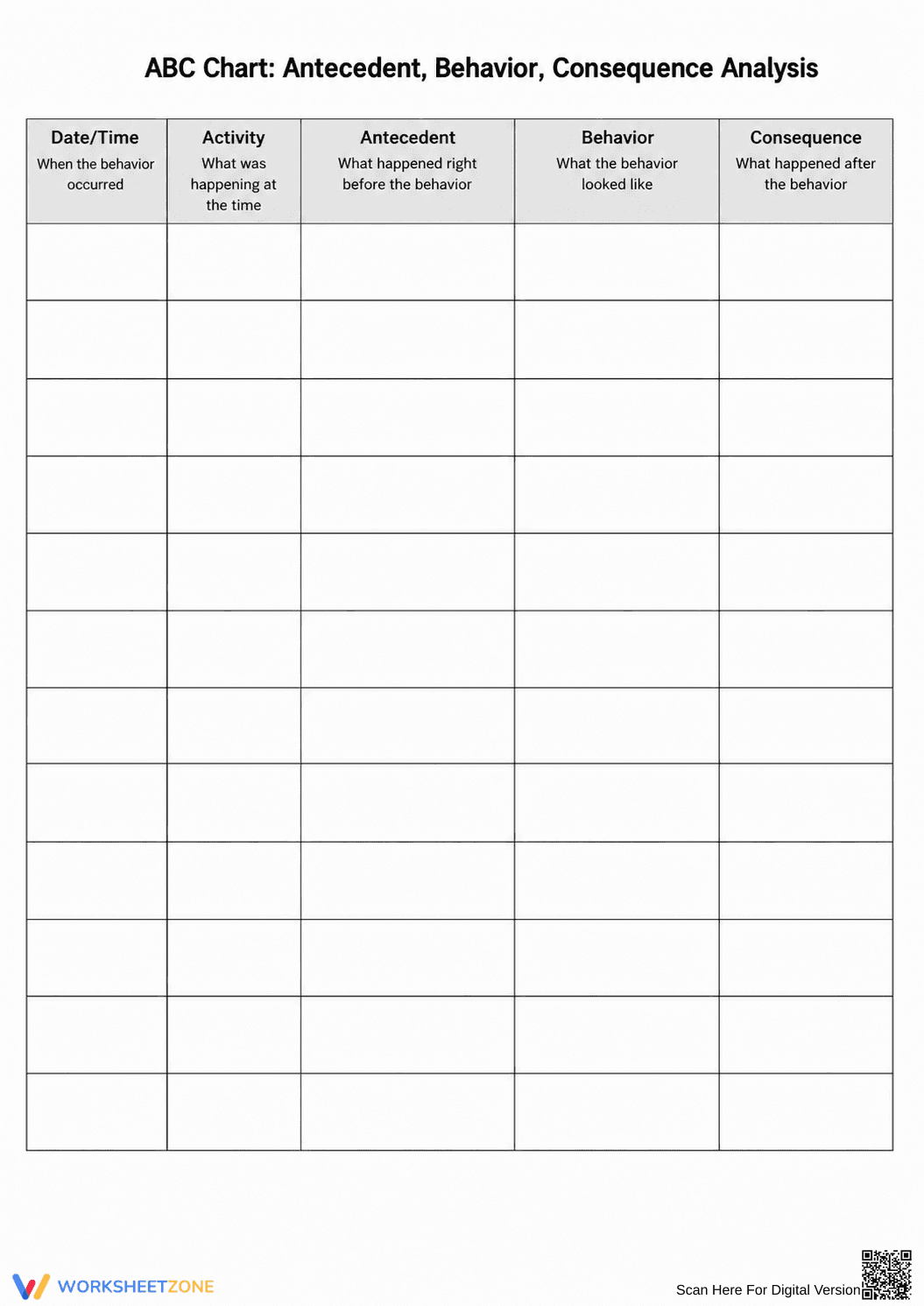

Printable ABC Behavior Chart | Grade 9-12 Essential
Paste this activity's link or code into your existing LMS (Google Classroom, Canvas, Teams, Schoology, Moodle, etc.).
Students can open and work on the activity right away, with no student login required.
You'll still be able to track student progress and results from your teacher account.
This Grade 9-12 behavioral observation worksheet provides a structured framework for students and educators to document and analyze behavioral patterns. By systematically recording antecedents, behaviors, and consequences, users can identify environmental triggers and reinforcing outcomes. This tool fosters self-awareness and supports effective intervention strategies.
At a Glance
- Grade: 9-12 · Subject: Behavior Activities
- Standard:
CCSS.ELA-LITERACY.W.11-12.10— Write routinely to document and analyze behavioral patterns- Skill Focus: Behavioral Observation
- Format: 1 page · 12 rows · No answer key · PDF
- Best For: Functional Behavioral Assessment data collection
- Time: 15–30 minutes
This resource consists of a single-page tracking form designed for clear data entry. The layout features a five-column table with 12 dedicated rows for recording separate incidents. Each column includes helpful sub-headers defining the required information: Date/Time, Activity, Antecedent, Behavior, and Consequence. The clean design ensures data remains the focus, making it suitable for official student portfolios.
Zero-Prep Workflow
- Print (30 Seconds): Generate as many copies as needed for the observation period; no complex settings or color ink required.
- Distribute (1 Minute): Provide the chart to the observer or student with a brief explanation of the column headers to ensure objective recording.
- Review (5 Minutes): After 12 incidents are recorded, scan the rows vertically to identify recurring antecedents or consequences that suggest a behavioral function.
This streamlined workflow requires under 7 minutes of total teacher prep time, making it an ideal choice for busy special education teachers or as a reliable sub plan component.
This worksheet aligns with CCSS.ELA-LITERACY.W.11-12.10, which requires students to write routinely over extended time frames for a range of tasks, purposes, and audiences. In this context, the task is the objective documentation of social data. Both standard codes can be copied directly into lesson plans, IEP goals, or district curriculum mapping tools.
This chart is best utilized during active observation periods or as a self-monitoring tool for high school students working on self-regulation goals. For formative assessment, teachers should look for clustering in the Antecedent column; if the same activity appears multiple times before a negative behavior, it indicates a clear environmental trigger. We recommend using this over a 3-to-5 day period, requiring about 15 to 30 minutes of active observation per session, to gather enough data points for a valid functional hypothesis.
This resource is designed for high school students, adult learners, and educational professionals. It is particularly effective for students with IEPs or 504 plans focusing on social-emotional growth. For best results, pair this worksheet with a direct instruction lesson on behavioral functions or a visual anchor chart defining the difference between objective observation and subjective interpretation.
According to the RAND AIRS 2024 report on behavioral health in educational settings, structured observation tools like the ABC Chart significantly improve the accuracy of Functional Behavioral Assessments compared to anecdotal reporting. This worksheet facilitates the collection of high-frequency data, allowing educators to move beyond surface-level descriptions to root-cause analysis. By documenting 12 distinct data points on a single page, the tool provides a statistically relevant sample size for identifying behavioral functions such as escape or attention. Aligning with CCSS.ELA-LITERACY.W.11-12.10 to write routinely to document and analyze behavioral patterns, this chart offers necessary scaffolding for students to eventually manage their own responses independently. It is a foundational component for any evidence-based classroom management system.


