


























Views
Downloads
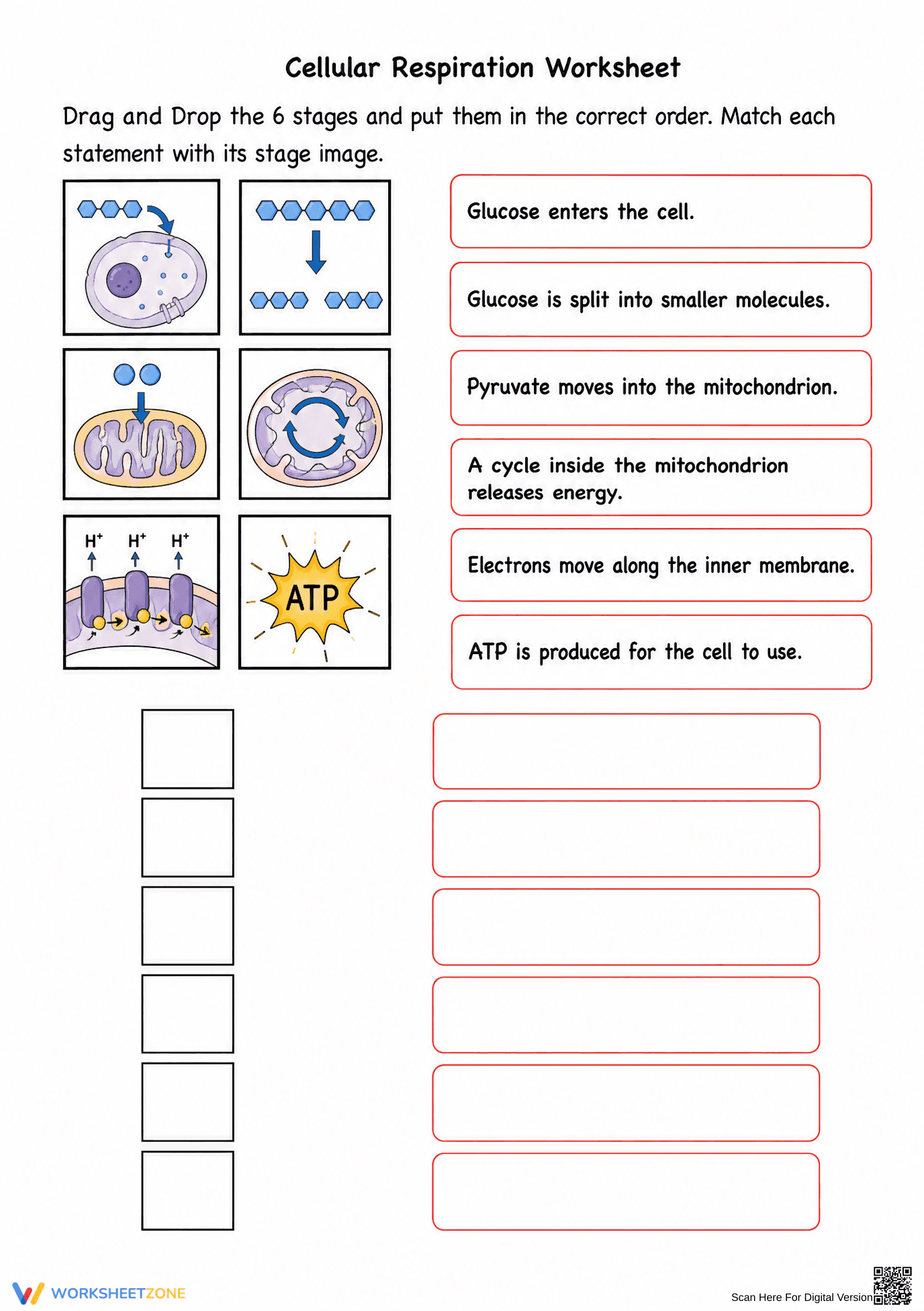

Printable Cellular Respiration Worksheet | Grade 9-10
Paste this activity's link or code into your existing LMS (Google Classroom, Canvas, Teams, Schoology, Moodle, etc.).
Students can open and work on the activity right away, with no student login required.
You'll still be able to track student progress and results from your teacher account.
This high school biology worksheet helps students visualize and sequence the complex process of cellular respiration. By matching descriptive statements to visual models, learners actively connect abstract concepts to concrete biological outcomes.
At a Glance
- Grade: 9-10 · Subject: Biology
- Standard:
HS-LS1-7— Model the chemical process of cellular respiration- Skill Focus: Sequencing cellular respiration stages
- Format: 1 page · 6 tasks · Answer key included · PDF
- Best For: Independent practice or review
- Time: 15–20 minutes
This single-page resource features a clear visual matching activity. Students receive six illustrated stages of cellular respiration alongside six descriptive statements, such as "Glucose is split into smaller molecules." The task requires learners to sequence the images chronologically and pair them with the correct text in the provided blank boxes. A complete answer key is included.
Zero-Prep Workflow
- Print (1 minute): Generate copies of the single-page PDF for each student. No special materials or complex setup required.
- Distribute (1 minute): Hand out the worksheets as a warm-up, exit ticket, or independent practice assignment following direct instruction.
- Review (3 minutes): Use the included answer key to quickly verify student sequences or project the correct order on the board for self-grading.
Total teacher preparation time is under two minutes, making this an excellent, reliable option for emergency substitute plans or quick formative assessments.
Standards Alignment
This activity aligns with HS-LS1-7: Use a model to illustrate that cellular respiration is a chemical process whereby bonds of food and oxygen molecules are broken and new compounds are formed, resulting in a net transfer of energy. Both standard codes can be copied directly into lesson plans, IEP goals, or district curriculum mapping tools.
How to Use It
Deploy this worksheet during direct instruction as a guided note-taking tool, or assign it after a lecture to consolidate learning. It works exceptionally well as a collaborative pairs activity where students debate the correct sequence of events. As a formative assessment tip, observe which students struggle to differentiate between the Krebs cycle and the electron transport chain; this indicates a need to review mitochondrial anatomy. Expected completion time is 15 to 20 minutes.
Who It's For
This resource is designed for high school biology students encountering cellular energy processes for the first time. For students requiring accommodations, teachers can pre-fill the first and last steps to reduce the cognitive load of sequencing all six items simultaneously. It pairs perfectly with an introductory lesson or anchor chart detailing the mitochondria.
Aligning instructional materials to HS-LS1-7 ensures that students can accurately model the chemical process of cellular respiration and understand how energy is transferred within biological systems. According to a ScienceDirect TpT Analysis, visual sequencing tasks significantly improve retention of complex, multi-step biological processes compared to rote memorization of text alone. When students actively manipulate models and match them to descriptive text, they build stronger cognitive pathways that support long-term mastery of metabolic concepts. This worksheet provides the exact structured practice needed to bridge the gap between abstract chemical equations and observable biological phenomena. By breaking down cellular respiration into six distinct, manageable stages, educators can effectively reduce cognitive overload, facilitate deeper comprehension of essential life science standards, and ensure learners are fully prepared for subsequent units on cellular energy and ecology.


