


























Views
Downloads

Cellular Respiration Review Worksheet | Essential Biology
Paste this activity's link or code into your existing LMS (Google Classroom, Canvas, Teams, Schoology, Moodle, etc.).
Students can open and work on the activity right away, with no student login required.
You'll still be able to track student progress and results from your teacher account.
This comprehensive biology worksheet provides a rigorous review of cellular respiration, ensuring students master the complex biochemical pathways of energy production. By analyzing glycolysis, the citric acid cycle, and the electron transport chain, learners develop a concrete understanding of how eukaryotic cells convert glucose into usable ATP.
At a Glance
- Grade: 9-12 · Subject: Biology
- Standard:
HS-LS1-7— Illustrate how cellular respiration breaks bonds to transfer energy into ATP- Skill Focus: Metabolic Pathways & ATP Synthesis
- Format: 3 pages · 22 problems · Answer key included · PDF
- Best For: Unit review or summative assessment prep
- Time: 35–50 minutes
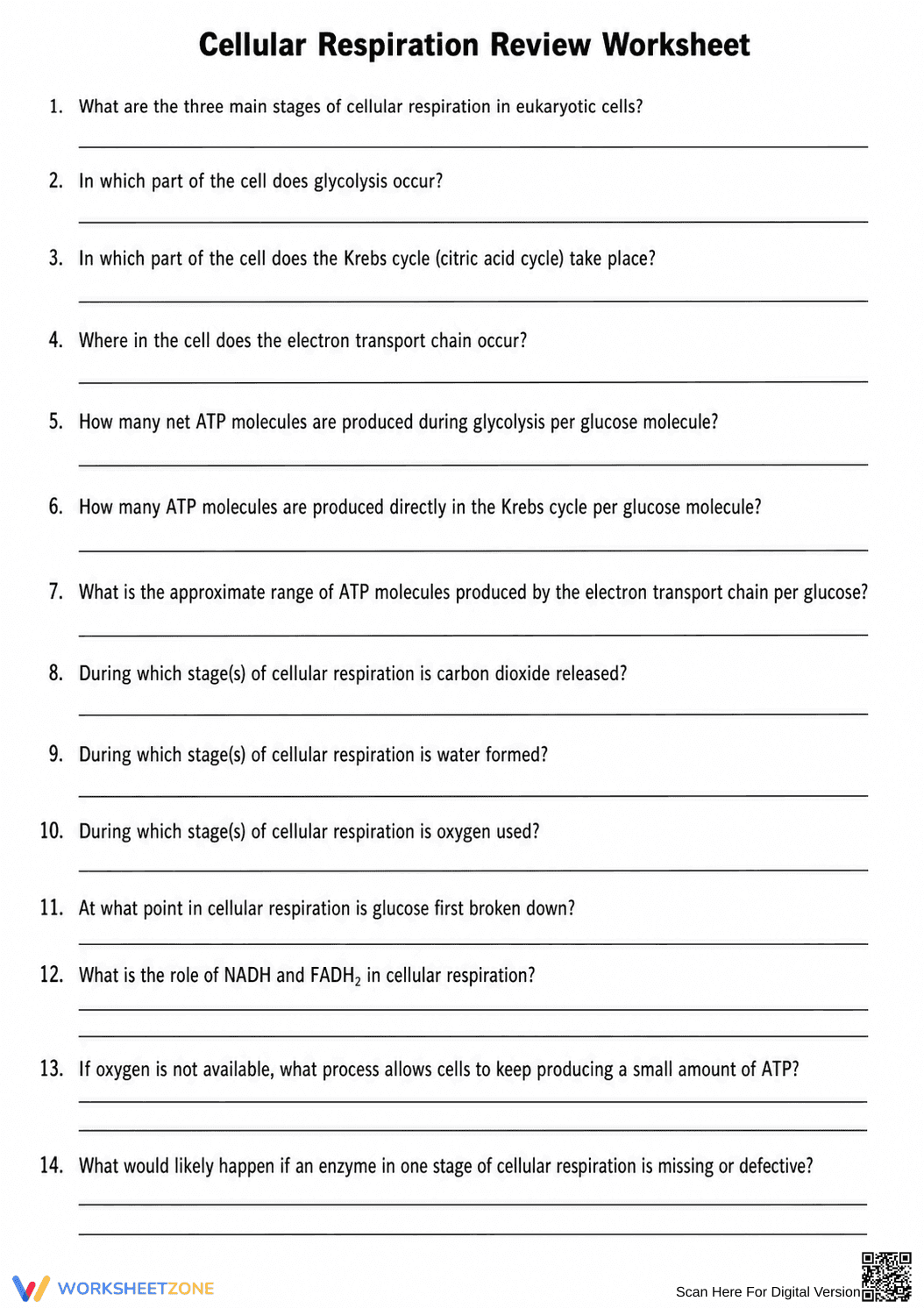
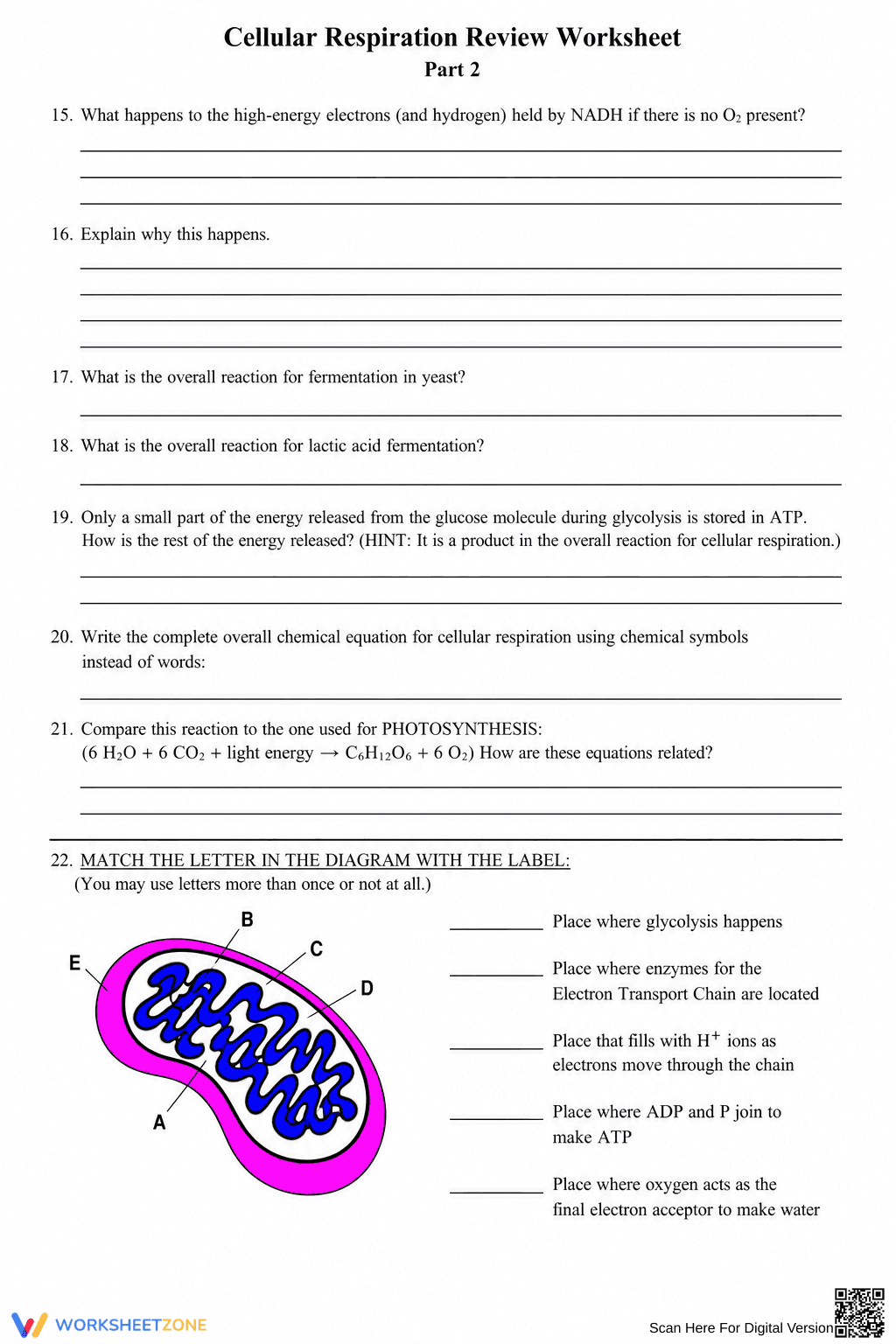
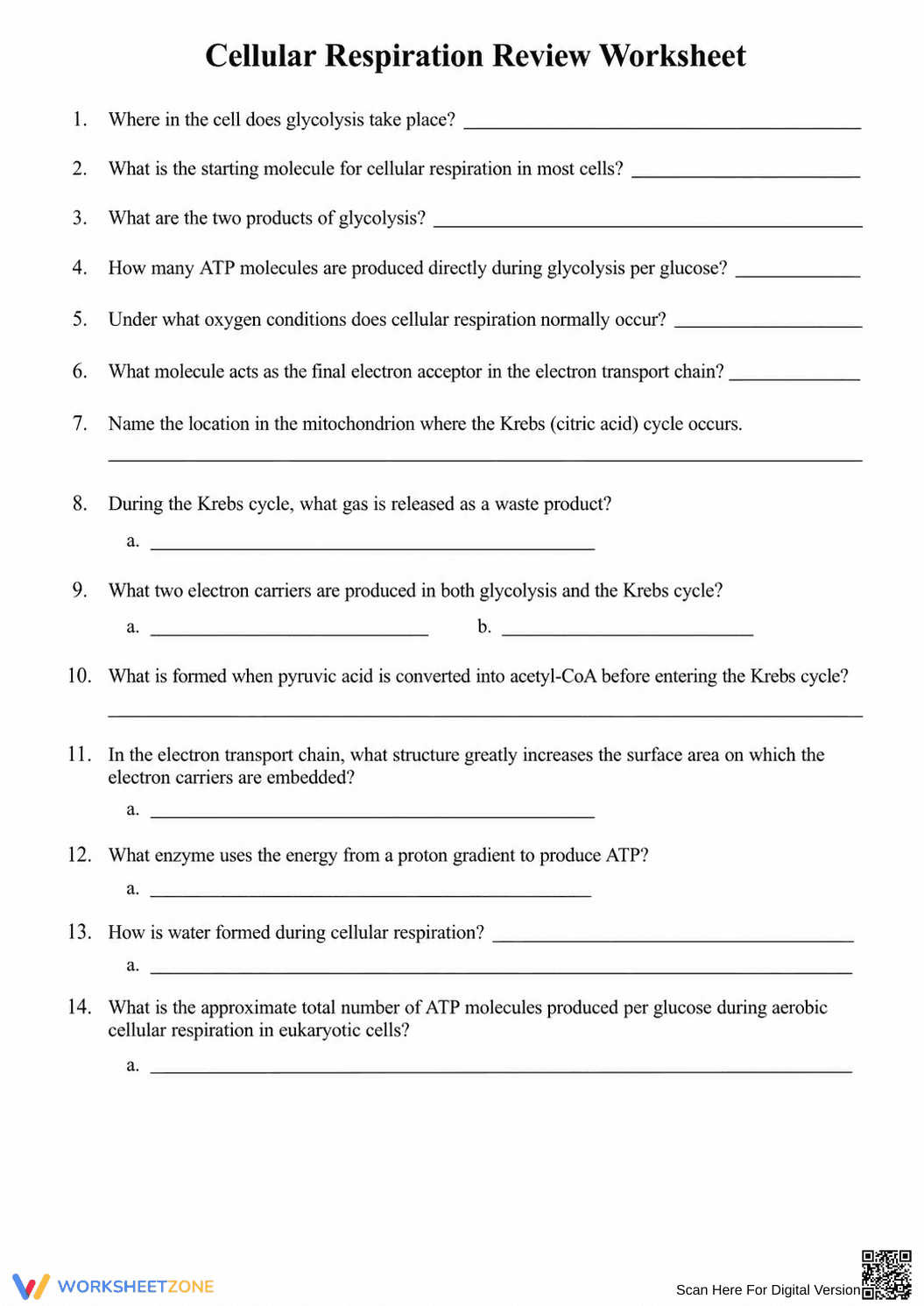
The resource contains three distinct pages of content. The first page features 14 short-answer questions focusing on the locations and outputs of metabolic stages. The second page introduces a detailed mitochondrion diagram for anatomical matching, alongside chemical equations for fermentation and photosynthesis comparison. The final page serves as a consolidated review of key molecular roles, including NADH and FADH2. A full answer key is provided for efficient grading.
Skill Progression
- Guided Practice: Students begin by identifying the three main stages and their specific cellular locations, using 7 foundational questions to establish a baseline of knowledge.
- Supported Practice: The worksheet transitions to quantitative analysis, requiring students to calculate net ATP yields and identify specific inputs and outputs like carbon dioxide and water.
- Independent Practice: The final section demands higher-order thinking, where students compare aerobic respiration to fermentation and use a diagram to visualize the electron transport chain's physical environment.
This gradual-release approach ensures students move from simple recall to complex system analysis.
Standards Alignment
This worksheet is specifically aligned to HS-LS1-7: "Use a model to illustrate that cellular respiration is a chemical process whereby the bonds of food molecules and oxygen molecules are broken and the bonds in new compounds are formed resulting in a net transfer of energy." It also supports MS-LS1-7 by connecting food molecules to energy release. Both standard codes can be copied directly into lesson plans, IEP goals, or district curriculum mapping tools.
How to Use It
Use this worksheet as a mid-unit formative assessment after lecturing on the Krebs cycle but before the final unit exam. During instruction, circulate while students complete the mitochondrion diagram to observe if they can correctly distinguish between the matrix and the inner membrane. Completion typically takes 40 minutes, making it an ideal single-period activity.
Who It's For
This resource is designed for high school biology students, including those in Honors or AP tracks who need a refresher on stoichiometry and metabolic locations. It pairs naturally with a classroom anchor chart showing the ATP synthase motor or a laboratory investigation into yeast fermentation rates.
The HS-LS1-7 standard requires students to conceptualize cellular respiration as a multi-stage chemical process rather than a single reaction. This worksheet facilitates that conceptual shift by isolating glycolysis, the Krebs cycle, and the electron transport chain into discrete analytical tasks. According to Fisher & Frey (2014), the use of scaffolded review tools and visual models, such as the mitochondrion diagram included here, significantly improves the retention of complex biological sequences. By requiring students to track the movement of high-energy electrons through carriers like NADH and FADH2, the resource addresses common misconceptions regarding energy conservation. Research from the RAND AIRS 2024 report suggests that structured practice with biochemical equations enhances scientific literacy and prepares students for college-level physiology. This 3-page printable ensures that learners can accurately describe the transformation of matter and energy within the cell, meeting rigorous state and national science frameworks.


