


























Views
Downloads
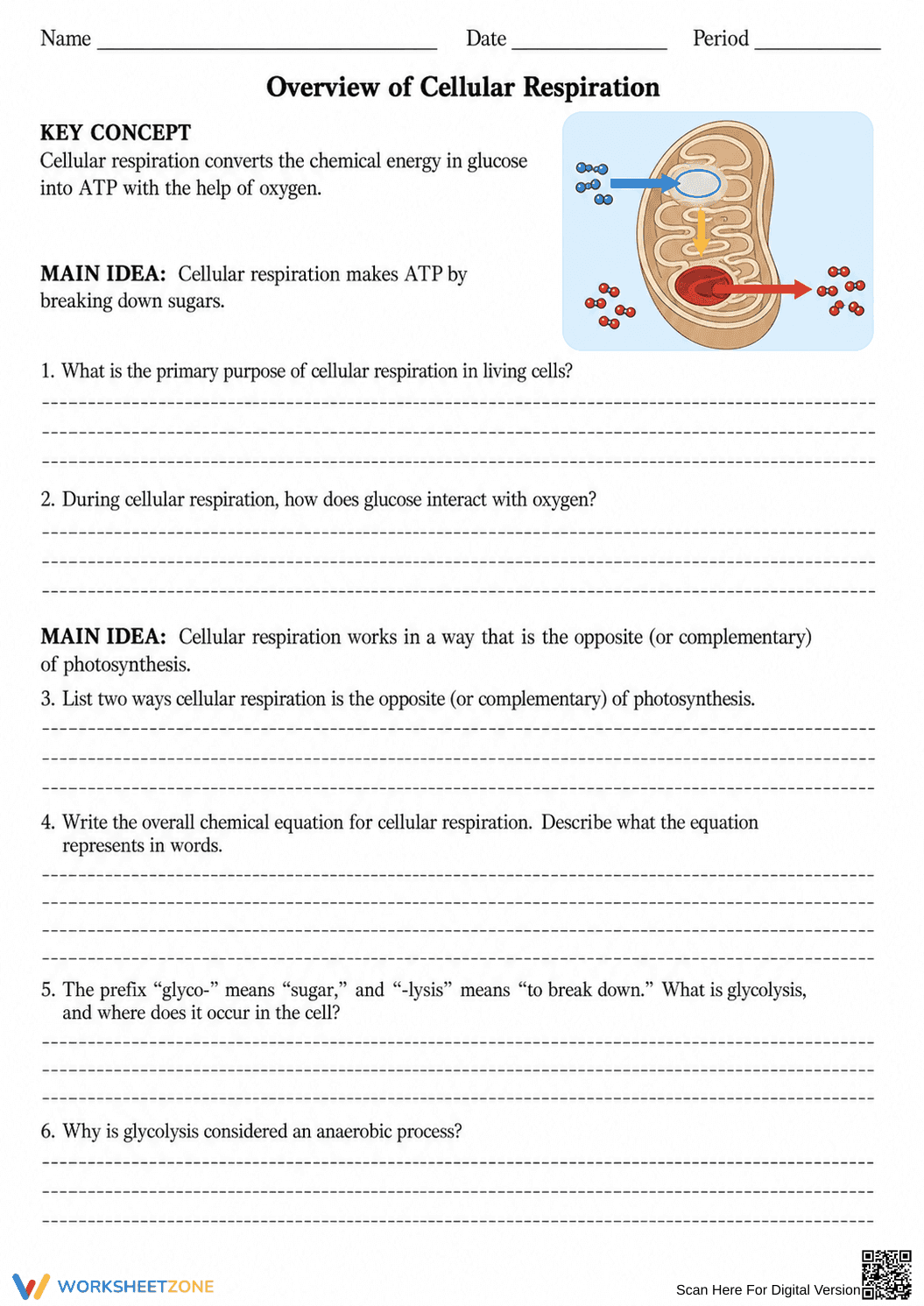
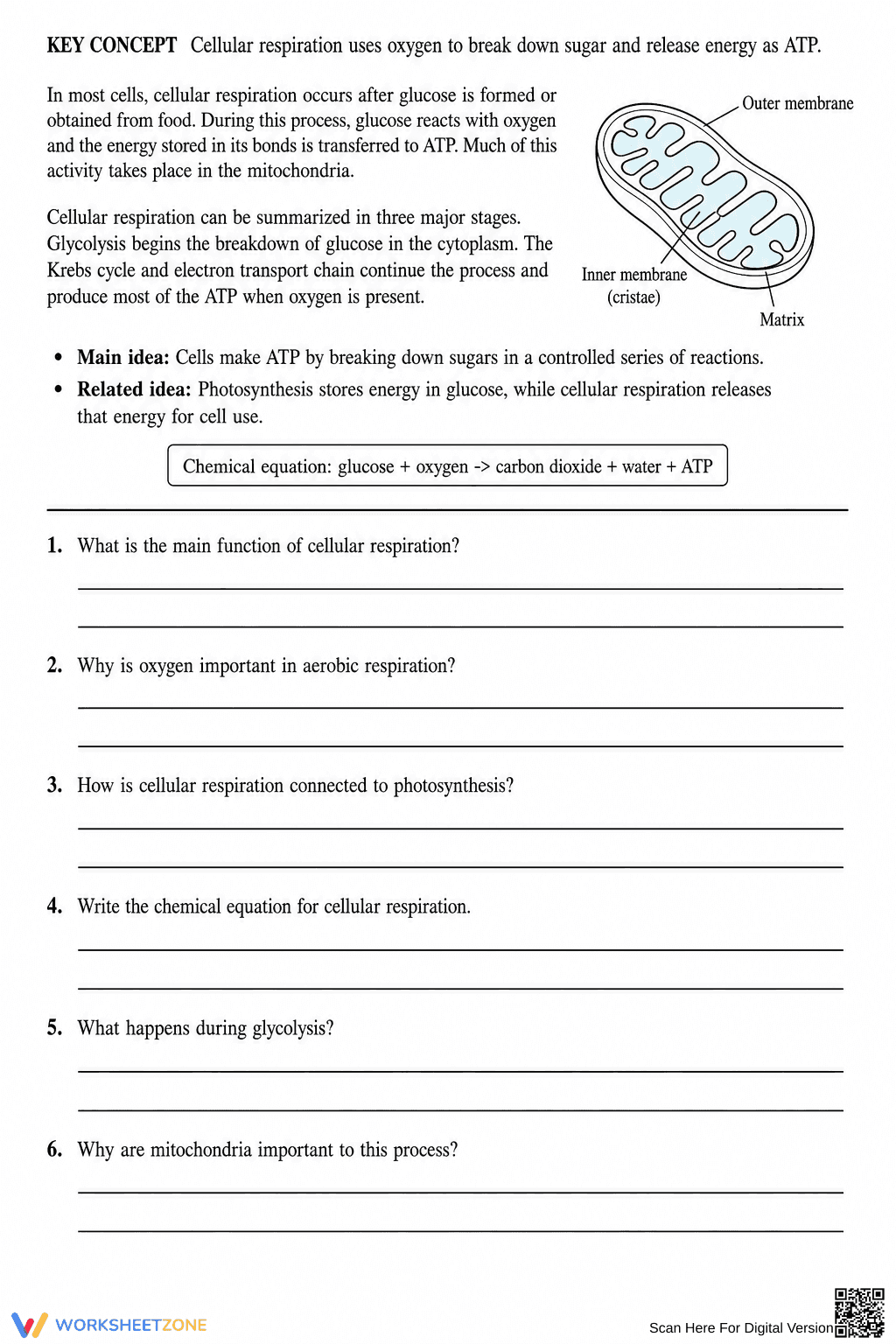

Printable Cellular Respiration Worksheet | Grade 9 Biology
Paste this activity's link or code into your existing LMS (Google Classroom, Canvas, Teams, Schoology, Moodle, etc.).
Students can open and work on the activity right away, with no student login required.
You'll still be able to track student progress and results from your teacher account.
This comprehensive biology worksheet helps students master the fundamentals of cellular respiration and ATP production. By analyzing key concepts and diagrams, learners will successfully identify how cells convert glucose and oxygen into usable energy, reinforcing their understanding of essential life processes.
At a Glance
- Grade: 9 · Subject: Biology
- Standard:
HS-LS1-7— Illustrate cellular respiration and energy transfer- Skill Focus: Cellular Respiration & ATP Production
- Format: 2 pages · 12 problems · Answer key included · PDF
- Best For: Independent practice or review
- Time: 20–30 minutes
This resource features two structured pages containing informative reading blocks, detailed mitochondrion diagrams, and 12 short-answer questions. Students will encounter a mix of recall and application tasks, including writing the chemical equation for respiration and comparing the process to photosynthesis. A complete answer key is provided to ensure accurate grading and immediate feedback.
- Guided practice: The first section introduces the key concept of ATP production alongside a visual model, offering immediate context for the initial 4 questions.
- Supported practice: Students transition to analyzing the relationship between photosynthesis and respiration, using the provided text to support their reasoning across 4 intermediate tasks.
- Independent practice: The final 4 questions challenge learners to define glycolysis, explain anaerobic processes, and synthesize the overall chemical equation without direct prompts.
This gradual-release approach ensures students build confidence as they move from basic comprehension to deeper scientific application.
This material is aligned to HS-LS1-7: Use a model to illustrate that cellular respiration is a chemical process whereby the bonds of food molecules and oxygen molecules are broken and the bonds in new compounds are formed resulting in a net transfer of energy. Both standard codes can be copied directly into lesson plans, IEP goals, or district curriculum mapping tools.
Deploy this worksheet during direct instruction as a guided notes companion, or assign it as an independent review activity after introducing cellular metabolism. As a formative assessment tip, review student responses to the chemical equation question to quickly identify misconceptions about reactants and products. Expect students to complete the full two-page set in 20 to 30 minutes.
Designed primarily for high school biology students, this resource is highly effective for general education classrooms and inclusion settings. The built-in reading passages provide excellent scaffolding for struggling readers or English Language Learners. Pair this activity with a hands-on lab or an anchor chart detailing the carbon cycle for maximum impact.
Mastering the mechanics of energy transfer is a critical milestone in secondary science education. Aligned with HS-LS1-7, this resource helps students illustrate cellular respiration and energy transfer through structured, text-supported inquiry. According to EdReports 2024, high-quality instructional materials that integrate visual models with targeted questioning significantly improve student retention of complex biological processes. By requiring learners to actively engage with diagrams of mitochondria and write out chemical equations, this worksheet bridges the gap between abstract concepts and concrete understanding. Regular practice with these foundational life science principles ensures students are better prepared for advanced coursework and standardized assessments. Educators can rely on this evidence-based format to deliver rigorous, standards-aligned content that supports diverse learning needs while maintaining high academic expectations.


