


























Views
Downloads
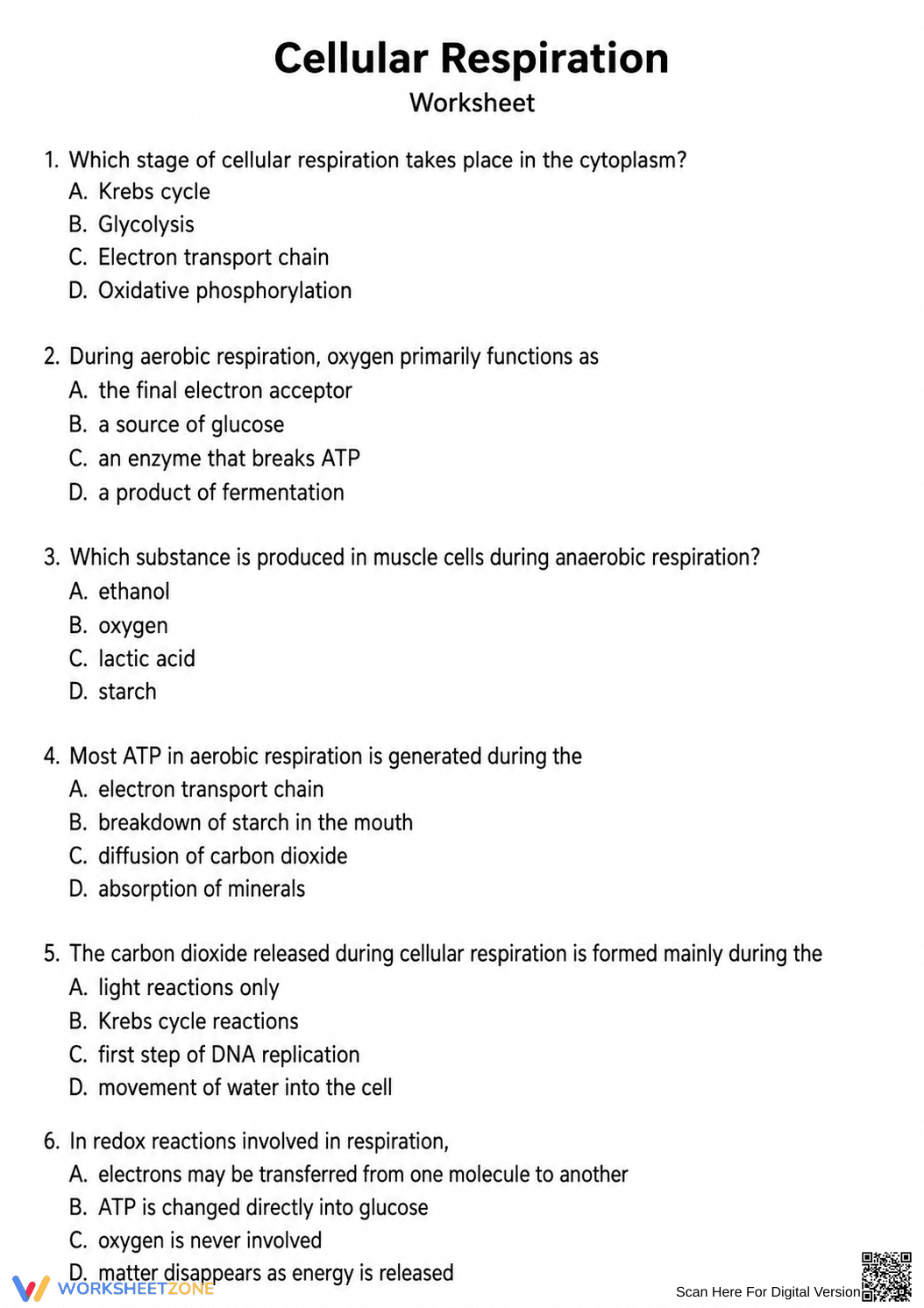
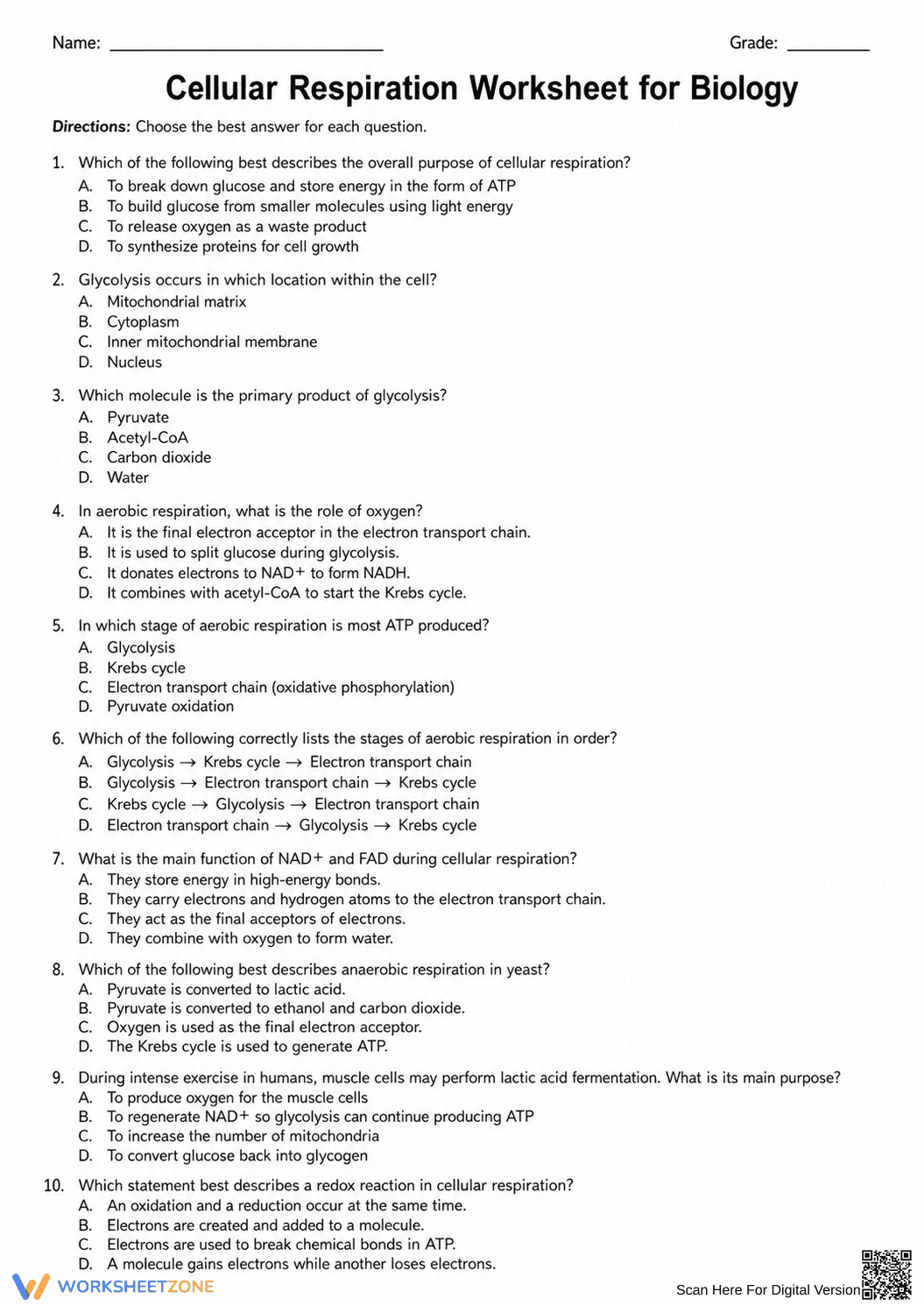

HS Cellular Respiration — Printable No-Prep Worksheet
Paste this activity's link or code into your existing LMS (Google Classroom, Canvas, Teams, Schoology, Moodle, etc.).
Students can open and work on the activity right away, with no student login required.
You'll still be able to track student progress and results from your teacher account.
This high school biology worksheet provides focused practice on the mechanics of cellular respiration, helping students solidify their understanding of how cells harvest energy. By evaluating multiple-choice scenarios, learners will demonstrate their grasp of aerobic and anaerobic processes, ATP generation, and the specific stages of respiration.
At a Glance
- Grade: High School · Subject: Biology
- Standard:
HS-LS1-7— Illustrate the chemical process of cellular respiration and energy transfer.- Skill Focus: Cellular respiration and ATP production
- Format: 2 pages · 16 problems · Answer key included · PDF
- Best For: Formative assessment or independent review
- Time: 20–30 minutes
This resource features two pages of targeted multiple-choice questions covering the essential components of cellular respiration. Students will navigate 16 distinct problems that test their knowledge of glycolysis, the Krebs cycle, the electron transport chain, and fermentation. The straightforward format eliminates confusion, while the included full answer key ensures accurate and efficient grading for educators.
Designed for immediate classroom implementation, this worksheet requires virtually zero teacher preparation:
- Print (1 min): Download the PDF and print the two-page handout.
- Distribute (1 min): Hand out the assignment as a warm-up or review activity.
- Review (5 mins): Use the provided answer key to quickly check comprehension.
With a total prep time of under two minutes, this resource is an ideal addition to any biology unit and serves as a highly effective emergency sub plan.
This worksheet is aligned to the Next Generation Science Standard HS-LS1-7: Use a model to illustrate that cellular respiration is a chemical process whereby the bonds of food molecules and oxygen molecules are broken and the bonds in new compounds are formed resulting in a net transfer of energy. Both standard codes can be copied directly into lesson plans, IEP goals, or district curriculum mapping tools.
Deploy this worksheet after direct instruction on the stages of cellular respiration to reinforce new vocabulary and concepts. Alternatively, use it as a pre-test before a major unit exam to identify knowledge gaps regarding aerobic versus anaerobic respiration. As a formative assessment tip, monitor which specific questions students struggle with—such as the role of oxygen as the final electron acceptor—to guide subsequent review sessions. Students should be able to complete the 16 questions within a 20 to 30-minute timeframe.
This resource is designed for high school biology students who need structured, straightforward practice with cellular energy concepts. It is easily accessible for on-level learners while serving as a reliable review for advanced students preparing for standardized testing. Pair this worksheet with a visual anchor chart detailing the mitochondria and the specific inputs and outputs of glycolysis, the Krebs cycle, and the electron transport chain to maximize student retention.
Aligning instructional materials with rigorous science standards like HS-LS1-7 ensures that students can accurately illustrate the chemical process of cellular respiration and energy transfer. According to EdReports 2024, providing students with clear, targeted practice opportunities significantly enhances their ability to retain complex biological pathways and vocabulary. This worksheet supports that pedagogical framework by offering direct assessment that isolates specific mechanisms of energy production, such as ATP synthesis and redox reactions. By integrating these focused problem sets into regular classroom routines, educators can systematically build student confidence and scientific literacy. Regular formative assessment through structured questioning allows teachers to quickly identify misconceptions about cellular processes and adjust their instruction accordingly, ultimately leading to deeper conceptual understanding and improved academic outcomes in high school science curricula.


