


























Views
Downloads

Essential Diploid and Haploid Worksheet | Grade 9-12 Biology
Paste this activity's link or code into your existing LMS (Google Classroom, Canvas, Teams, Schoology, Moodle, etc.).
Students can open and work on the activity right away, with no student login required.
You'll still be able to track student progress and results from your teacher account.
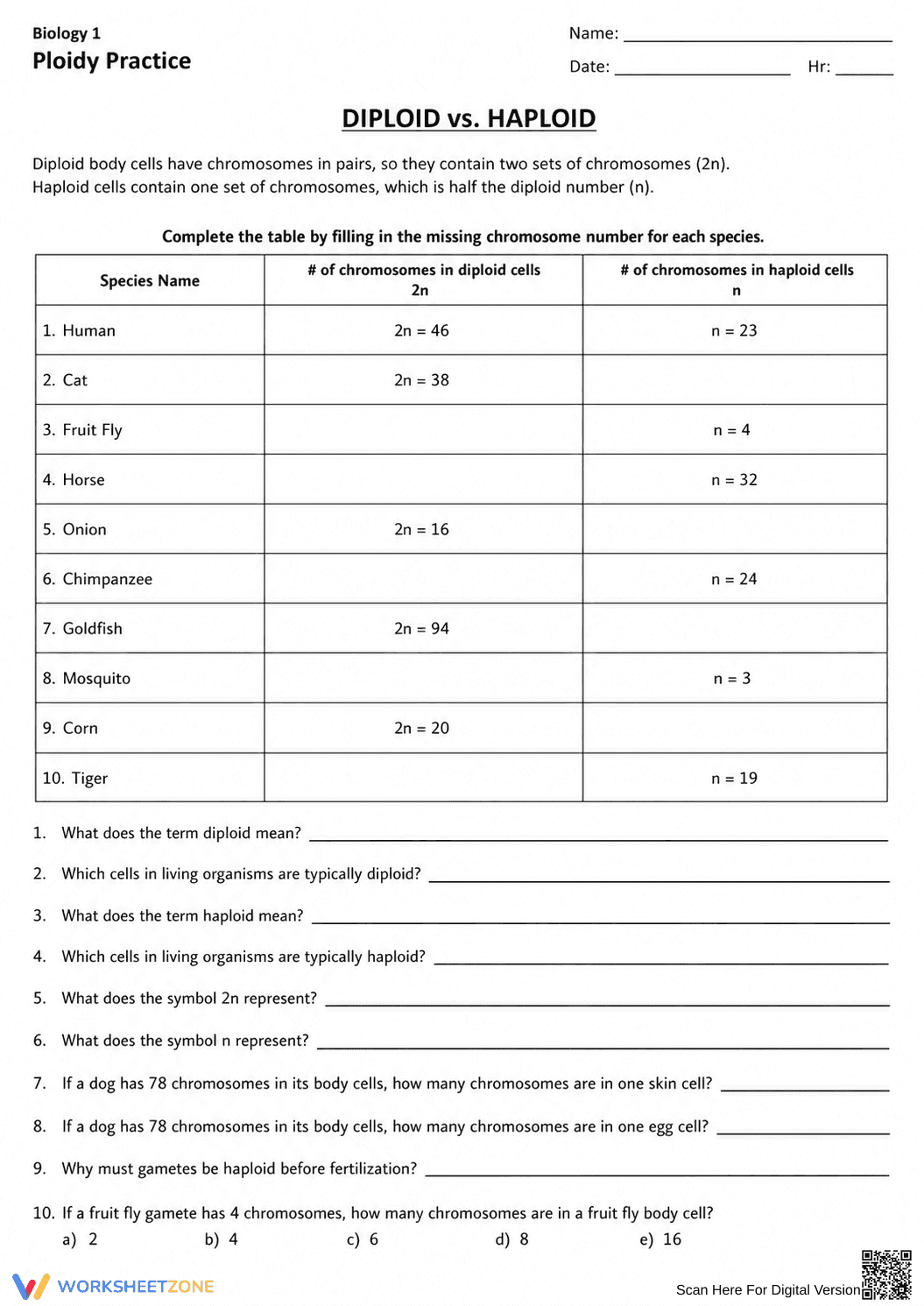
This comprehensive biology worksheet helps high school students master the relationship between diploid (2n) and haploid (n) chromosome numbers. By calculating ploidy across various species and analyzing real-world karyotypes, learners build a concrete understanding of cellular genetics and inheritance patterns. It is an ideal resource for reinforcing meiosis and mitosis concepts through active problem-solving.
At a Glance
- Grade: 9-12 · Subject: Biology
- Standard:
HS-LS3-1— Clarify relationships between DNA, chromosomes, and inherited traits in offspring- Skill Focus: Ploidy calculations and karyotype analysis
- Format: 2 pages · 31 problems · No-prep · PDF
- Best For: Independent practice or sub plans
- Time: 30–45 minutes
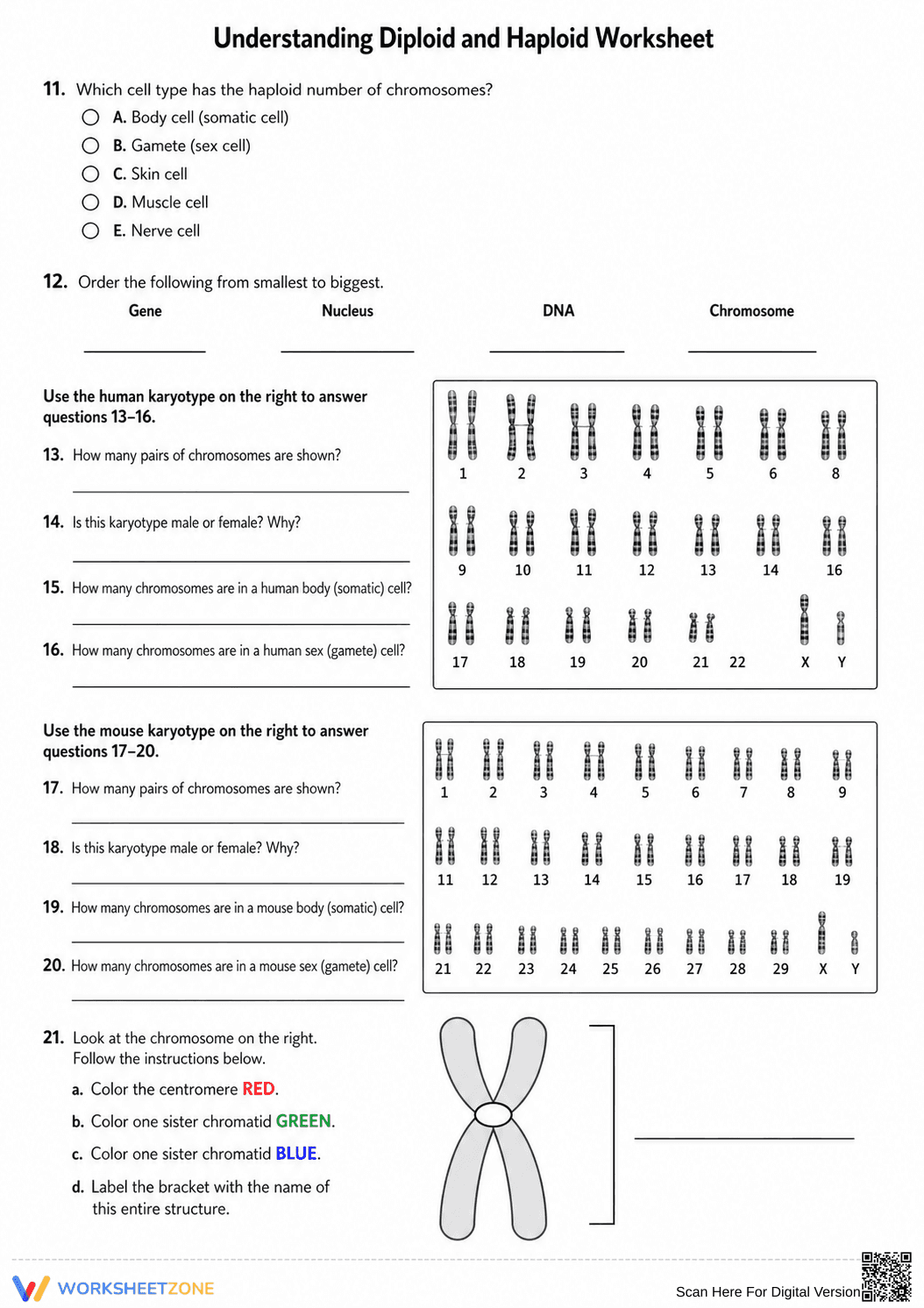
The two-page PDF features a structured data table for 10 different species, requiring students to toggle between somatic and gametic chromosome counts. The second page introduces visual literacy through human and mouse karyotypes, alongside a diagram for labeling chromosome anatomy, including centromeres and sister chromatids. The layout uses clear headers and ample writing space for student responses.
This resource is designed for immediate classroom implementation. Teachers can print the double-sided document in under 1 minute, distribute it to students for a 35-minute independent work session, and review the quantitative table as a whole-class check in the final 5 minutes. It serves as a reliable, self-contained sub plan that requires no prior setup or specialized lab equipment.
This worksheet aligns with `HS-LS3-1`, focusing on the physical structure of chromosomes and their role in heredity. It also supports CCSS.ELA-LITERACY.RST.9-10.7 by requiring students to translate quantitative data from tables and visual karyotypes into written conclusions. Both standard codes can be copied directly into lesson plans, IEP goals, or district curriculum mapping tools.
Assign this worksheet immediately following a lecture on meiosis to provide immediate formative feedback on student understanding of ploidy. During the activity, circulate to observe if students correctly identify the sex of the organisms in the karyotype section; this serves as a quick check for their ability to distinguish between autosomes and sex chromosomes. Expected completion time is 30 to 45 minutes.
This practice set is tailored for general biology students in grades 9 through 12, as well as AP Biology students needing a quick refresher on chromosomal math. It pairs naturally with a unit on the cell cycle or a direct instruction lesson on Mendelian genetics to bridge the gap between abstract numbers and visual evidence.
According to the RAND AIRS 2024 report on secondary science instruction, high-quality visual aids like karyotypes significantly improve student retention of abstract genetic concepts. This worksheet addresses the HS-LS3-1 standard by requiring students to perform ploidy calculations and identify chromosomal structures, which are foundational skills for understanding inheritance. Research from Fisher & Frey (2014) emphasizes that structured practice with quantitative biological data helps bridge the gap between rote memorization and conceptual mastery. By engaging with 31 distinct tasks ranging from simple math to complex visual analysis, students develop the scientific literacy necessary for advanced genetics coursework. This resource provides the rigorous, standards-aligned practice required for college and career readiness in the life sciences, ensuring students can accurately interpret the chromosomal basis of heredity.


