


























Views
Downloads

Ploidy Worksheet | Essential Grade 9-12 Biology
Paste this activity's link or code into your existing LMS (Google Classroom, Canvas, Teams, Schoology, Moodle, etc.).
Students can open and work on the activity right away, with no student login required.
You'll still be able to track student progress and results from your teacher account.
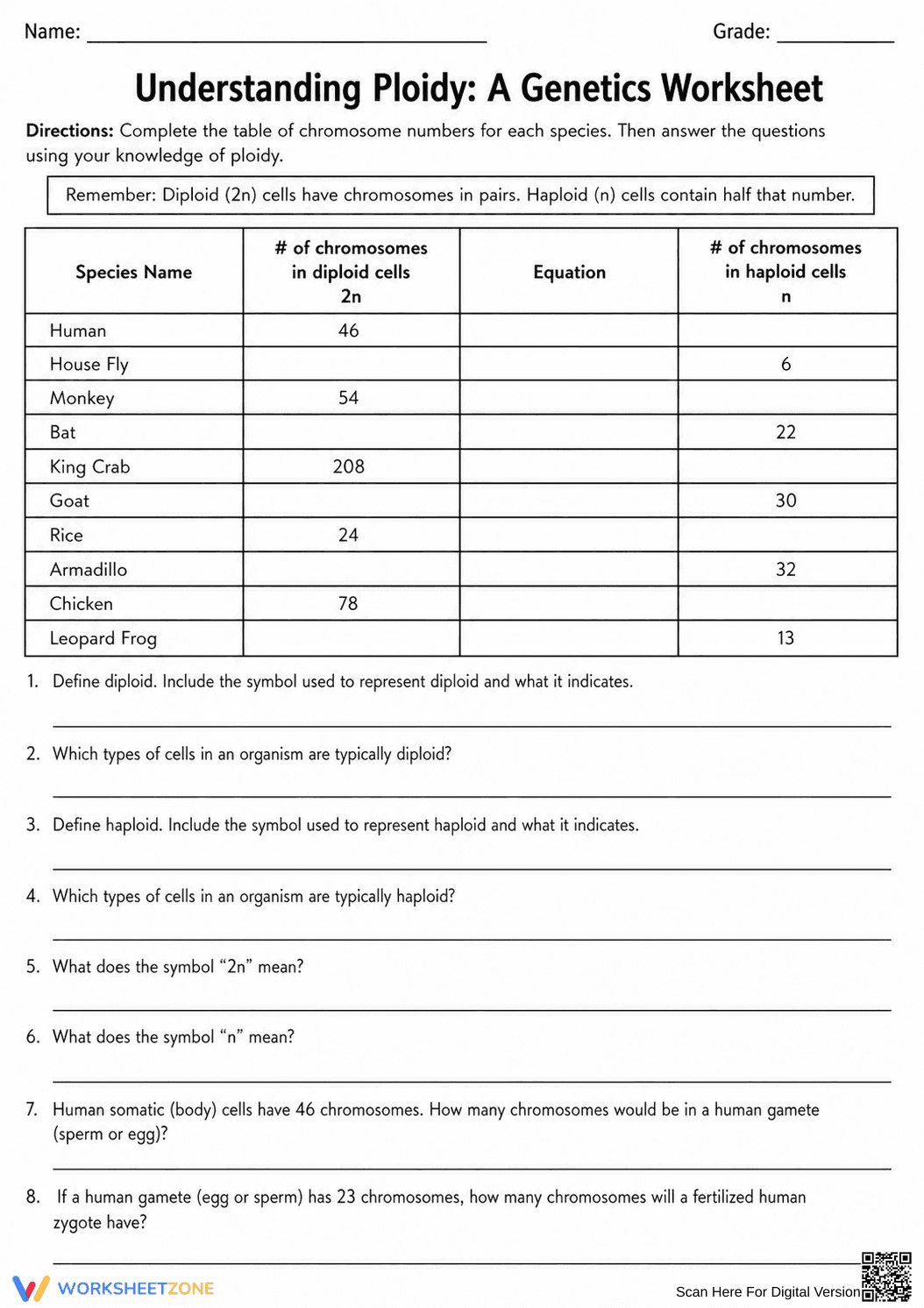
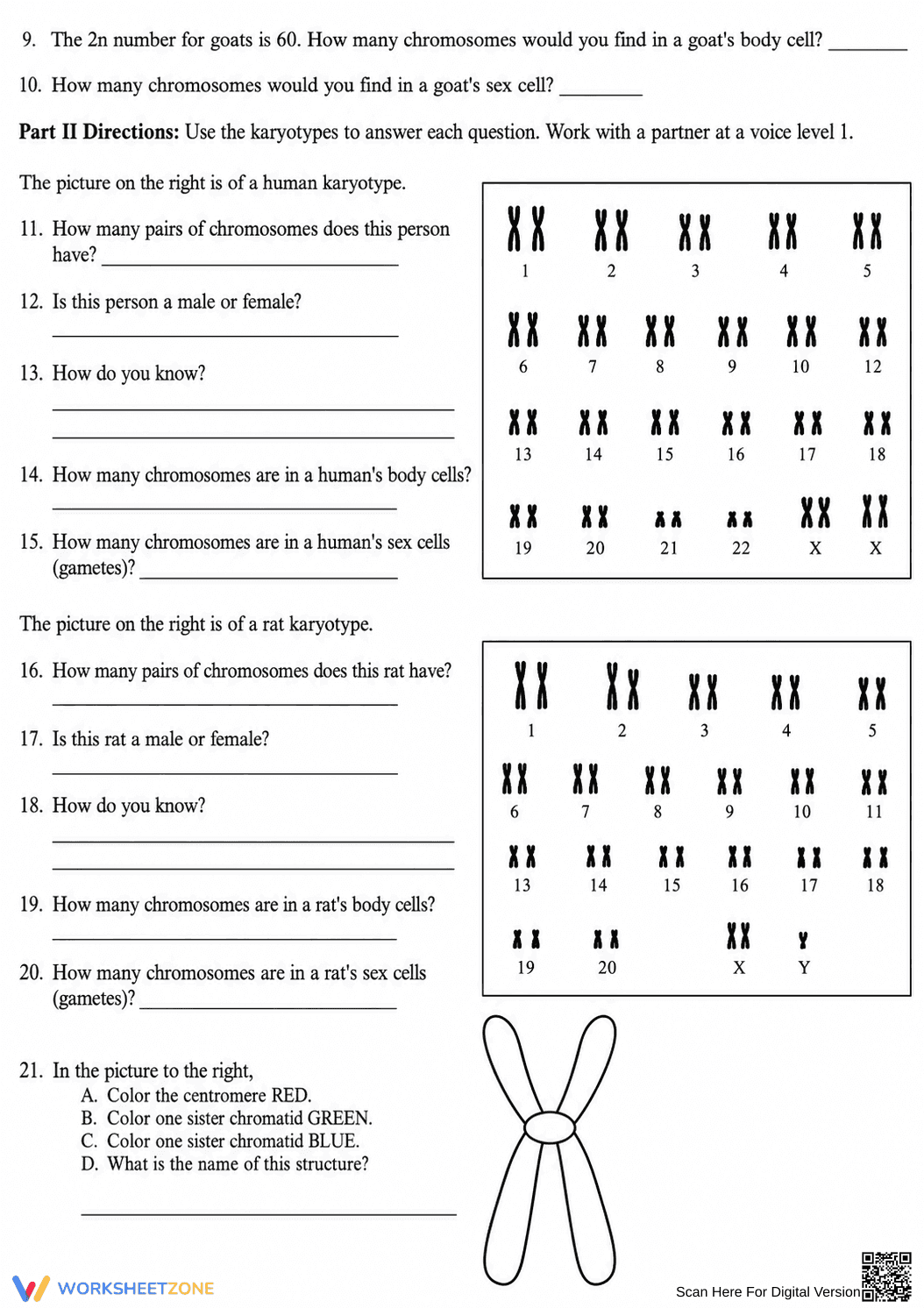
This Grade 9-12 biology worksheet provides a comprehensive review of ploidy, helping students master the relationship between haploid (n) and diploid (2n) chromosome numbers. Students will calculate genetic data across various species and analyze karyotypes to identify biological sex and chromosomal pairings. It ensures a solid foundation for genetics and meiosis units.
At a Glance
- Grade: 9-12 · Subject: Biology
- Standard:
HS-LS3-1— Clarify relationships between chromosomes and the inheritance of characteristic traits- Skill Focus: Ploidy calculations and karyotype analysis
- Format: 2 pages · 31 problems · Answer key included · PDF
- Best For: Genetics unit practice or formative assessment
- Time: 30–45 minutes
The 2-page PDF features a structured species comparison table where students solve for 2n or n values using algebraic equations. It includes 21 targeted questions ranging from basic definitions to complex karyotype interpretation. Visual aids include human and rat karyotypes for comparative analysis and a chromosome diagram for structural labeling and coloring.
This resource is designed for immediate classroom implementation with a total teacher prep time of under 2 minutes. Simply print the double-sided document and distribute. The "Voice Level 1" partner instruction allows for collaborative learning without additional management setup. It serves as an ideal sub plan or independent practice during meiosis and mitosis rotations.
Primary standard HS-LS3-1: "Ask questions to clarify relationships about the role of DNA and chromosomes in coding the instructions for characteristic traits passed from parents to offspring." This worksheet supports the understanding of how chromosome sets are maintained and divided. Both standard codes can be copied directly into lesson plans, IEP goals, or district curriculum mapping tools.
Use this worksheet as a mid-unit check after introducing the concepts of somatic cells and gametes. It works effectively as a guided practice activity where the teacher models the first three species calculations before students work independently. Observe student work on the karyotype section to identify misconceptions regarding homologous pairs and sex determination.
This resource is tailored for high school biology students, including those in Honors or AP tracks requiring a refresher on genetic math. It provides necessary scaffolding for English Language Learners through clear symbols (n/2n) and visual karyotypes. Pair this with a digital karyotyping simulation or a meiosis anchor chart for a complete instructional cycle.
According to the RAND AIRS 2024 report on secondary science instruction, structured practice in quantitative genetics significantly improves student retention of complex biological concepts. This worksheet addresses the specific cognitive demand of HS-LS3-1 by requiring students to translate between symbolic representations (n and 2n) and physical chromosome counts across diverse biological models. By integrating karyotype analysis with mathematical calculation, the resource aligns with Fisher & Frey’s (2014) gradual release of responsibility framework, moving students from basic recall to evidence-based interpretation. The inclusion of 31 distinct tasks ensures sufficient repetition for mastery while the comparative species data encourages students to view ploidy as a universal biological principle rather than a human-centric fact. This evidence-based approach supports high-stakes testing preparation and long-term scientific literacy in high school learners.


