


























Views
Downloads

Essential Diploid vs Haploid Worksheet | Grade 9-12
Paste this activity's link or code into your existing LMS (Google Classroom, Canvas, Teams, Schoology, Moodle, etc.).
Students can open and work on the activity right away, with no student login required.
You'll still be able to track student progress and results from your teacher account.
This high school biology worksheet clarifies the fundamental differences between haploid (n) and diploid (2n) cells within complex life cycles. Students analyze biological diagrams to identify where meiosis and mitosis occur, ensuring they can accurately calculate chromosome numbers across different reproductive stages. It provides a clear visual framework for understanding genetic inheritance and cellular division.
At a Glance
- Grade: 9-12 · Subject: Biology
- Standard:
HS-LS3-2— Explain the role of meiosis in maintaining chromosome counts and creating genetic variation- Skill Focus: Diploid vs Haploid Identification
- Format: 1 page · 12 problems · Answer key included · PDF
- Best For: Reinforcing cellular division and life cycles
- Time: 20–30 minutes
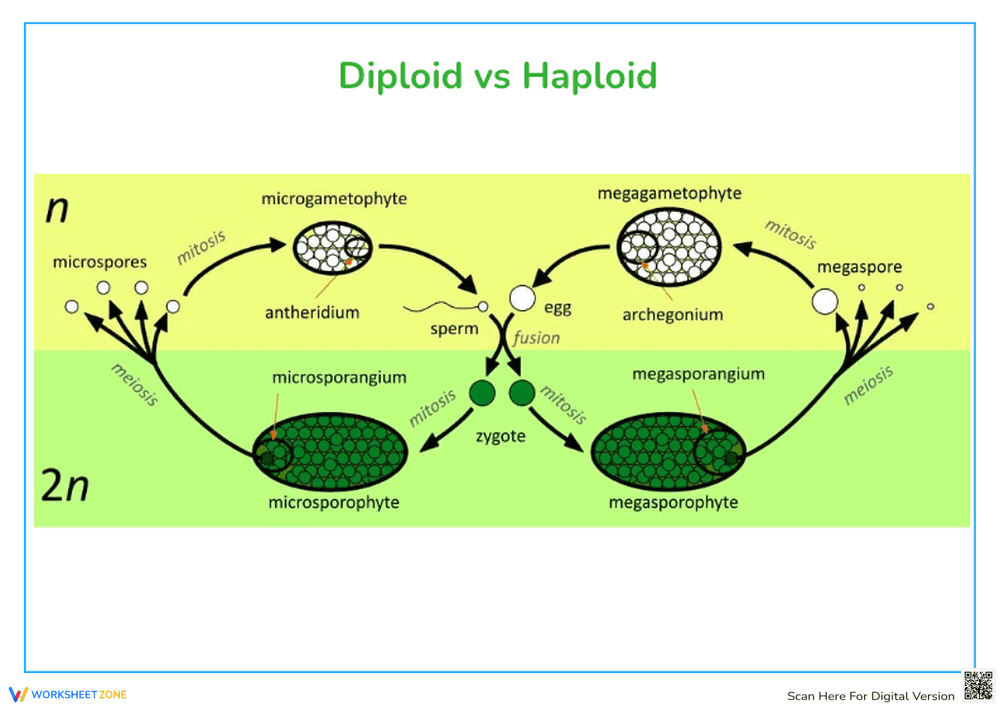
The resource features a detailed anatomical diagram of a plant life cycle, illustrating the transition between the gametophyte and sporophyte generations. It includes 12 targeted questions that require students to label phases as n or 2n, identify the specific processes of fusion and meiosis, and calculate hypothetical chromosome counts. A full answer key is provided for quick grading and immediate student feedback.
The worksheet follows a structured pedagogical path. It begins with guided identification, where students label the n and 2n sections of a provided diagram. Next, supported practice tasks ask students to define the relationship between sperm, egg, and zygote formation. Finally, independent practice requires students to apply these concepts to new scenarios, calculating chromosome numbers for various species. This gradual release model ensures students move from recognition to application.
This worksheet aligns with HS-LS3-2, which requires students to make and defend a claim based on evidence that inheritable genetic variations may result from new genetic combinations through meiosis. It also supports HS-LS1-4 by examining how mitosis and differentiation produce and maintain a complex organism. Both standard codes can be copied directly into lesson plans, IEP goals, or district curriculum mapping tools.
Use this worksheet as a mid-unit check for understanding after introducing the stages of meiosis. It serves as an excellent formative assessment tool; observe if students struggle to identify the fusion point as the transition to diploidy. Expect students to complete the analysis in approximately 25 minutes during an independent work block or as a homework assignment to reinforce classroom lectures.
This resource is designed for high school biology students, including those in AP Biology or honors tracks who need a refresher on alternation of generations. It pairs naturally with a lecture on reproductive strategies or a laboratory investigation involving microscope slides of onion root tips or lily anthers. The visual nature of the diagram supports English Language Learners and visual learners alike.
According to the EdReports 2024 analysis of high school science curricula, visual literacy in cellular biology is a critical predictor of success in advanced genetics. This worksheet addresses that need by requiring students to interpret complex life cycle diagrams, a skill directly aligned with the HS-LS3-2 standard. By distinguishing between haploid and diploid states, students build the conceptual foundation necessary to understand how meiosis maintains species-specific chromosome counts across generations. Research from Fisher & Frey (2014) emphasizes that scaffolded diagram analysis helps bridge the gap between abstract genetic theory and observable biological processes. This resource provides exactly that bridge, offering 12 structured tasks that move from simple identification to complex calculation. It ensures that learners can explain the student action of identifying chromosome state transitions during gametogenesis and fertilization. This focused practice is essential for mastering the mechanics of inheritance and the broader implications of genetic diversity in biological populations.


