


























Views
Downloads

Haploid and Diploid Worksheet | Grade 9-12 Essential
Paste this activity's link or code into your existing LMS (Google Classroom, Canvas, Teams, Schoology, Moodle, etc.).
Students can open and work on the activity right away, with no student login required.
You'll still be able to track student progress and results from your teacher account.
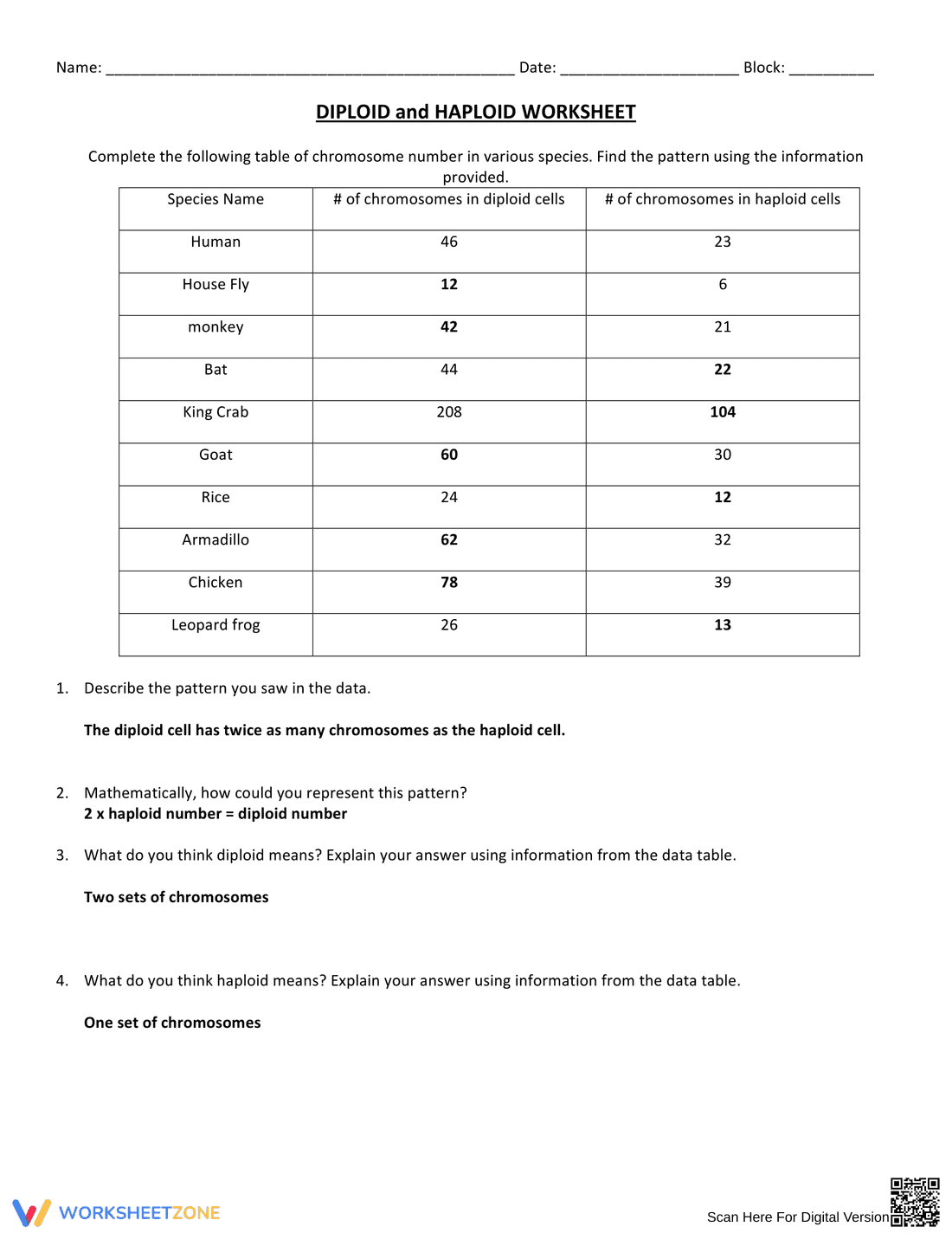
This high school biology worksheet provides targeted practice on calculating haploid and diploid chromosome numbers. Students analyze data tables, define key terms, and interpret karyotypes to understand somatic cells versus gametes. This builds foundational knowledge for advanced genetics.
At a Glance
- Grade: 9-12 · Subject: Biology
- Standard:
HS-LS3-2— Understand genetic variation and chromosome counts in meiosis.- Skill Focus: Calculating haploid and diploid numbers
- Format: 2 pages · 21 problems · Answer key included · PDF
- Best For: Guided practice and independent review
- Time: 25–35 minutes
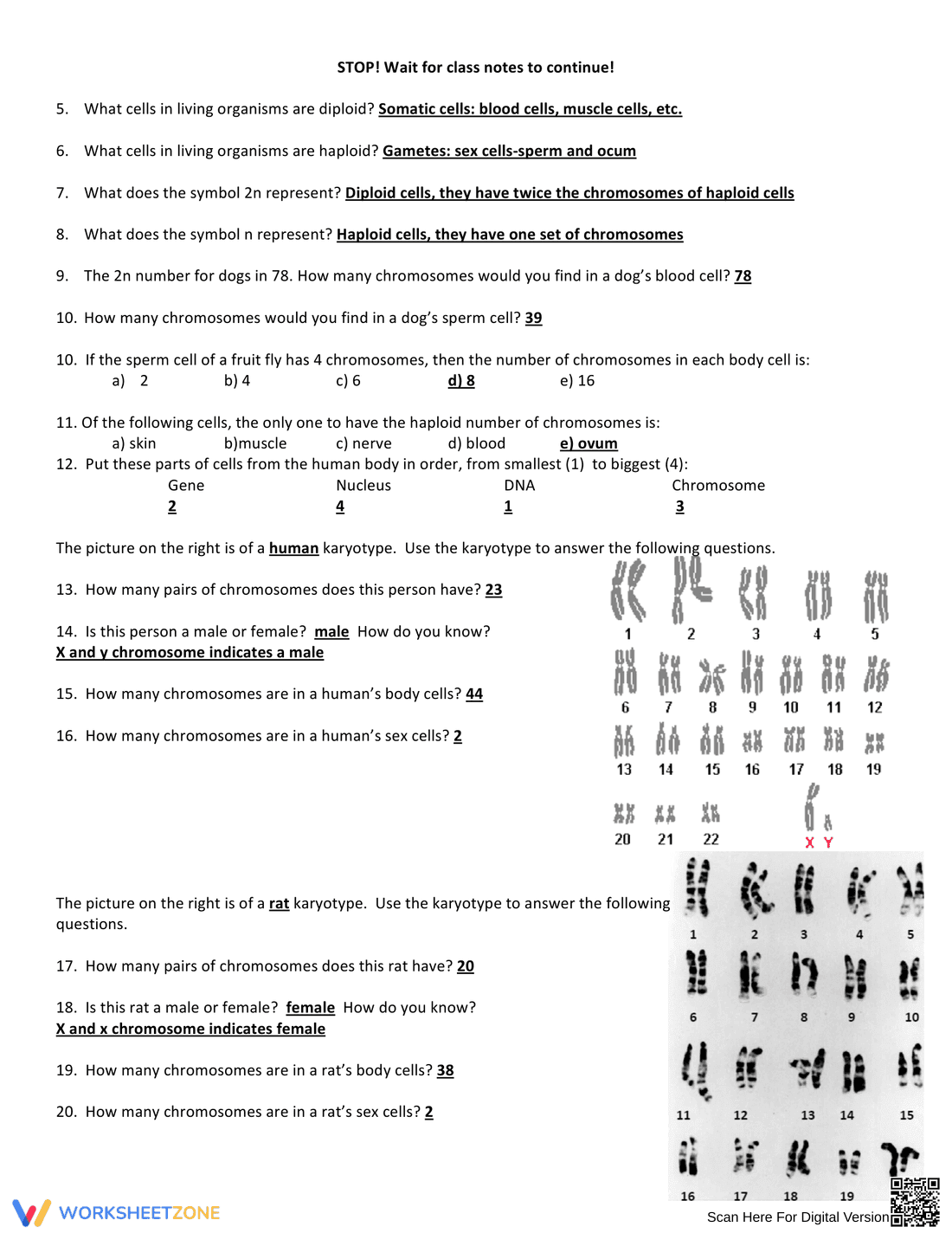
This two-page printable includes 21 tasks to reinforce chromosome concepts. It features a pattern-recognition table comparing species, short-answer questions, and multiple-choice problems. The second page includes human and rat karyotype analysis sections where students determine sex and chromosome counts. A complete answer key is provided.
- Guided practice: Students complete a data table to discover the mathematical relationship between diploid (2n) and haploid (n) numbers.
- Supported practice: Learners define somatic cells and gametes while applying formulas to specific examples.
- Independent practice: Students analyze real karyotypes to identify homologous pairs, determine sex, and calculate total chromosomes.
This gradual-release approach builds confidence before tackling complex visual data.
Aligned to HS-LS3-2: Make and defend a claim based on evidence that inheritable genetic variations result from new genetic combinations through meiosis. Mastering these calculations builds the foundation to understand how meiosis halves chromosome numbers. Both standard codes can be copied directly into lesson plans, IEP goals, or district curriculum mapping tools.
Use the first page as an introductory activity before direct instruction, allowing students to discover the 2n/n pattern organically. The second page serves as an excellent post-lecture application. As a formative assessment tip, monitor students analyzing karyotypes; confusion between total chromosomes and pairs indicates a need for reteaching. Expect completion to take 25 to 35 minutes.
Designed for 9th-12th grade biology students. It naturally differentiates by starting with simple math patterns before moving to abstract concepts. Pair this worksheet with a visual anchor chart illustrating mitosis versus meiosis for students needing extra support.
Mastering the distinction between somatic and sex cells is a critical threshold concept in secondary life sciences. This resource aligns with HS-LS3-2, focusing on the ability to understand genetic variation and chromosome counts in meiosis. According to a ScienceDirect TpT Analysis, structured practice that combines mathematical pattern recognition with visual data interpretation—such as karyotype analysis—significantly improves student retention of abstract genetic mechanisms. By explicitly connecting the mathematical formulas of 2n and n to physical representations of chromosomes, educators can reduce cognitive overload and correct common misconceptions early in the instructional sequence. This targeted approach ensures learners are adequately prepared for more complex topics like Mendelian genetics, Punnett squares, and chromosomal mutations, ultimately fostering deeper scientific literacy and analytical reasoning skills in the high school biology classroom.


