


























Views
Downloads


Essential Chromosome Worksheet | Grade 9-12 Biology
Paste this activity's link or code into your existing LMS (Google Classroom, Canvas, Teams, Schoology, Moodle, etc.).
Students can open and work on the activity right away, with no student login required.
You'll still be able to track student progress and results from your teacher account.
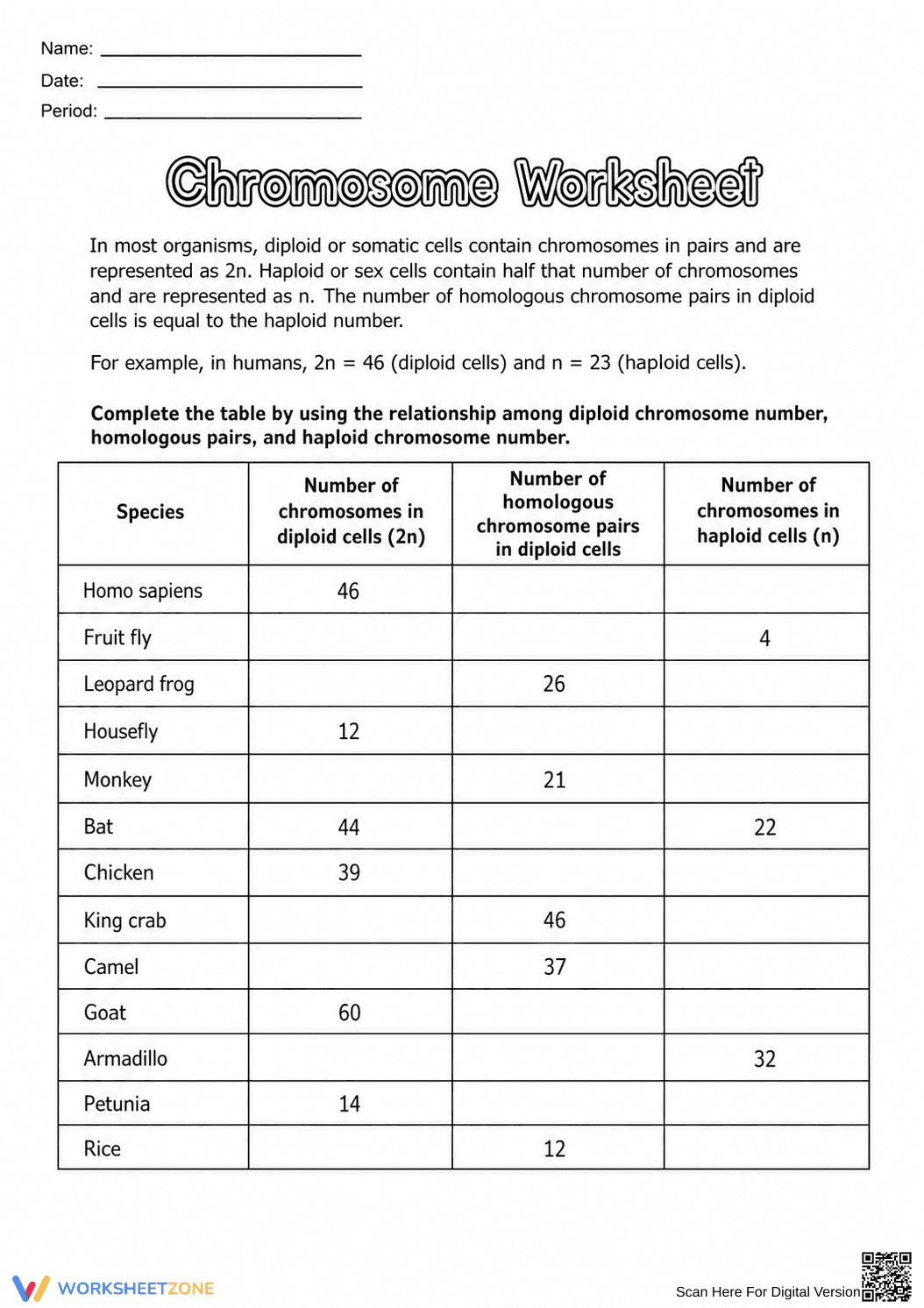
This Grade 9-12 biology worksheet provides targeted practice for calculating haploid (n) and diploid (2n) chromosome numbers. Students analyze various species to determine homologous pairs and total chromosome counts, ensuring a firm grasp of cellular genetics before moving to meiosis. It transforms abstract genetic concepts into concrete mathematical relationships for high school learners.
At a Glance
- Grade: 9-12 · Subject: Biology
- Standard:
HS-LS3-2— Identify how inheritable genetic variations result from meiosis and chromosomal reduction- Skill Focus: Haploid and Diploid Calculations
- Format: 2 pages · 21 problems · Answer key included · PDF
- Best For: High school genetics and meiosis units
- Time: 25–35 minutes
This 2-page PDF features a comprehensive data table covering 13 different species, from Homo sapiens to the King Crab. Students must fill in missing values for diploid numbers, homologous pairs, and haploid counts. The second page includes 8 critical thinking questions and a karyotype identification task to verify gender based on sex chromosomes, providing a complete overview of chromosomal structure.
Skill Progression
- Guided practice: The worksheet begins with a clear definition of 2n and n, using humans as a worked example to establish the mathematical ratio.
- Supported practice: A 13-row table provides varying starting points (some give n, some give 2n), requiring students to apply the division and multiplication rules repeatedly.
- Independent practice: Eight open-ended questions and a karyotype analysis challenge students to apply their knowledge to new organisms like turkeys and onions without scaffolding.
Standards Alignment
This resource aligns with `HS-LS3-2`, which requires students to understand the role of meiosis in genetic variation. By mastering the relationship between somatic cells and gametes, students build the prerequisite knowledge for understanding how chromosome reduction occurs. Both standard codes can be copied directly into lesson plans, IEP goals, or district curriculum mapping tools.
How to Use It
Use this worksheet as a formative assessment immediately following a lecture on mitosis and meiosis. It serves as an excellent bridge to explain why gametes must be haploid. Teachers should circulate during the table-completion phase to identify students struggling with the 2:1 ratio, providing a quick check for understanding before the karyotype analysis. Expected completion time is 30 minutes.
Who It's For
Designed for high school biology students, this resource is ideal for General Biology, Honors, or AP Biology introductory units. It pairs naturally with a karyotype station lab or a digital meiosis simulation to provide a balanced mix of calculation and visual identification for diverse learners.
According to Fisher & Frey (2014), the use of structured data tables and gradual release of responsibility is essential for mastering complex biological nomenclature. This worksheet implements these strategies by requiring students to calculate haploid and diploid numbers (HS-LS3-2) across diverse species. By engaging with 21 distinct tasks, students move beyond rote memorization to a functional understanding of chromosomal relationships. Research from the RAND AIRS 2024 report suggests that high-quality, standards-aligned science materials that integrate mathematical reasoning—such as the 2n vs. n ratio—significantly improve student retention of genetic concepts. This resource provides the necessary repetition for students to internalize the difference between somatic cells and gametes, a foundational requirement for success in advanced life science assessments.


