


























Views
Downloads

Meiosis & Diploid Numbers Printable Worksheet | Grade 9-12
Paste this activity's link or code into your existing LMS (Google Classroom, Canvas, Teams, Schoology, Moodle, etc.).
Students can open and work on the activity right away, with no student login required.
You'll still be able to track student progress and results from your teacher account.
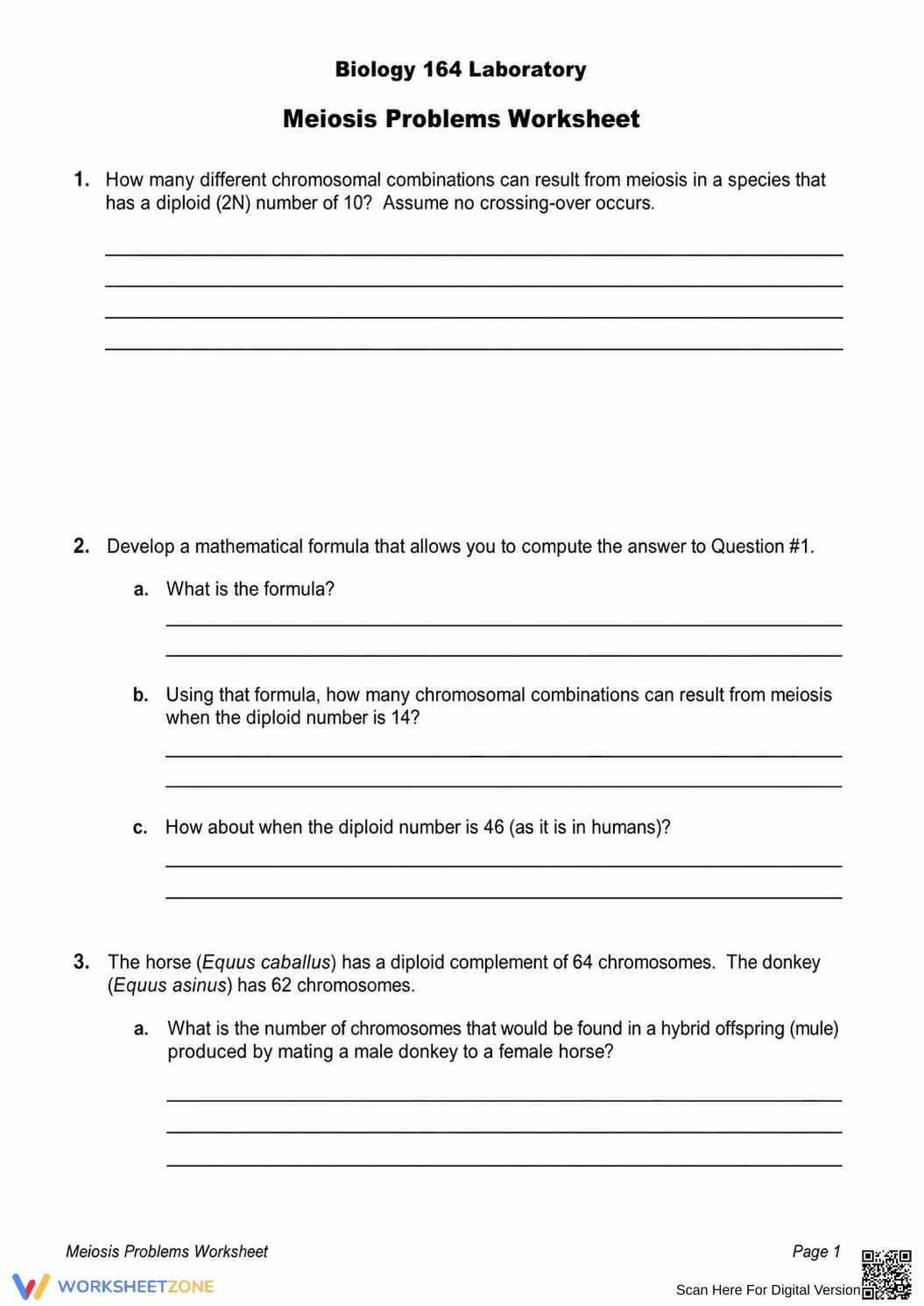
This high school biology worksheet provides focused practice on calculating chromosomal combinations and understanding diploid numbers. Students will apply mathematical formulas to determine genetic variation and visually compare the stages of meiosis and mitosis, solidifying their comprehension of cellular division and genetic inheritance.
At a Glance
- Grade: 9-12 · Subject: Biology
- Standard:
HS-LS3-2— Calculate genetic combinations resulting from meiosis- Skill Focus: Calculating chromosomal combinations
- Format: 2 pages · 4 problems · Answer key included · PDF
- Best For: Independent practice or homework
- Time: 20–30 minutes
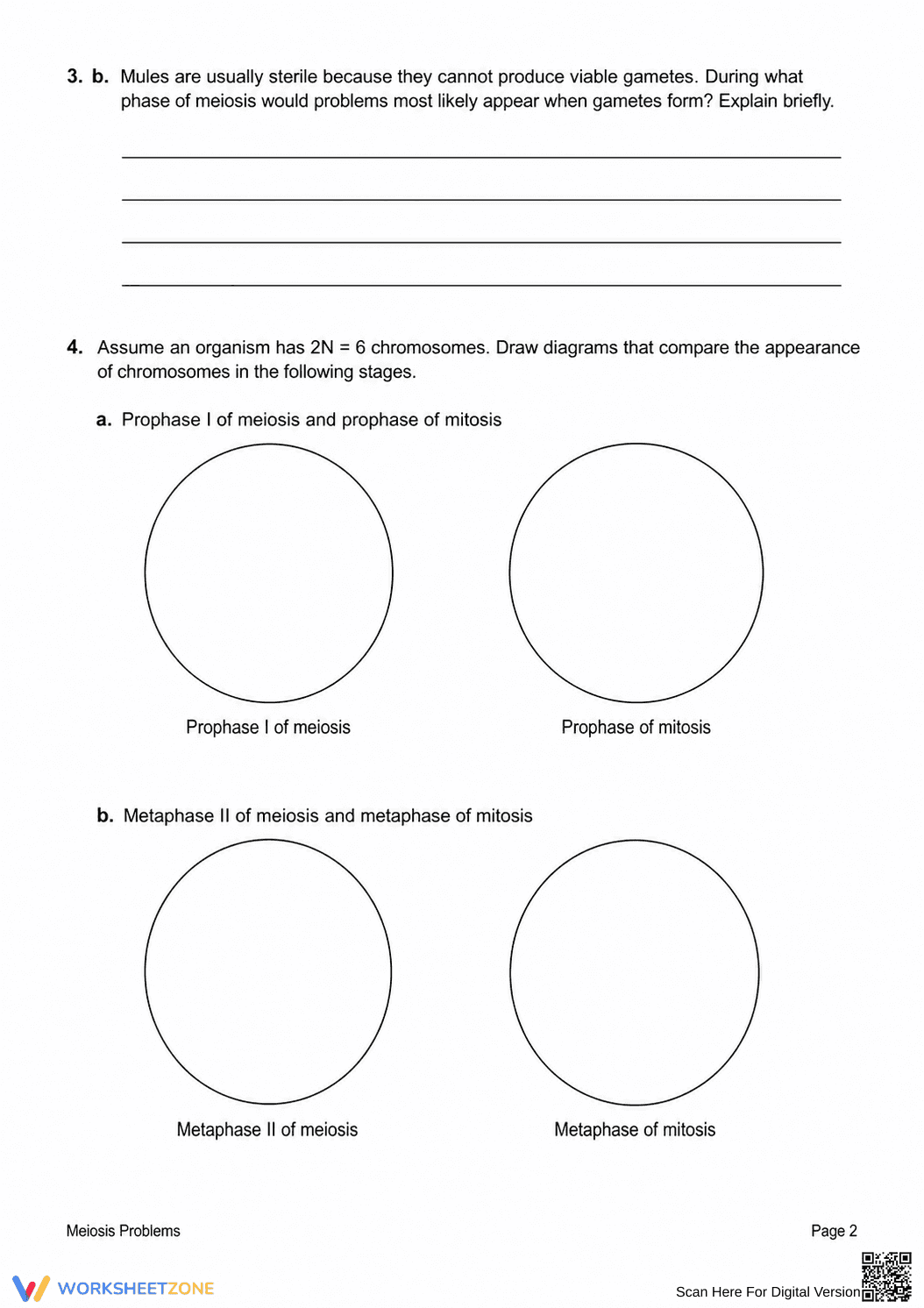
Inside this two-page resource, educators will find four multi-part problems that challenge students to apply the 2^n formula for chromosomal combinations. The tasks range from calculating combinations for various species, including humans and mules, to drawing and comparing specific cellular stages like Prophase I and Metaphase II. A complete answer key is included to streamline grading.
- Guided practice: The first problem introduces the basic concept of calculating combinations from a given diploid number without crossing-over, providing a clear starting point.
- Supported practice: Students then develop and apply a mathematical formula to compute combinations for different diploid numbers, including real-world examples like horses and donkeys.
- Independent practice: The final tasks require students to independently draw and compare the appearance of chromosomes during specific stages of meiosis and mitosis.
This gradual-release approach ensures students build confidence before tackling complex visual comparisons.
Aligned to primary standard HS-LS3-2, this resource supports students as they make and defend claims about how inheritable genetic variations result from new genetic combinations through meiosis. Both standard codes can be copied directly into lesson plans, IEP goals, or district curriculum mapping tools.
Deploy this worksheet during direct instruction as a guided application activity, or assign it as independent homework after introducing meiosis. As a formative assessment tip, review students' drawings in problem four to quickly identify misconceptions about homologous chromosomes aligning during Metaphase I versus Metaphase II. Expected completion time is 20 to 30 minutes.
This resource is designed for high school biology students in grades 9 through 12. It serves as an excellent tool for general education classrooms and can be paired with 3D cell models or interactive digital simulations of cell division to support visual learners who need extra reinforcement.
Mastering the mechanics of cellular division is critical for understanding broader genetic concepts. This worksheet aligns with HS-LS3-2, requiring students to calculate genetic combinations resulting from meiosis and visually map chromosomal behavior. According to Fisher & Frey (2014), providing structured, gradual-release practice opportunities significantly improves student retention of complex biological processes. By moving from basic mathematical calculations of diploid numbers to the higher-order task of drawing specific cellular stages, students engage in the deep cognitive work necessary for scientific literacy. The inclusion of real-world examples, such as hybrid offspring, further contextualizes the abstract concepts of genetic variation. This targeted practice ensures learners can confidently articulate how meiosis contributes to genetic diversity, laying a strong foundation for advanced studies in genetics and evolutionary biology.


