


























Views
Downloads



Printable Counting Objects Worksheet | Kindergarten Math
Paste this activity's link or code into your existing LMS (Google Classroom, Canvas, Teams, Schoology, Moodle, etc.).
Students can open and work on the activity right away, with no student login required.
You'll still be able to track student progress and results from your teacher account.
This Kindergarten counting worksheet provides essential practice for early learners to develop one-to-one correspondence and number recognition. By matching vibrant illustrations of mermaids and turtles to numerals, students build a concrete foundation for cardinality. This resource ensures that young mathematicians transition from rote counting to meaningful understanding of quantity.
At a Glance
- Grade: Kindergarten · Subject: Math
- Standard:
K.CC.B.4— Understand the relationship between numbers and quantities through counting objects- Skill Focus: One-to-one correspondence and cardinality
- Format: 3 pages · 6 problems · Answer key included · PDF
- Best For: Independent math centers or morning work
- Time: 10–15 minutes
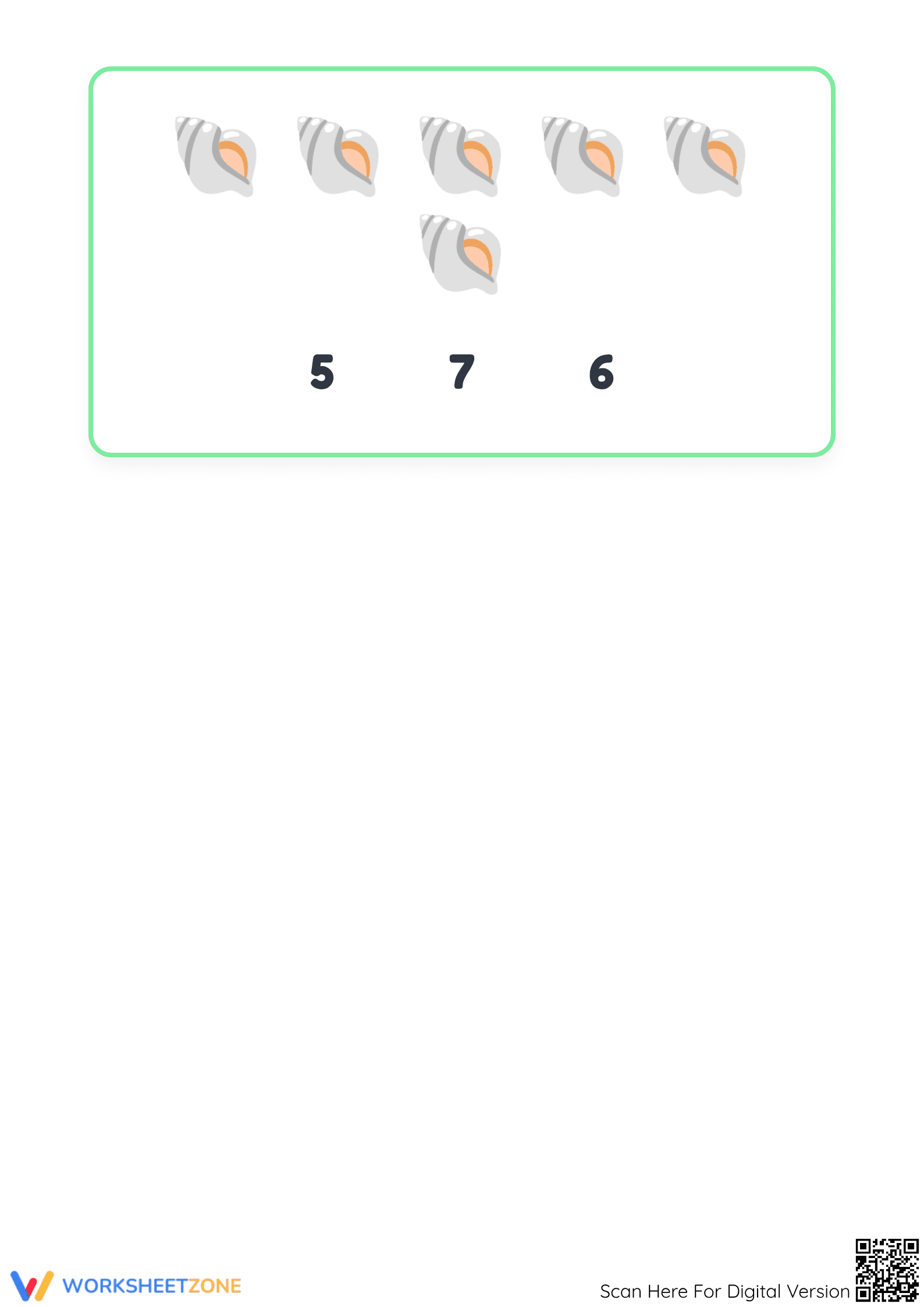
Inside this three-page PDF, educators will find six distinct counting blocks featuring engaging summer-themed graphics. Each task presents a group of objects alongside three numerical choices, requiring students to count accurately and circle the correct answer. The spacious layout accommodates the fine motor skills of preschool students while including a full answer key.
The zero-prep workflow of this worksheet makes it an ideal choice for busy classrooms. Teachers can simply print the three pages, distribute them to the class, and review results using the included key. The entire process requires less than two minutes of preparation time, making it highly suitable for emergency sub plans or quick transitions.
This worksheet aligns primarily with `K.CC.B.4`, focusing on the connection between numbers and quantities. It also supports `K.CC.B.5` as students count to answer "how many?" for sets of objects. These standard codes can be copied directly into lesson plans, IEP goals, or district curriculum mapping tools to ensure instructional alignment.
Use this worksheet as a formative assessment during a unit on counting to 10. Educators can observe whether students are touching each object once or skipping items, providing immediate data on developmental stages. It also works perfectly as a quiet activity for early finishers or as part of a morning routine to reinforce skills.
This resource is designed for kindergarten and preschool students developing initial counting skills. It is effective for English Language Learners and students with IEPs who benefit from clear visual cues. Naturally pair this worksheet with physical manipulatives, such as counting bears, to bridge the gap between concrete and representational math practice.
Mathematical research by Fisher & Frey (2014) emphasizes the importance of guided practice and visual representations in the gradual release of responsibility model for early numeracy. This worksheet applies those principles by providing clear, isolated tasks that allow students to demonstrate mastery of K.CC.B.4. By engaging with discrete sets of objects, children internalize the principle that the last number named tells the total number of objects counted. Educational data from NAEP indicates that early proficiency in one-to-one correspondence is a significant predictor of future success in operations and algebraic thinking. This structured activity provides the necessary scaffolding for students to move beyond verbal counting sequences toward a sophisticated understanding of quantity. Implementing such targeted practice ensures that learners develop the precision required for higher-order math concepts in later elementary grades while maintaining high engagement through visually appealing, summer-themed illustrations and interactive circling tasks.


