


























0
Views
0
Downloads

0.0
0
Save
0 Likes
Share
Practice One-to-One Correspondence
0 Views
0 Downloads
Paste this activity's link or code into your existing LMS (Google Classroom, Canvas, Teams, Schoology, Moodle, etc.).
Students can open and work on the activity right away, with no student login required.
You'll still be able to track student progress and results from your teacher account.
Information
Description
What It Is:
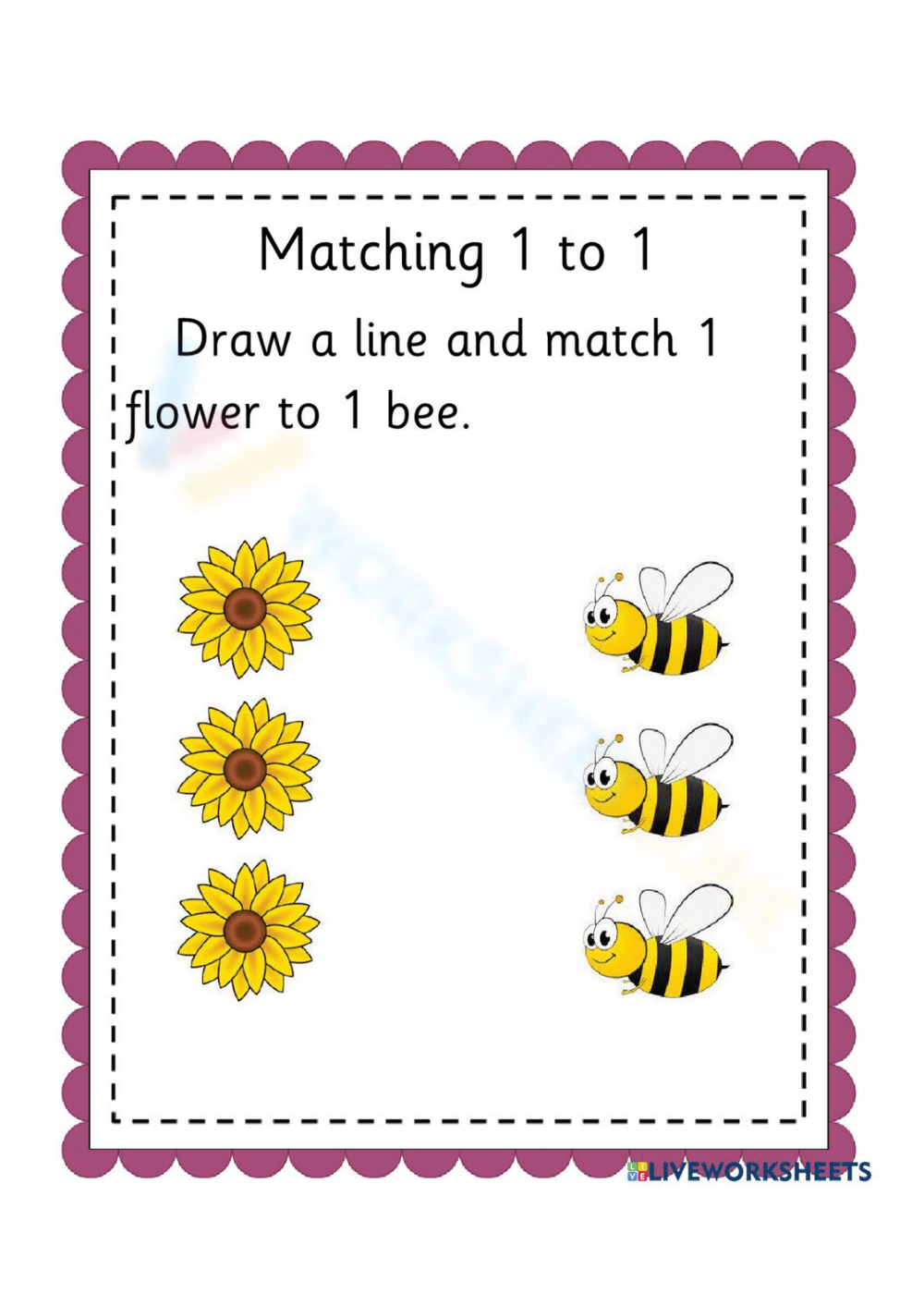
This is a worksheet designed to teach one-to-one correspondence. The worksheet has the title 'Matching 1 to 1' and instructions to 'Draw a line and match 1 flower to 1 bee.' There are three images of flowers on the left and three images of bees on the right. The task is to match each flower to one bee by drawing a line.
Grade Level Suitability:
This worksheet is most suitable for Pre-K and Kindergarten. The concept of one-to-one matching is a foundational math skill introduced in early childhood education. The simple graphics and straightforward instructions make it appropriate for this age group.
Why Use It:
This worksheet helps develop early math skills, specifically one-to-one correspondence, which is crucial for understanding number concepts. It also enhances fine motor skills through drawing lines, and visual discrimination skills by matching objects.
How to Use It:
Provide the worksheet and a pencil or crayon to the child. Explain the instructions clearly: 'Draw a line from each flower to one bee.' Encourage the child to carefully match each flower to only one bee.
Target Users:
The target users are preschool and kindergarten students who are learning about matching and early counting skills. It's also useful for children who need to practice fine motor skills.
This is a worksheet designed to teach one-to-one correspondence. The worksheet has the title 'Matching 1 to 1' and instructions to 'Draw a line and match 1 flower to 1 bee.' There are three images of flowers on the left and three images of bees on the right. The task is to match each flower to one bee by drawing a line.
Grade Level Suitability:
This worksheet is most suitable for Pre-K and Kindergarten. The concept of one-to-one matching is a foundational math skill introduced in early childhood education. The simple graphics and straightforward instructions make it appropriate for this age group.
Why Use It:
This worksheet helps develop early math skills, specifically one-to-one correspondence, which is crucial for understanding number concepts. It also enhances fine motor skills through drawing lines, and visual discrimination skills by matching objects.
How to Use It:
Provide the worksheet and a pencil or crayon to the child. Explain the instructions clearly: 'Draw a line from each flower to one bee.' Encourage the child to carefully match each flower to only one bee.
Target Users:
The target users are preschool and kindergarten students who are learning about matching and early counting skills. It's also useful for children who need to practice fine motor skills.


