


























Views
Downloads

Printable One to One Correspondence Worksheet | Grades K-1
Paste this activity's link or code into your existing LMS (Google Classroom, Canvas, Teams, Schoology, Moodle, etc.).
Students can open and work on the activity right away, with no student login required.
You'll still be able to track student progress and results from your teacher account.
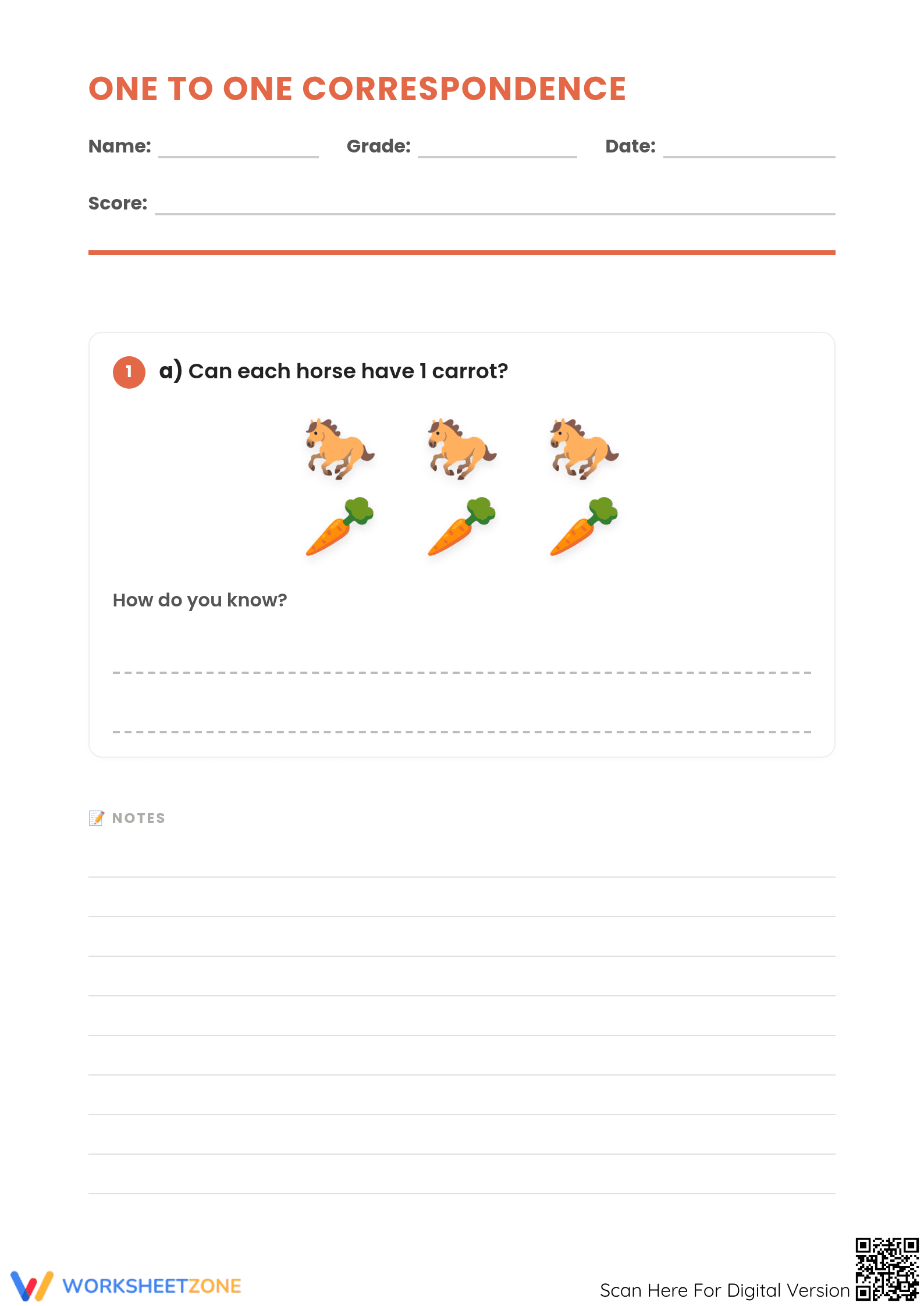
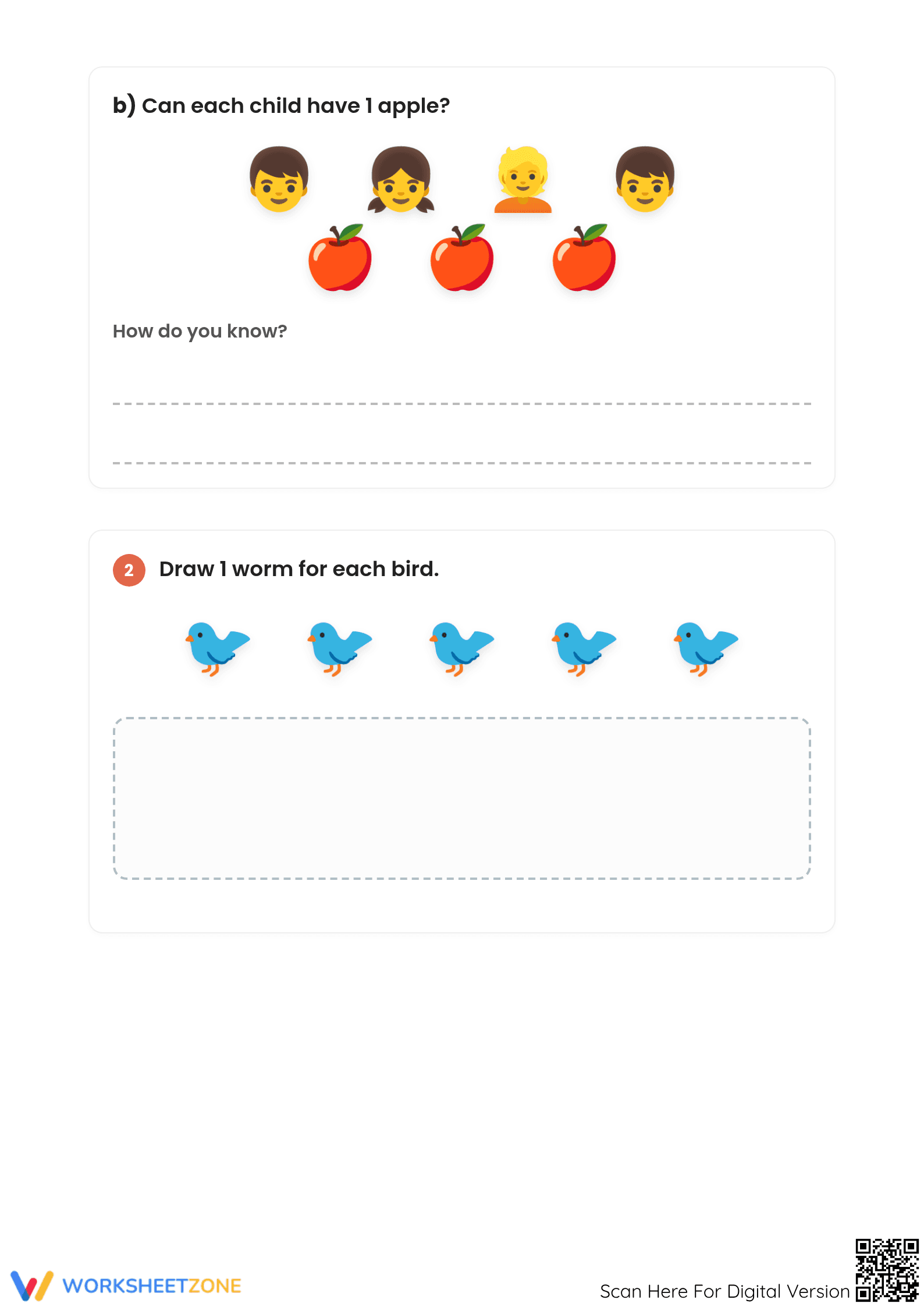
This one-to-one correspondence worksheet provides students with targeted practice in matching objects between two groups to determine equality or disparity. By engaging with visual sets of horses, children, birds, and school supplies, learners develop the foundational counting skills necessary for higher-level operations. This resource ensures students can accurately map individual items to one another and explain their mathematical reasoning through writing and drawing.
At a Glance
- Grade: K–1 · Subject: Math
- Standard:
CCSS.MATH.CONTENT.K.CC.C.6— Identify whether the number of objects in one group is greater, less, or equal- Skill Focus: One-to-one object mapping and group comparison
- Format: 3 pages · 5 problems · Answer key included · PDF
- Best For: Initial counting instruction and early numeracy assessment
- Time: 15–20 minutes
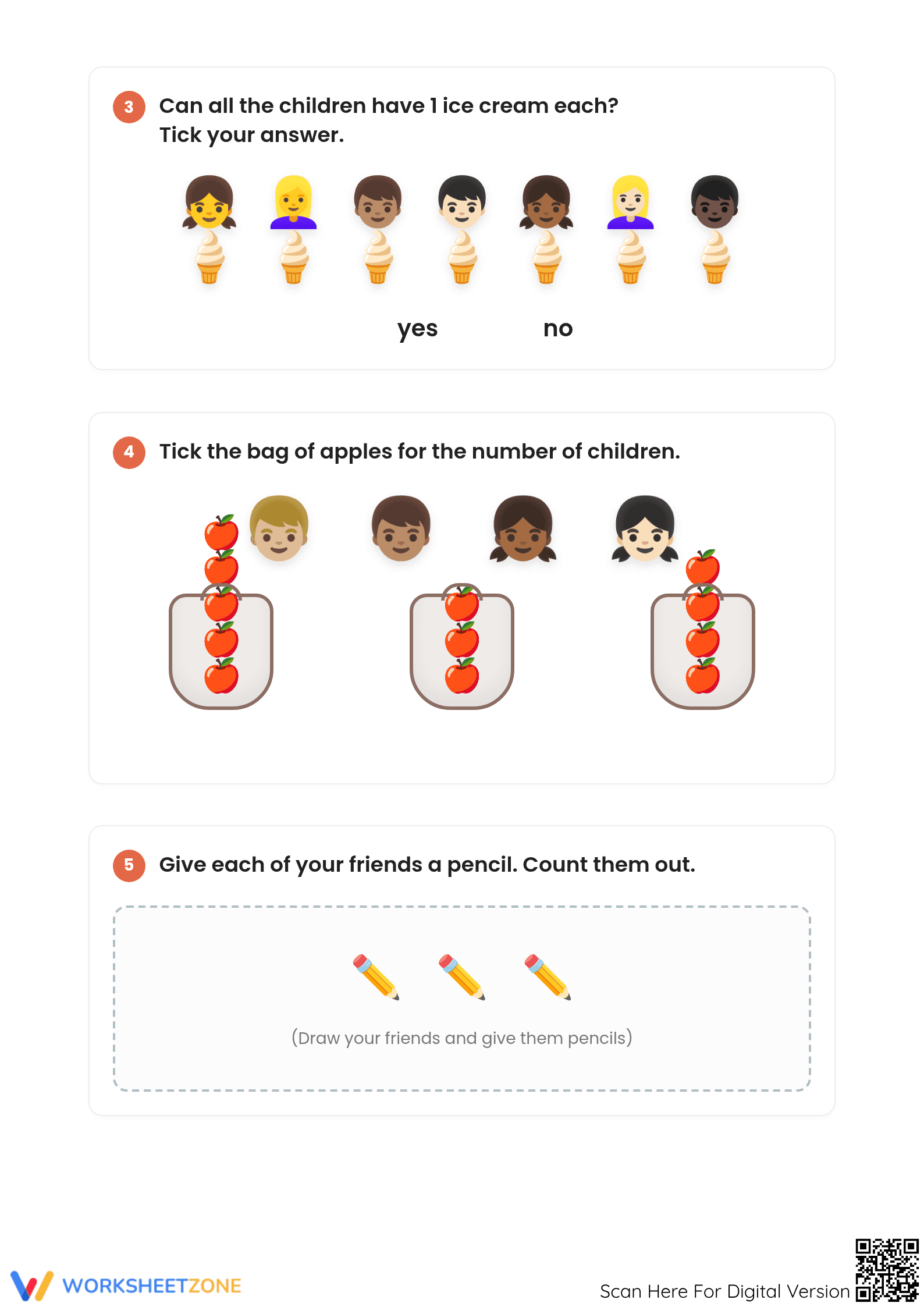
Inside this 3-page PDF, you will find five comprehensive tasks that transition from simple yes/no identification to active drawing and matching. The worksheet includes structured sections for students to justify their answers, a tick-the-box comparison activity involving bags of apples, and a creative drawing task where students must provide a pencil for each friend. A clear, visual layout ensures that young learners can focus on the correspondence logic without being overwhelmed by crowded pages.
Skill Progression and Scaffolding
- Guided Practice: The first page utilizes paired visuals (horses and carrots) to introduce the concept of matching sets, providing dotted lines for students to write their reasoning.
- Supported Practice: Mid-level tasks move to comparison, asking students to tick correct answers or identify the group that matches a specific count from a diverse set of child icons.
- Independent Practice: The final challenge requires students to draw their own representations to satisfy a one-to-one requirement, moving from recognition to production.
This sequence follows a gradual-release model, moving from visual identification to independent application of counting principles.
Standards Alignment
The primary alignment for this resource is `CCSS.MATH.CONTENT.K.CC.C.6`: "Identify whether the number of objects in one group is greater than, less than, or equal to the number of objects in another group, e.g., by using matching and counting strategies." It also supports `K.CC.B.4a` regarding the relationship between numbers and quantities. Both standard codes can be copied directly into lesson plans, IEP goals, or district curriculum mapping tools.
How to Use It
Deploy this worksheet during the first week of a counting unit to gauge student understanding of set equality. It works effectively as an exit ticket following a hands-on manipulative lesson where students move physical counters. For a formative assessment observation, watch how students physically map the objects—do they draw lines between pairs or count each set individually? The expected completion time is 15–20 minutes depending on writing speed.
Who It's For
This worksheet is designed for Kindergarten and first-grade students who are developing cardinality and counting skills. It is an ideal intervention tool for small groups or RTI (Response To Intervention) tiers where students struggle with the concept of "enough" or "leftover" items. This resource pairs naturally with an anchor chart showing matched versus unmatched pairs or a direct instruction lesson on matching strategies.
Mastery of one-to-one correspondence is crucial for later success in addition and subtraction, a point highlighted by EdReports 2024. This worksheet helps students move beyond rote counting to understanding the functional relationship between sets. By using matching strategies aligned with CCSS.MATH.CONTENT.K.CC.C.6, students develop a robust mental model for number quantity and group comparison. Research shows visual-to-object mapping significantly reduces errors in early cardinality. The included answer key allows for rapid grading or self-correction, ensuring students can demonstrate 1:1 mapping across various contexts.


