Looking for a fun and educational way to challenge young minds? These math brain teasers for kids are the perfect blend of learning and play. Whether you are a parent, teacher, or tutor, brain teasers can help children develop critical thinking, number sense, and problem-solving skills while having fun. From simple puzzles for beginners to trickier challenges for older kids, this collection offers something for every level. Get ready to turn math time into an exciting mental adventure!
35 Math Brain Teasers for Kids
Here are 35 math brain teasers for kids, categorized by difficulty level, with answers:
Easy Math Brain Teasers
1. If you have 7 apples and you take away 3 of them, how many do you have?
Answer: 3. You have 3 apples because that’s how many you took.

2. What number do you get when you multiply all of the numbers on a telephone keypad?
Answer: 0. Since one of the numbers is 0, the product of all numbers will be 0.
3. I am an odd number. If you take away one letter from my name, I become even. What number am I?
Answer: Seven. When you take away the ‘s’ from ‘seven’, it becomes ‘even’.
4. You have two coins that total 30 cents. One of them is not a nickel. What are the two coins?
Answer: A quarter and a nickel. One coin is not a nickel (the quarter), but the other one is.
5. What is the next number in this sequence: 2, 4, 6, 8, …?
Answer: 10. This is a sequence of even numbers, increasing by 2 each time.
Medium Math Brain Teasers
6. A farmer has 19 sheep on his land. One day, a big storm hits and all but seven run away. How many sheep does the farmer have left?
Answer: 7. The riddle states that all but seven ran away, meaning seven remained.
7. Using only addition, how can you use eight eights to get the number 1,000?
Answer: 888 + 88 + 8 + 8 + 8 = 1,000.

8. When Ashley was 15, her mother was 37. Now, her mother is twice her age. How old is Ashley?
Answer: 22 years old. The difference in their ages is 37 – 15 = 22 years. When her mother is twice her age, the age difference is still 22 years. So, Ashley is 22 and her mother is 44 (twice 22).
9. You planted sunflower seeds in your back garden. Every day, the number of flowers doubles. If it takes 52 days for the flowers to fill the garden, how many days would it take for them to fill half the garden?
Answer: 51 days. If the number of flowers doubles every day, half the garden would be full the day before, on the 51st day.
10. Your sock drawer only contains 18 white socks and 18 blue socks. How many times do you need to reach inside the drawer and take out a sock to guarantee a matching pair?
Answer: 3 times. In the worst-case scenario, you could pick one white sock and one blue sock with your first two tries. The third sock you pick is guaranteed to match one of the first two.
11. I am a two-digit number. My tens digit is double my ones digit, and the sum of my digits is 9. What number am I?
Answer: 63. The sum of the digits is 6 + 3 = 9, and the tens digit (6) is double the ones digit (3).
12. A clock is running 15 minutes slow and shows 2:45. What is the correct time?
Answer: 3:00. If the clock is 15 minutes slow at 2:45, the actual time is 15 minutes later, which is 3:00.

13. If you divide 30 by half and add 10, what do you get?
Answer: 70. Dividing 30 by half is the same as multiplying 30 by 2, which is 60. Adding 10 to 60 gives you 70.
14. In a family, there are 2 brothers and 1 sister. How many children are there?
Answer: 3. The 2 brothers and the 1 sister are the children in the family.
15. What three numbers give the same result when multiplied and added together?
Answer: 1, 2, and 3. 1 + 2 + 3 = 6, and 1 * 2 * 3 = 6.
16. A zookeeper had 10 pairs of animals, but 2 pairs ran away. How many animals are left?
Answer: 16 animals. The zookeeper started with 10 * 2 = 20 animals. After 2 * 2 = 4 animals ran away, 20 – 4 = 16 animals were left.
17. I appear twice in the morning and twice in the evening. But I only appear once at night. What am I?
Answer: The letter ‘N’. ‘Morning’ has two N’s, ‘evening’ has two N’s, and ‘night’ has one N.

18. If you write all the numbers from 300 to 400, how many times do you write the digit 3?
Answer: 120 times. The digit 3 appears 100 times in the hundreds place (300-399), 10 times in the tens place (330-339), and 10 times in the units place (303, 313, … 393). 100 + 10 + 10 = 120.
19. If 3 cats can catch 3 bunnies in 3 minutes, how long will it take 100 cats to catch 100 bunnies?
Answer: 3 minutes. The rate is 1 cat catches 1 bunny in 3 minutes. With 100 cats, they can catch 100 bunnies simultaneously in the same amount of time.
20. If you write out all the numbers from 1 to 100, how many times do you write the number 2?
Answer: 20 times. The digit 2 appears in the units place 10 times (2, 12, 22, … 92) and in the tens place 10 times (20, 21, 22, … 29).
21. What is the next number in this sequence: 2, 3, 5, 7, 11, …?
Answer: 13. This is the sequence of prime numbers.
22. If 72 x 96 = 6927, 58 x 87 = 7885, then 79 x 86 = ?
Answer: 6897. The pattern is reversing the digits of the two numbers being multiplied. 72 becomes 27, 96 becomes 69, and they are swapped and placed together (6927). 58 becomes 85, 87 becomes 78, swapped and together (7885). So 79 becomes 97, 86 becomes 68, swapped and together (6897).

23. If you have a cake and you cut it into three pieces, how many cuts did you make?
Answer: 2 cuts. To get three pieces from a single cake, you only need to make two straight cuts.
24. What is the missing number in the sequence: 1, 1, 2, 3, 5, 8, 13, __?
Answer: 21. This is the Fibonacci sequence, where each number is the sum of the two preceding ones (1+1=2, 1+2=3, 2+3=5, and so on). 8 + 13 = 21.
25. A grandfather, two fathers, and two sons went to the cinema together and bought one ticket each. How many tickets did they buy in total?
Answer: 3 tickets. This is a classic riddle where the people are related: a grandfather (who is also a father), his son (who is also a father), and his grandson (who is a son). This is three distinct people.
26. Sarah has 3 bags of marbles. Each bag has 15 marbles. How many marbles does Sarah have in total?
Answer: 45. You multiply the number of bags by the number of marbles in each bag: 3×15=45.

27. A rectangle has a length of 8 cm and a width of 5 cm. What is the area of the rectangle?
Answer: 40 square cm. The area of a rectangle is found by multiplying the length by the width: 8×5=40.
28. I am a number. If you multiply me by 4 and then add 6, you get 30. What number am I?
Answer: 6. You can work backward: 30−6=24, and 24÷4=6.
29. What is one-quarter of 24?
Answer: 6. To find one-quarter of a number, you divide it by 4: 24÷4=6.
30. I am an odd number between 20 and 30. The sum of my digits is 9. What number am I?
Answer: 27. The odd numbers between 20 and 30 are 21, 23, 25, 27, 29. The sum of the digits of 27 is 2+7=9.

Hard Math Brain Teasers
31. In 1990, a person celebrated their 15th birthday. In 1995, the same person celebrated their 10th birthday. How is this possible?
Answer: The years are in BCE (Before Common Era). 1995 BCE is 5 years before 1990 BCE. So, in 1995 BCE, they were 10, and 5 years later in 1990 BCE, they were 15.
32. A snail is at the bottom of a 30-foot well. Each day it crawls up 3 feet, but each night it slips back 2 feet. How many days will it take the snail to reach the top of the well?
Answer: 28 days. The snail makes a net progress of 3 – 2 = 1 foot per day. However, on the last day, the snail reached the top and did not slip back. After 27 days, the snail will have climbed 27 feet. On the 28th day, the snail climbs 3 feet and reaches the top (27 + 3 = 30).
Suggestion: For students who enjoy a good challenge, moving from simple counting to using the distance formula practice helps them understand the mathematical logic behind measuring diagonal lines.
33. A number is doubled and then increased by 10. The result is 50. What is the number?
Answer: 20. Let the number be x: 2x + 10 = 50 → 2x = 40 → x = 20.
34. What is the next number in this sequence? 1, 4, 9, 16, 25, __?
Answer: 36. These are square numbers: 1², 2², 3²… so the next is 6² = 36.

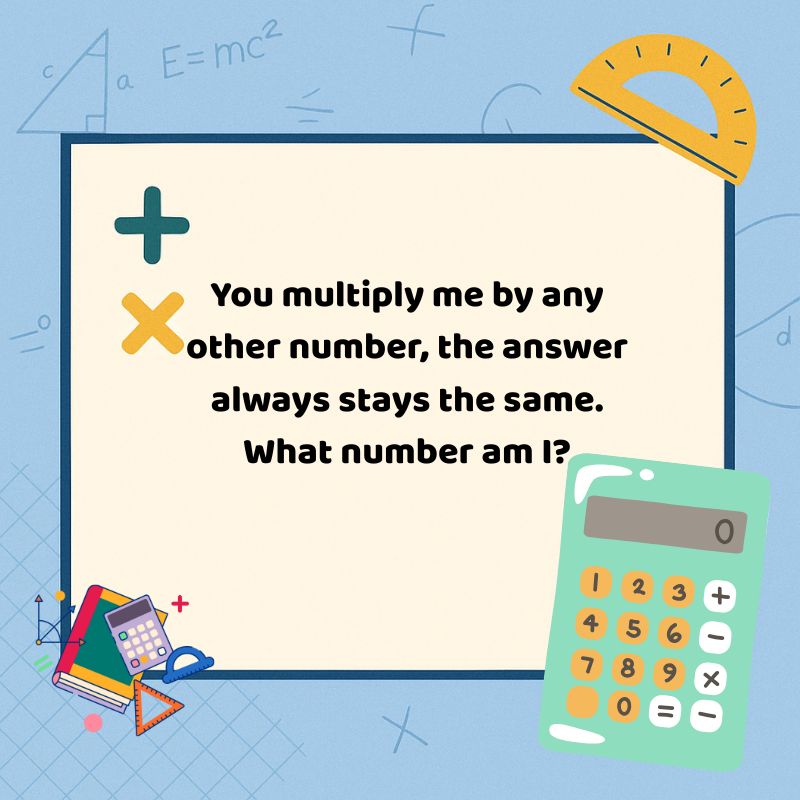
35. You multiply me by any other number, the answer always stays the same. What number am I?
Answer: 0. Any number × 0 = 0.
For students who have mastered basic geometry, introducing Riemann Sum problems can be a great way to challenge their logic regarding infinity and area.
Final thoughts
Adding math brain teasers for kids into daily routines is a fantastic way to make learning enjoyable and interactive. They can serve as warm-up activities, homework alternatives, or family challenges that build a love for math. Whether you’re at home or in the classroom, these teasers can inspire young learners to think outside the box and embrace problem-solving with enthusiasm. Keep it playful, keep it curious! For even more brain-stretching fun, explore our collection of math riddles for kids that sharpen reasoning in playful ways.
Recommendation: Moving beyond basic arithmetic, a great way to sharpen logical thinking is through system of equations practice, where students learn to eliminate variables to solve a puzzle.