


























Views
Downloads
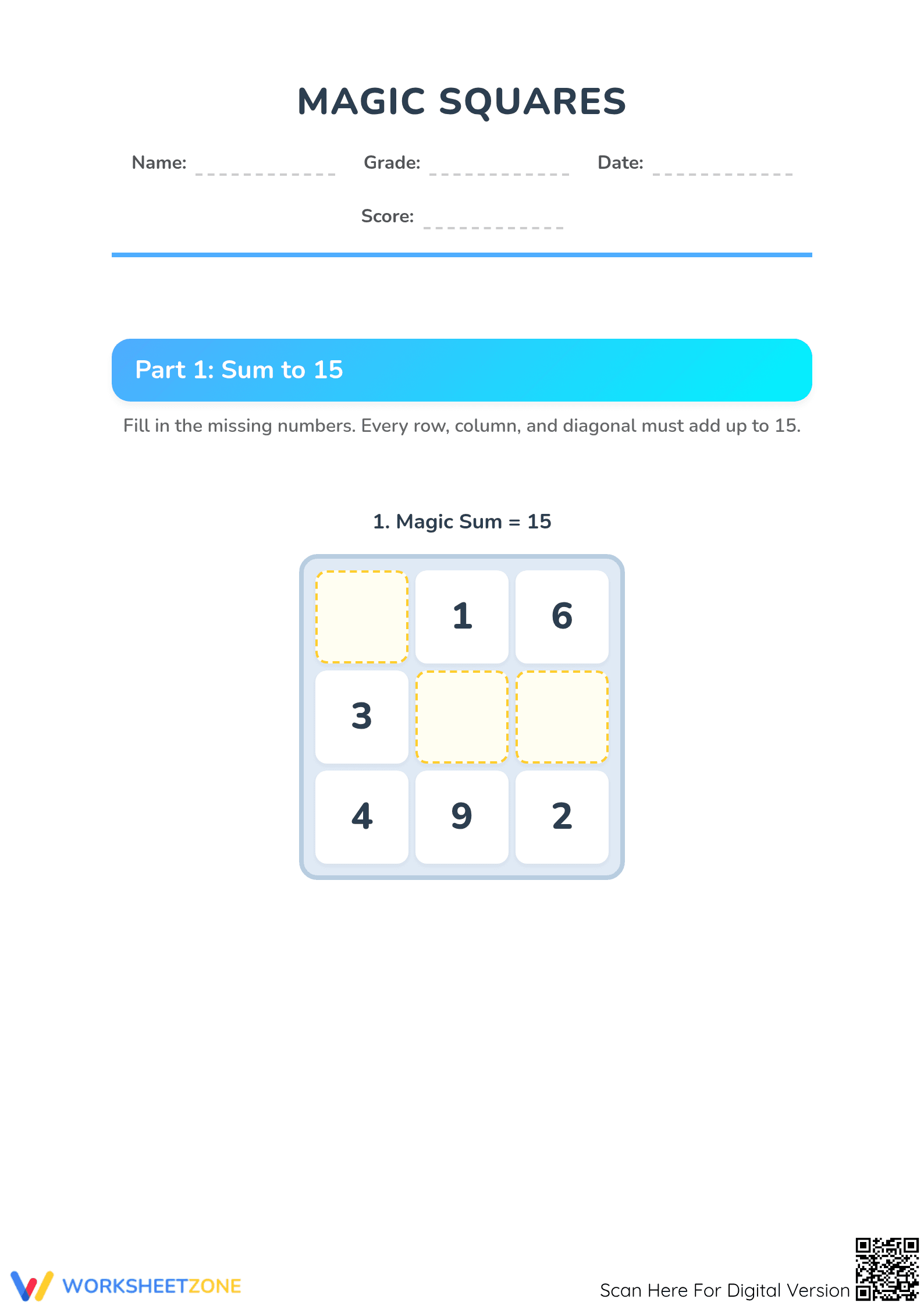
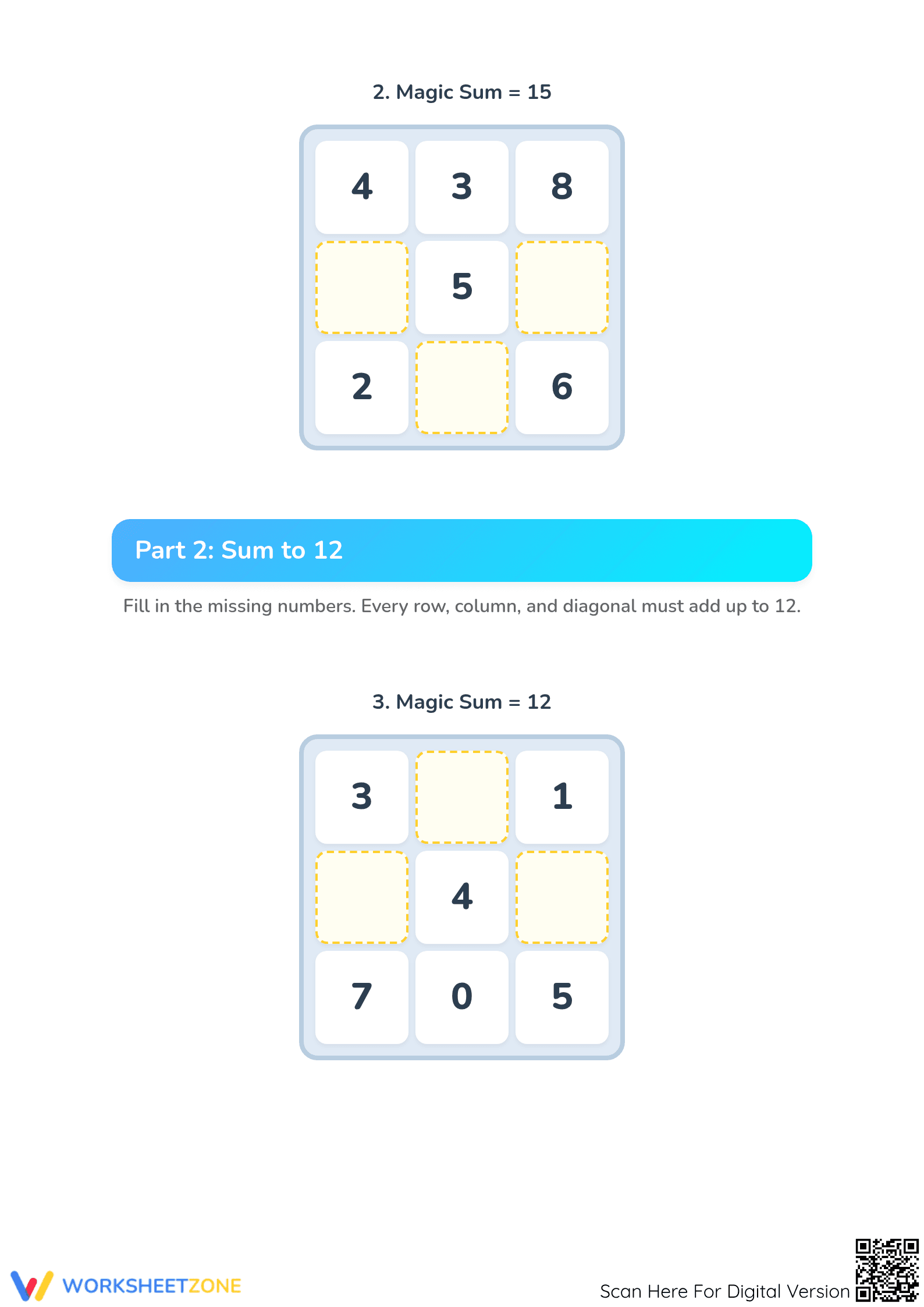
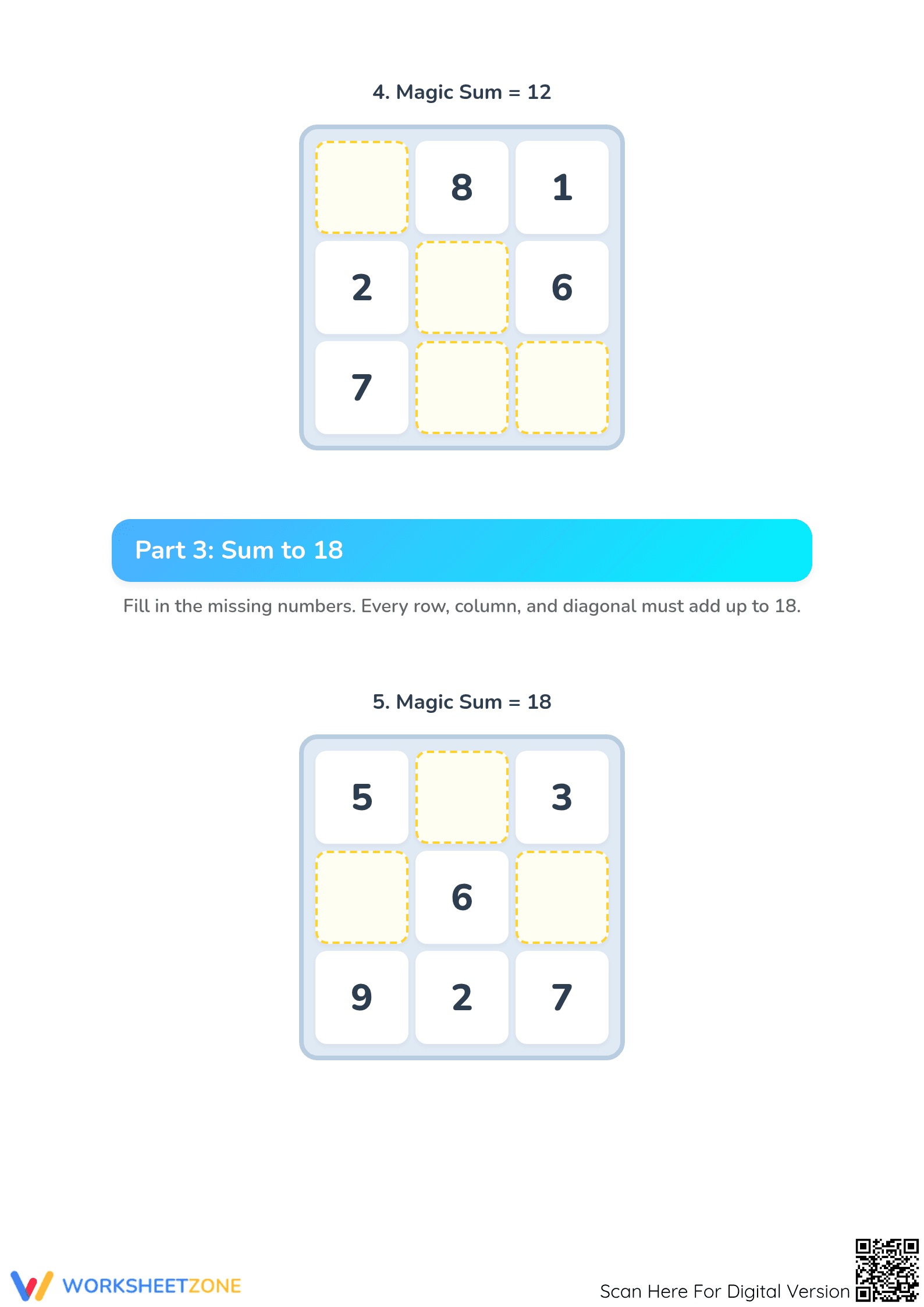
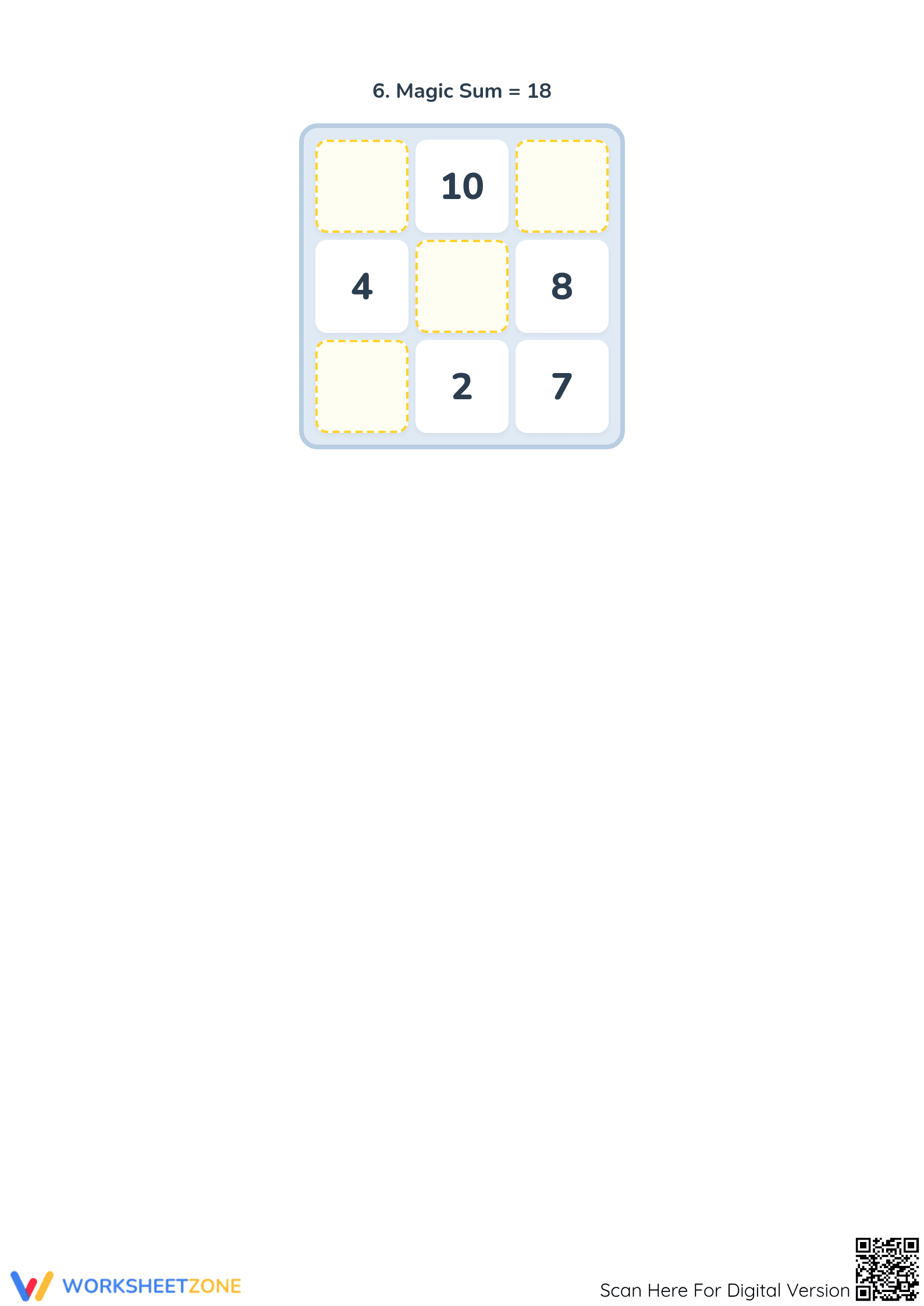

Printable 1st Grade Magic Square Worksheets | Addition Logic
Paste this activity's link or code into your existing LMS (Google Classroom, Canvas, Teams, Schoology, Moodle, etc.).
Students can open and work on the activity right away, with no student login required.
You'll still be able to track student progress and results from your teacher account.
Enhance mental math fluency with these structured logic puzzles designed for young learners. This collection of magic squares challenges students to apply addition strategies and deductive reasoning to find missing values within a 3x3 grid. By ensuring every row, column, and diagonal adds up to a target sum, children build a deeper understanding of number relationships and operational properties.
At a Glance
- Grade: 1 · Subject: Math
- Standard:
CCSS.MATH.CONTENT.1.OA.D.8— Find the unknown whole number in an addition equation relating three whole numbers- Skill Focus: Mental math & algebraic logic
- Format: 4 pages · 6 problems · Answer key included · PDF
- Best For: Early finishers and logic center activities
- Time: 15–20 minutes
This comprehensive 4-page PDF contains six distinct magic square challenges organized by target sums. Part 1 focuses on the magic sum of 15, Part 2 moves to 12, and Part 3 reaches 18. Each puzzle provides several anchor numbers to guide the student, ensuring the logic is accessible yet stimulating. A full answer key is provided for rapid checking or student self-correction.
The zero-prep workflow is designed for maximum efficiency in the classroom. Teachers can print the set in less than 30 seconds, distribute the pages to the class in 1 minute, and review the logic during a 5-minute wrap-up session. This low-threshold, high-ceiling activity requires no prior setup, making it an ideal choice for substitute folders or transition periods between core lessons.
This resource aligns directly with `CCSS.MATH.CONTENT.1.OA.D.8`. The standard requires students to determine the unknown whole number in an addition or subtraction equation relating three whole numbers. By filling in the missing pieces of the magic square, students solve multiple equations simultaneously. This standard code can be copied directly into lesson plans, IEP goals, or district curriculum mapping tools.
Use this worksheet as a formative assessment during your operations and algebraic thinking unit. Observe how students approach the empty cells—do they look for rows with only one missing number first? This reveals their strategic planning skills. The resource also works perfectly as a quiet morning work activity to settle the class while building essential number sense and fluency within 20.
This pack is built for Grade 1 students who have mastered basic addition facts and are ready for a cognitive challenge. It provides natural differentiation for advanced kindergarteners or second graders needing a logic refresher. Pair this worksheet with physical manipulatives or a 1-20 number line to support students who are still developing mental calculation speed.
According to NAEP research, early exposure to algebraic structures like magic squares significantly improves long-term mathematical reasoning and problem-solving resilience. By engaging with `CCSS.MATH.CONTENT.1.OA.D.8` through these puzzles, students move beyond rote memorization into active mathematical inquiry. Logic-based addition tasks foster a mathematical mindset as defined by Fisher & Frey (2014), where students view numbers as flexible tools rather than static facts. This worksheet provides 6 distinct opportunities to practice these skills, ensuring that mental math remains a vibrant and interactive part of the primary curriculum. The inclusion of target sums 12, 15, and 18 provides a controlled environment for practicing composition and decomposition of numbers within 20. This data-driven approach to logic practice ensures that classroom time is spent on high-impact instructional activities that yield measurable gains in student confidence and operational accuracy.


