


























1 / 2
0
Views
0
Downloads


0.0
0
Save
0 Likes
Share
Understanding the Discriminant in Quadratic Equations
0 Views
0 Downloads
Paste this activity's link or code into your existing LMS (Google Classroom, Canvas, Teams, Schoology, Moodle, etc.).
Students can open and work on the activity right away, with no student login required.
You'll still be able to track student progress and results from your teacher account.
Information
Description
What It Is:
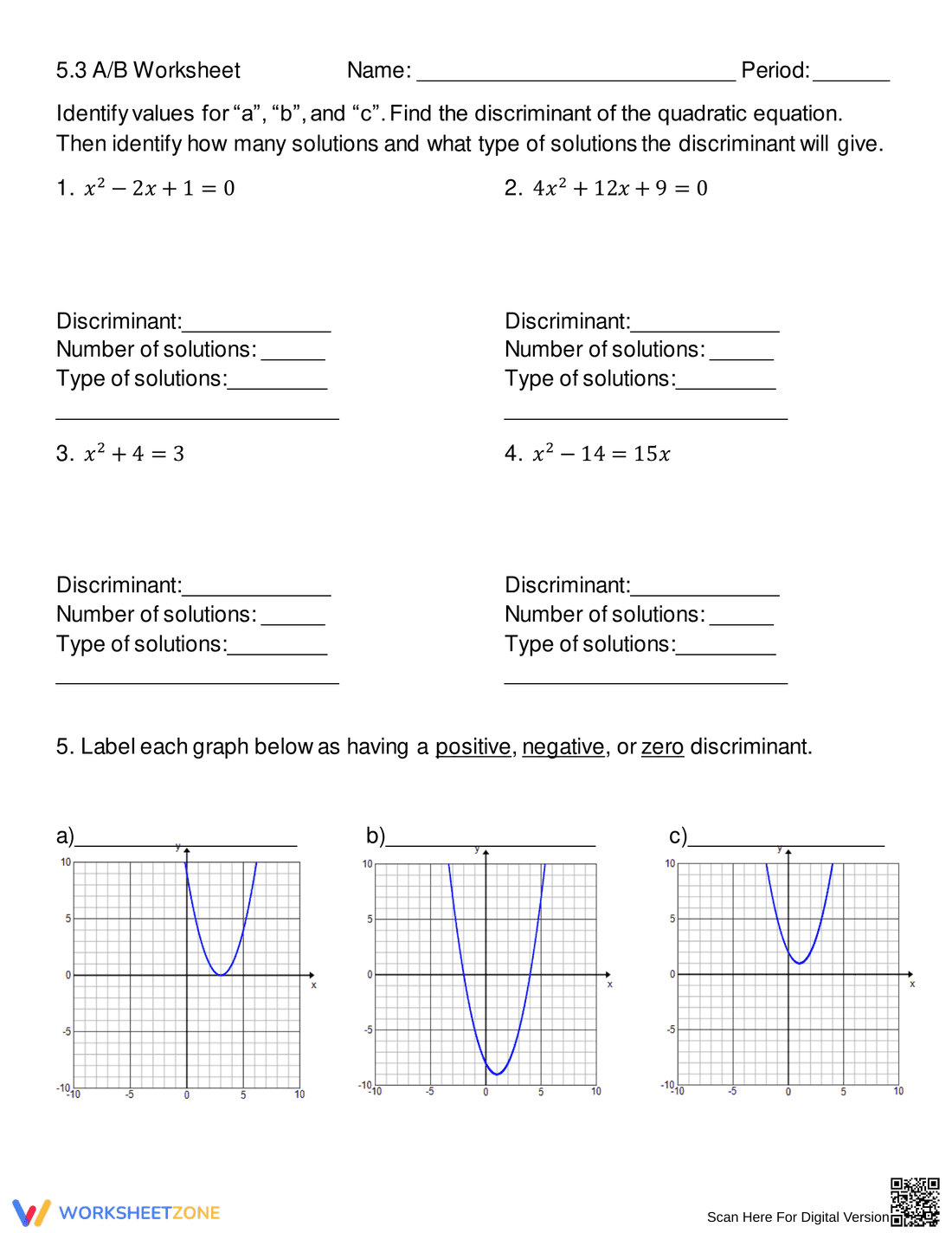
This is an algebra worksheet focused on the discriminant of quadratic equations. It requires students to identify the values of 'a', 'b', and 'c' from given quadratic equations, calculate the discriminant, determine the number of solutions, and identify the type of solutions (real, imaginary, or rational). The worksheet includes four quadratic equations in standard form and one that requires rearranging. The final section presents three graphs of quadratic functions and asks students to label each with a positive, negative, or zero discriminant based on the graph.
Grade Level Suitability:
This worksheet is suitable for high school students, specifically grades 9-11, who are studying quadratic equations and their properties. It assumes a basic understanding of algebra and the quadratic formula.
Why Use It:
This worksheet helps students practice applying the discriminant to determine the nature and number of solutions to quadratic equations. It reinforces the connection between the discriminant and the graphical representation of quadratic functions. It also provides practice in identifying coefficients in quadratic equations.
How to Use It:
Students should first identify the values of a, b, and c in each quadratic equation. Then, they should calculate the discriminant using the formula b² - 4ac. Based on the value of the discriminant, they should determine the number and type of solutions (two real solutions, one real solution, or two complex solutions). For the graphs, they should visually assess whether the parabola intersects the x-axis (positive discriminant), touches the x-axis (zero discriminant), or does not intersect the x-axis (negative discriminant).
Target Users:
The target users are high school algebra students learning about quadratic equations and the discriminant. It is also useful for teachers looking for practice problems to reinforce these concepts.
This is an algebra worksheet focused on the discriminant of quadratic equations. It requires students to identify the values of 'a', 'b', and 'c' from given quadratic equations, calculate the discriminant, determine the number of solutions, and identify the type of solutions (real, imaginary, or rational). The worksheet includes four quadratic equations in standard form and one that requires rearranging. The final section presents three graphs of quadratic functions and asks students to label each with a positive, negative, or zero discriminant based on the graph.
Grade Level Suitability:
This worksheet is suitable for high school students, specifically grades 9-11, who are studying quadratic equations and their properties. It assumes a basic understanding of algebra and the quadratic formula.
Why Use It:
This worksheet helps students practice applying the discriminant to determine the nature and number of solutions to quadratic equations. It reinforces the connection between the discriminant and the graphical representation of quadratic functions. It also provides practice in identifying coefficients in quadratic equations.
How to Use It:
Students should first identify the values of a, b, and c in each quadratic equation. Then, they should calculate the discriminant using the formula b² - 4ac. Based on the value of the discriminant, they should determine the number and type of solutions (two real solutions, one real solution, or two complex solutions). For the graphs, they should visually assess whether the parabola intersects the x-axis (positive discriminant), touches the x-axis (zero discriminant), or does not intersect the x-axis (negative discriminant).
Target Users:
The target users are high school algebra students learning about quadratic equations and the discriminant. It is also useful for teachers looking for practice problems to reinforce these concepts.


