


























0
Views
0
Downloads

0.0
0
Save
0 Likes
Finding the Discriminant
0 Views
0 Downloads
Paste this activity's link or code into your existing LMS (Google Classroom, Canvas, Teams, Schoology, Moodle, etc.).
Students can open and work on the activity right away, with no student login required.
You'll still be able to track student progress and results from your teacher account.
Information
Description
What It Is:
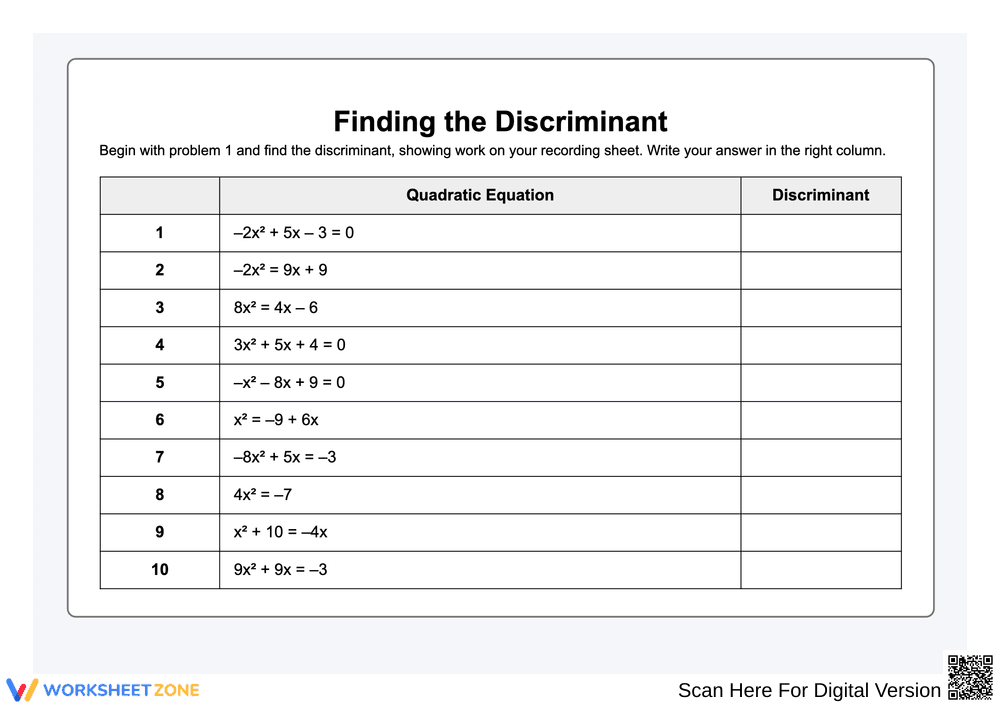
A structured Algebra practice worksheet where students calculate the discriminant for ten quadratic equations. Each equation must first be rewritten in standard form, allowing students to identify coefficients clearly before applying the discriminant formula. The worksheet includes equations with negative coefficients, constants on both sides, and linear terms arranged in different orders to deepen conceptual understanding.
Why Use It:
This worksheet strengthens students’ mastery of the discriminant and its role in determining the number and type of solutions to a quadratic equation. By practicing with varied equation formats, learners improve their ability to identify a, b, and c accurately and analyze solution types without fully solving the equation. It builds confidence and prepares students for graphing quadratics and using the quadratic formula.
How to Use It:
• Rewrite each equation in standard form: ax² + bx + c = 0.
• Identify the coefficients and substitute them into the formula b² − 4ac.
• Have students record the discriminant in the right column and determine the nature of the roots.
• Ideal for warm-ups, independent practice, homework, or Algebra I test review.
Grade Suitability:
Best suited for Grades 8–10.
• Algebra I students learning quadratic equations and solution types.
• Pre-Algebra or Algebra II students needing review of discriminants.
Target Users:
Teachers, tutors, and students who want guided practice evaluating discriminants and understanding quadratic solution behavior.
A structured Algebra practice worksheet where students calculate the discriminant for ten quadratic equations. Each equation must first be rewritten in standard form, allowing students to identify coefficients clearly before applying the discriminant formula. The worksheet includes equations with negative coefficients, constants on both sides, and linear terms arranged in different orders to deepen conceptual understanding.
Why Use It:
This worksheet strengthens students’ mastery of the discriminant and its role in determining the number and type of solutions to a quadratic equation. By practicing with varied equation formats, learners improve their ability to identify a, b, and c accurately and analyze solution types without fully solving the equation. It builds confidence and prepares students for graphing quadratics and using the quadratic formula.
How to Use It:
• Rewrite each equation in standard form: ax² + bx + c = 0.
• Identify the coefficients and substitute them into the formula b² − 4ac.
• Have students record the discriminant in the right column and determine the nature of the roots.
• Ideal for warm-ups, independent practice, homework, or Algebra I test review.
Grade Suitability:
Best suited for Grades 8–10.
• Algebra I students learning quadratic equations and solution types.
• Pre-Algebra or Algebra II students needing review of discriminants.
Target Users:
Teachers, tutors, and students who want guided practice evaluating discriminants and understanding quadratic solution behavior.


