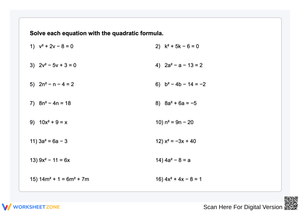
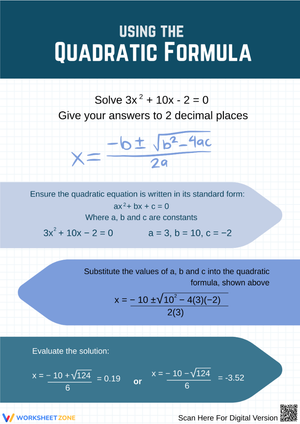
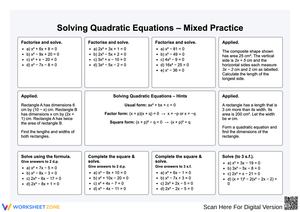
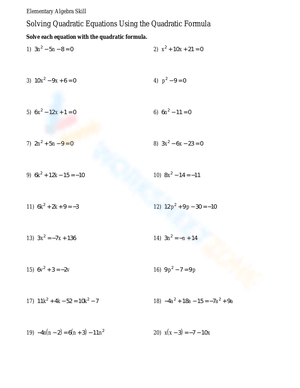
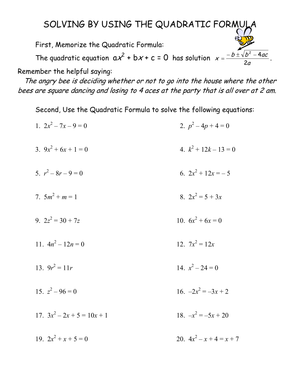
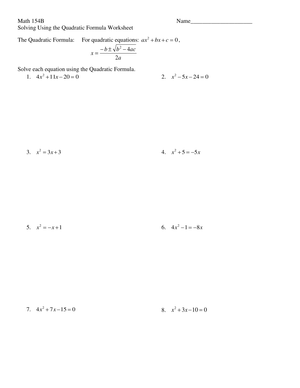
Quadratic formula worksheets do their best work as the practice engine of your Algebra 1 quadratics unit. The formula is the one method that solves every quadratic equation, so students need enough clean repetitions to trust it, plus enough varied problems to avoid the sign and substitution traps that quietly cost points. The right worksheet set makes that practice targeted instead of busywork.
Where Quadratic Formula Worksheets Fit in Algebra 1
By the time students reach the quadratic formula, they've usually already solved equations by factoring, graphing, and completing the square. That sequence matters. The quadratic formula isn't a starting point; it's the universal tool students reach for when an equation won't factor cleanly. Worksheets land best right after your class derives the formula, so practice reinforces where it comes from instead of treating it as a magic string of symbols to memorize.
In most US Algebra 1 courses, this unit shows up in grade 9, after the discriminant and completing the square. Teachers using worksheets at this point are usually chasing one of three goals: locking in the procedure during direct instruction, giving students repetitions for homework, or checking who still confuses solving methods. A good worksheet set supports all three without asking you to rewrite problems from scratch.
What Strong Quadratic Formula Practice Targets
The value of a worksheet isn't the number of problems; it's whether the problems surface the mistakes students actually make. Research on quadratic equation instruction consistently points to a small cluster of predictable errors, and the best practice sets are built to expose them early.
Watch for these recurring trouble spots:
- Identifying a, b, and c when the equation isn't written in standard form or has a leading coefficient of 1 that students overlook.
- Negative b values, where students drop the sign or mishandle the opposite of a negative inside the formula.
- Simplifying the discriminant, especially arithmetic under the radical and squaring a negative correctly.
- Substitution slips, where a value lands in the wrong place in the formula.
Here's the pattern worth naming for your students: most quadratic formula errors aren't conceptual, they're transformation and procedural. Students understand the formula but lose points converting an equation into a, b, c and simplifying the radical. That means a worksheet full of already-standardized equations can hide the exact skill students fail on a test. Mix in equations that aren't pre-arranged so students practice the rewriting step, not just the plugging-in step.
Standards Alignment for Quadratic Formula Worksheets
Aligning practice to the standard keeps your worksheets defensible in planning documents and useful for state assessment prep. The core expectation is explicit about connecting derivation to application.
According to the Common Core State Standards Initiative, standard HSA.REI.B.4 asks students to derive the quadratic formula by completing the square (4a) and then solve equations using the formula, factoring, or taking square roots (4b). That two-part structure tells teachers practice should connect where the formula comes from to how it's used, not just plug-and-chug.
Practically, that means your worksheet sequence should move students from recognizing when the formula is the right choice to executing it accurately, and eventually to interpreting the discriminant to predict the number and type of solutions.
Building Discriminant Awareness Into Practice
The discriminant, the b squared minus 4ac piece under the radical, is where a lot of the mathematical thinking lives, and it's easy to skip when students rush to a numeric answer. Worksheets that ask students to compute and interpret the discriminant before solving turn a mechanical step into a prediction. Students decide whether an equation has two real solutions, one repeated solution, or no real solutions, then verify their prediction by finishing the problem.
This small routine pays off in two ways. It catches sign and arithmetic errors early, because a student who miscomputes the discriminant usually notices when their predicted solution count doesn't match the final answer. It also builds the conceptual link that standards ask for, connecting the structure of an equation to the nature of its solutions rather than treating every problem as an identical plug-in exercise.
Differentiating Practice for Every Level
One worksheet rarely fits a full class. The cleanest way to differentiate quadratic formula practice is by the kind of roots the problems produce.
- Scaffolded practice: equations with rational or integer roots, so students confirm the formula works and can self-check against factoring.
- On-level practice: equations with irrational roots that force careful radical simplification.
- Advanced practice: equations with a negative discriminant, pushing students toward complex solutions and a deeper read of the discriminant.
Starting struggling students on integer-root problems gives them a built-in check: they can factor the same equation and see the two methods agree. That agreement builds trust in the formula before you raise the difficulty.
Layer the difficulty within a single class period, too. Give every student the same first three integer-root problems so nobody stalls at the start, then branch: students who breeze through move to irrational-root problems while others get another integer-root set with a partially worked example. This keeps the entry point common and the challenge personal.
Classroom Implementation
Worksheets earn their keep when they fit a routine, not when they're handed out cold. A reliable rhythm looks like this:
- Model first. Work two problems aloud, narrating how you pull a, b, and c and how you track the sign of b.
- Guided rows. Have students complete the first few problems in pairs while you circulate, catching sign errors before they repeat across the page.
- Independent set. Release the rest as individual practice, reserving the last two problems as an exit-ticket check.
- Error study. Project one worked-wrong problem and ask students to find the mistake, which turns common errors into a discussion instead of a deduction.
Keep an answer key visible during guided practice so students self-check row by row. When a pair spots a mismatch, they backtrack to find whether the slip was in the sign of b, the substitution, or the arithmetic. That habit of locating the error, not just fixing the number, is what transfers to independent work and to the test.
Immediate feedback is the point. When students catch a sign or substitution error on the same day they make it, the mistake doesn't harden into a habit they'll repeat on the unit test.
Frequently Asked Questions
1. When should teachers introduce quadratic formula worksheets?
Introduce them right after your class derives the formula from completing the square, typically in the grade 9 Algebra 1 unit on quadratic equations. Starting practice before students see where the formula comes from tends to produce memorization without understanding.
2. What are the most common student mistakes on these worksheets?
The biggest ones are procedural: mishandling a negative b value, arithmetic errors simplifying the discriminant, and substituting a, b, or c into the wrong spot. Including equations that aren't already in standard form surfaces these errors so you can address them directly.
3. How do these worksheets fit with factoring and completing the square?
Treat the formula as the universal method students use when factoring is messy or impossible. A strong practice sequence eventually mixes all three so students choose the most efficient method for each equation rather than defaulting to one.
4. How can teachers use these worksheets for formative assessment?
Use a short set of three or four problems that span integer, irrational, and complex roots as an exit ticket. The spread quickly shows who has the procedure down and who needs small-group reteaching before the unit test.
5. Should worksheets require students to check their solutions?
Yes. Building a substitution check into the worksheet, where students plug each solution back into the original equation, catches errors the formula alone won't reveal and reinforces what a solution actually means. It also gives students a reliable self-check when no answer key is handy.













 Interactive Worksheet Maker
 Quiz Maker
 Word Search Maker
 Crossword Puzzle Maker
 Word Scramble Generator
 Sentence Scramble Generator
 Handwriting Worksheet Generator
 Name Tracing Generator
 Fill In The Blank Generator