


























Views
Downloads
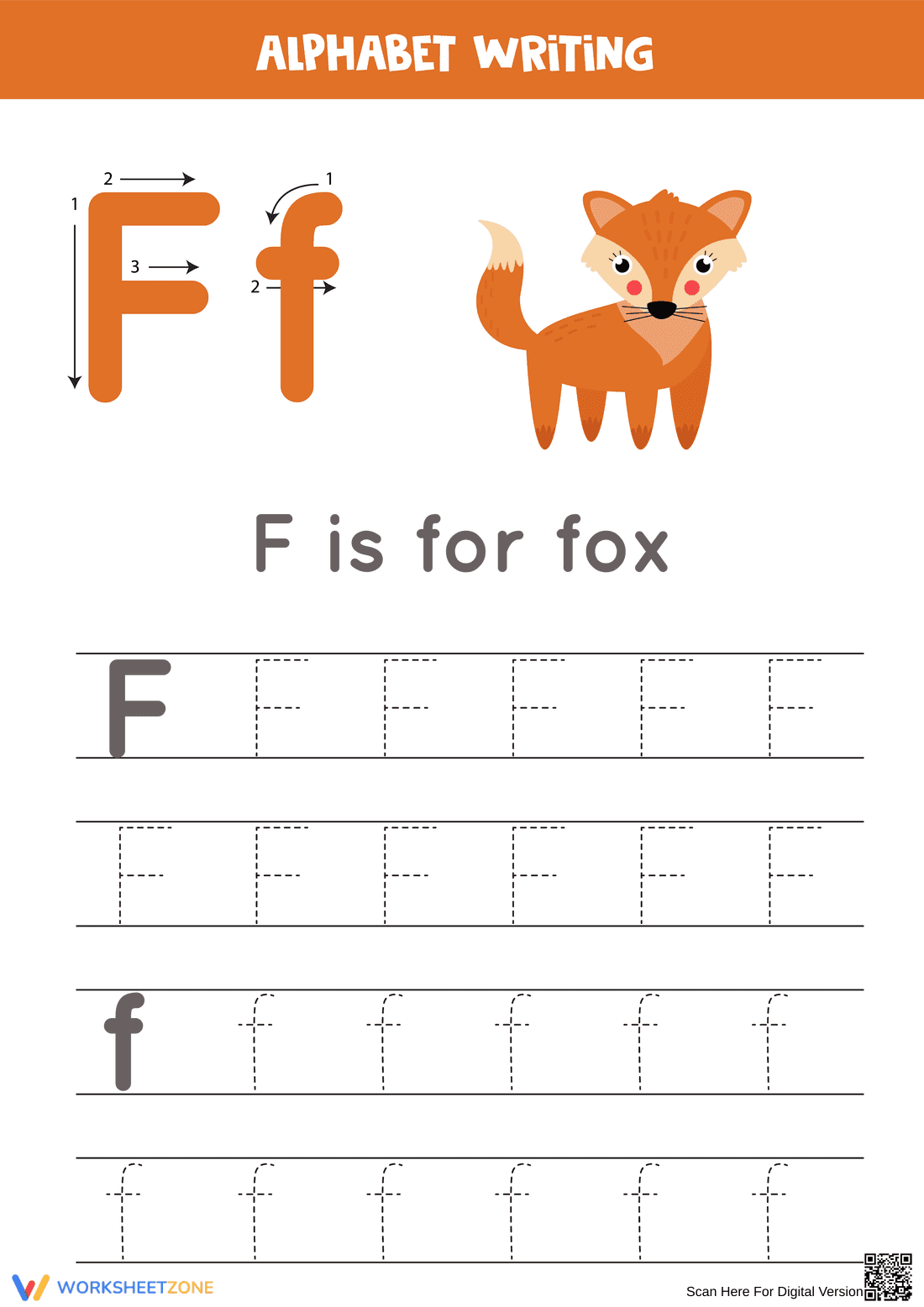

Letter F Tracing Printable | Kindergarten ELA Worksheet
Paste this activity's link or code into your existing LMS (Google Classroom, Canvas, Teams, Schoology, Moodle, etc.).
Students can open and work on the activity right away, with no student login required.
You'll still be able to track student progress and results from your teacher account.
This Kindergarten letter F tracing worksheet helps students master basic handwriting skills by practicing uppercase and lowercase letter formation. By following guided stroke arrows and tracing dotted lines, early learners develop fine motor control and letter recognition essential for foundational reading and writing success.
At a Glance
- Grade: Kindergarten · Subject: ELA
- Standard:
CCSS.ELA-LITERACY.L.K.1.A— Print many upper- and lowercase letters- Skill Focus: Letter F formation and tracing
- Format: 1 page · 24 problems · No answer key needed · PDF
- Best For: Independent practice and centers
- Time: 10–15 minutes
This single-page printable features a clear layout for early writers. Students find large, numbered stroke guides for uppercase and lowercase F, alongside a fox visual for phonetic connection. The core activity includes four rows of tracing—two uppercase, two lowercase. Each row begins with a solid example followed by five dotted letters, providing 24 total opportunities to refine pencil control.
Zero-Prep Workflow
This resource requires no teacher preparation.
- Print (1 min): Download the PDF and print copies. Black-and-white sections save ink.
- Distribute (1 min): Hand out during morning work or centers. Visual instructions are intuitive.
- Review (1 min): Scan work to check stroke order.
Total prep time is under two minutes, making it ideal for sub plans.
Standards Alignment
This handwriting activity is directly aligned to CCSS.ELA-LITERACY.L.K.1.A, which requires students to print many upper- and lowercase letters. By providing explicit stroke order guides and repeated tracing practice, the worksheet ensures students build the muscle memory required to meet this foundational literacy benchmark. Both standard codes can be copied directly into lesson plans, IEP goals, or district curriculum mapping tools.
How to Use It
Integrate this worksheet as a handwriting station after a whole-group phonics lesson on the /f/ sound. Alternatively, use it as morning work to establish a focused routine. While students work, observe their pencil grip—ensure they begin at the top line for the uppercase F rather than pushing upward. Expected completion time is 10 to 15 minutes.
Who It's For
This resource is primarily designed for Kindergarten students mastering their alphabet, but it also serves as excellent remediation for first graders who struggle with letter legibility. For students requiring additional scaffolding, consider highlighting the starting dots with a bright marker before distributing the page. This worksheet pairs perfectly with a tactile alphabet anchor chart or a sensory sand-tray writing lesson.
Developing automaticity in letter formation is a critical precursor to expressive writing and reading fluency. According to Fisher & Frey (2014), explicit handwriting instruction combined with guided repetition significantly reduces the cognitive load required for transcription, allowing young learners to allocate more mental resources to idea generation and phonemic awareness. This worksheet directly supports CCSS.ELA-LITERACY.L.K.1.A by requiring students to print many upper- and lowercase letters through structured, sequential tracing tasks. By isolating the letter F and providing directional cues, the activity builds essential muscle memory and fine motor precision. Consistent practice with targeted printables ensures that foundational transcription skills become automatic, paving the way for more complex literacy achievements in later grades. Educators can rely on this evidence-based approach to strengthen early childhood writing curricula.


