


























Views
Downloads

Letter M Tracing Worksheet | Printable Kindergarten Guide
Paste this activity's link or code into your existing LMS (Google Classroom, Canvas, Teams, Schoology, Moodle, etc.).
Students can open and work on the activity right away, with no student login required.
You'll still be able to track student progress and results from your teacher account.
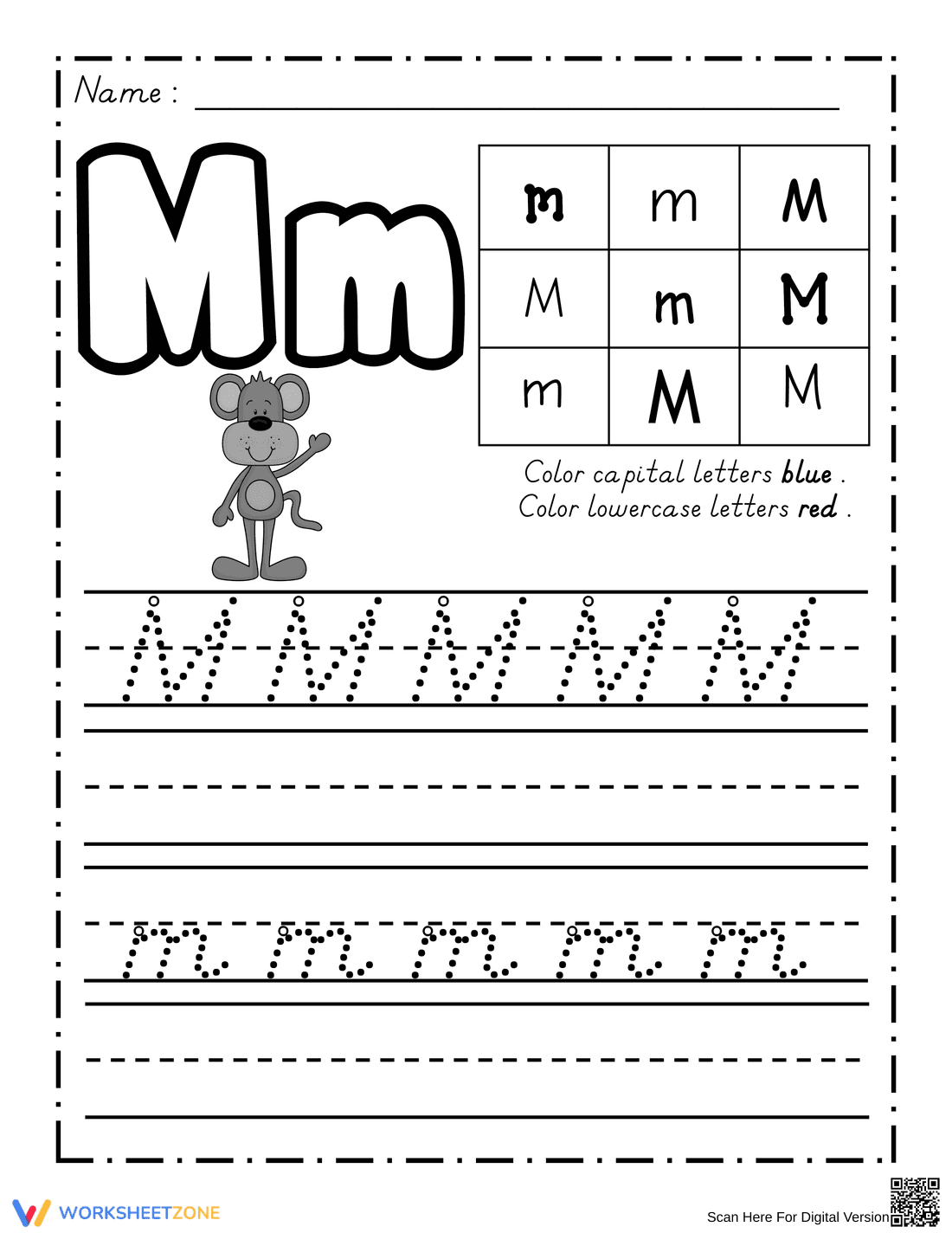
This Kindergarten handwriting worksheet provides targeted practice for the letter M, helping students master both uppercase and lowercase forms. By combining visual recognition through a color-coded letter grid with structured tracing lines, learners develop the fine motor control necessary for neat D'nealian penmanship. It is an essential tool for early literacy and alphabet fluency.
At a Glance
- Grade: Kindergarten · Subject: Handwriting
- Standard:
CCSS.ELA-LITERACY.L.K.1.A— Print many upper- and lowercase letters accurately- Skill Focus: Letter M formation and identification
- Format: 1 page · 21 tasks · Answer key included · PDF
- Best For: Morning work or literacy centers
- Time: 10–15 minutes
This single-page PDF features a 3x3 letter identification grid where students color-code capital and lowercase "m"s. Below the grid, two dedicated sections provide dotted-line tracing for five uppercase and five lowercase letters, followed by empty primary lines for independent practice. The D'nealian font style ensures a smooth transition to cursive later in their academic journey.
Zero-Prep Workflow: 1. Print (30 seconds): Simply send the PDF to your printer; no resizing or special settings required. 2. Distribute (30 seconds): Hand out copies along with blue and red crayons for the identification task. 3. Review (1 minute): Quickly scan the completed tracing lines to check for proper stroke order and letter height. Total teacher prep time is under 2 minutes.
This resource is directly aligned with `CCSS.ELA-LITERACY.L.K.1.A`, which requires students to print many upper- and lowercase letters. It also supports foundational reading skills by reinforcing letter-sound correspondence. Both standard codes can be copied directly into lesson plans, IEP goals, or district curriculum mapping tools.
Use this worksheet during your "Letter of the Week" rotation as a quiet-time activity after direct instruction on the letter M. It also serves as an excellent formative assessment; observe students as they trace to ensure they are starting their strokes from the top, which is a common hurdle for Kindergarten learners. Expected completion time is 10 to 15 minutes.
This worksheet is designed for Kindergarten students, but it is also highly effective for Pre-K learners ready for pencil control or first graders needing remedial handwriting support. It pairs naturally with an alphabet anchor chart or a tactile sand-tray tracing activity to reinforce the "M" shape and sound.
Handwriting remains a critical component of early literacy development, as the physical act of letter formation is linked to better letter recognition and reading fluency. This worksheet addresses CCSS.ELA-LITERACY.L.K.1.A by providing 21 specific interactions with the letter M, including identification, tracing, and independent production. According to Fisher & Frey (2014), the gradual release of responsibility—moving from guided tracing to independent writing—is essential for motor skill acquisition in young learners. By isolating the letter M, students can focus on the specific curves and vertical strokes required for D'nealian script without the cognitive load of full-sentence construction. Research from the NAEP suggests that early mastery of handwriting predicts later writing quality and speed, making these focused practice sessions vital. This resource provides a structured, low-stakes environment for students to build the muscle memory needed for academic success in primary grades.


