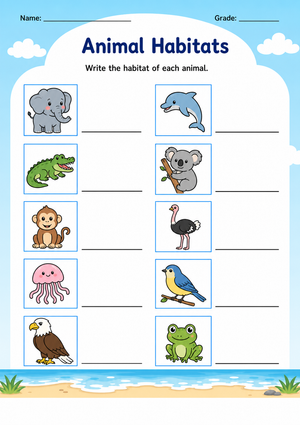
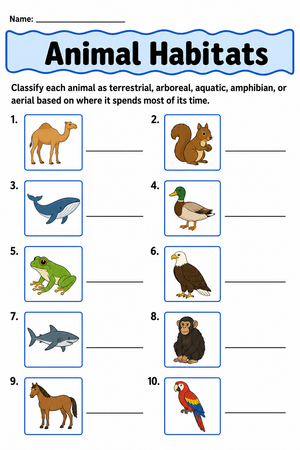
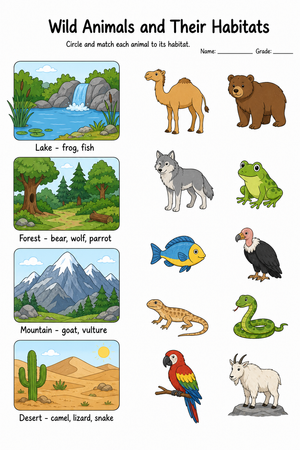
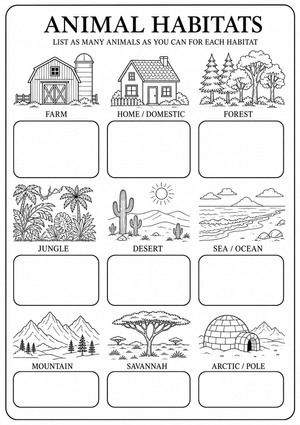
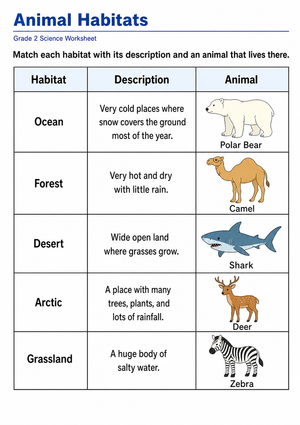
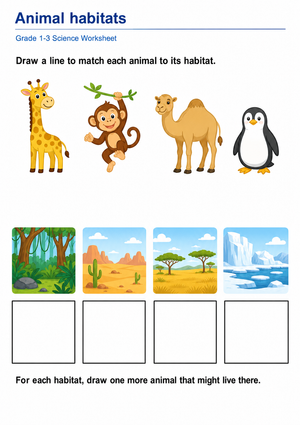
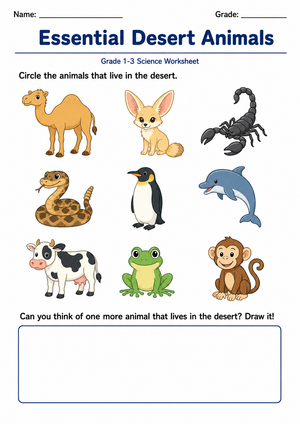
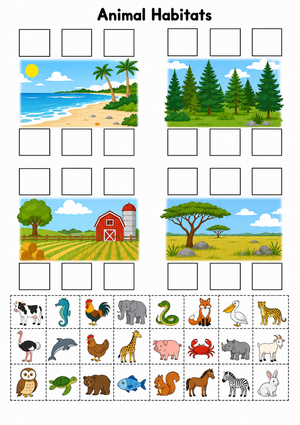
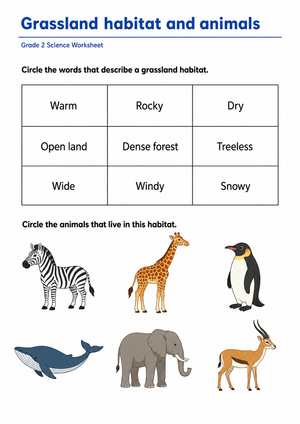
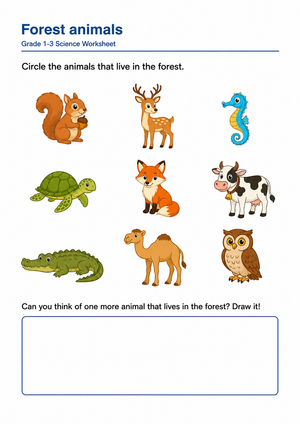
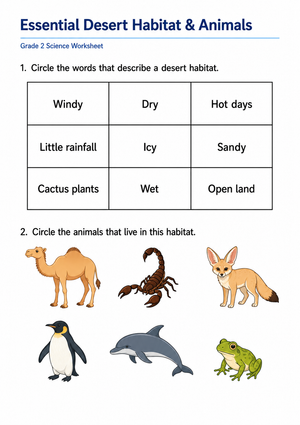
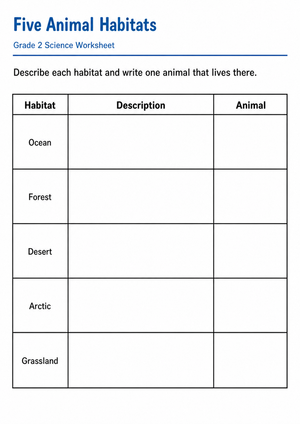
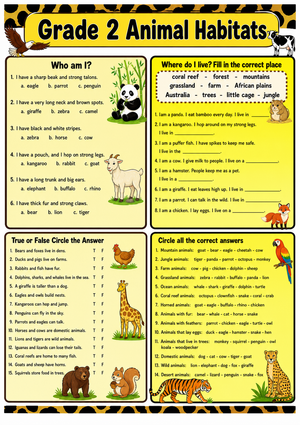
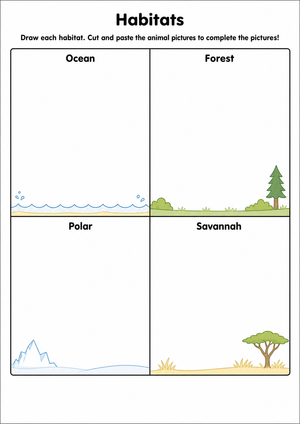
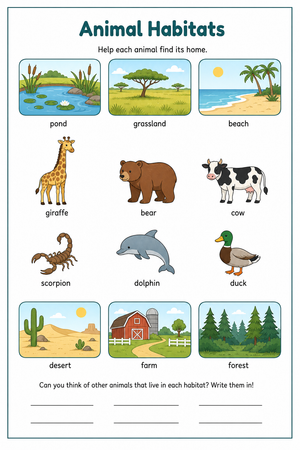
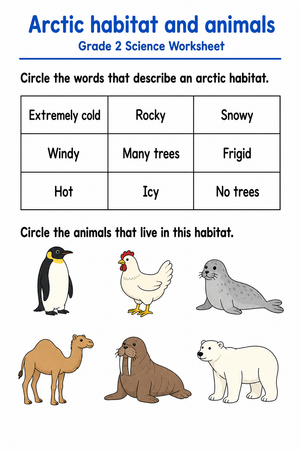
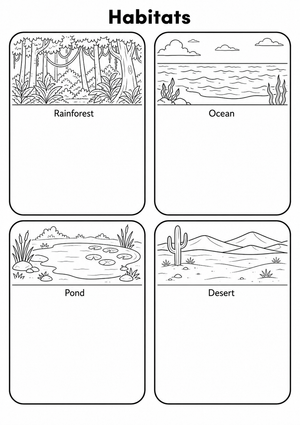
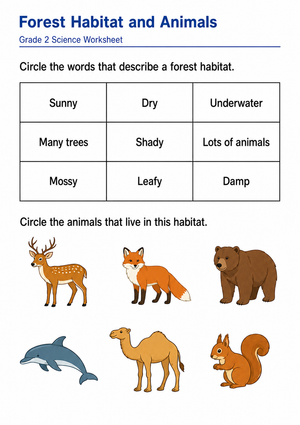
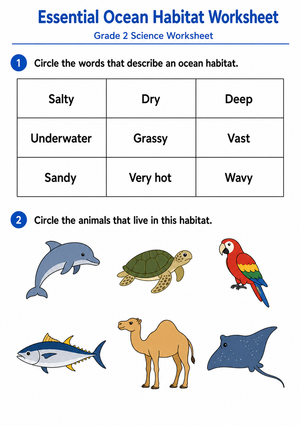
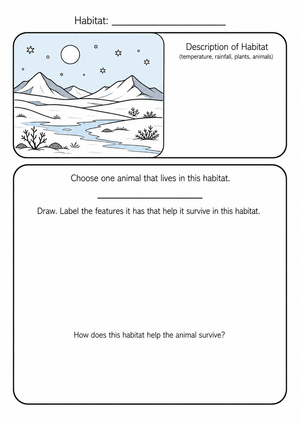
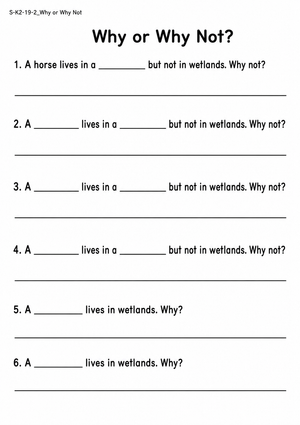
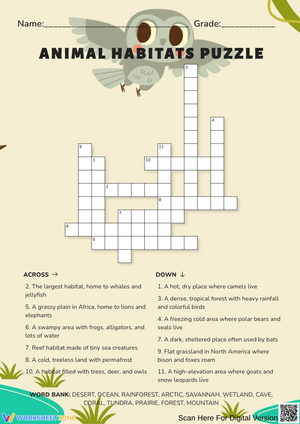
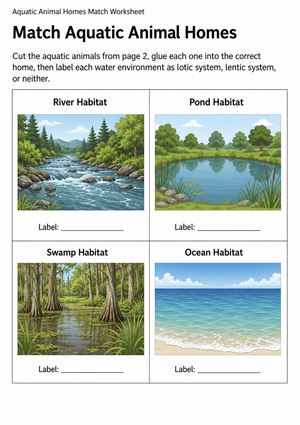
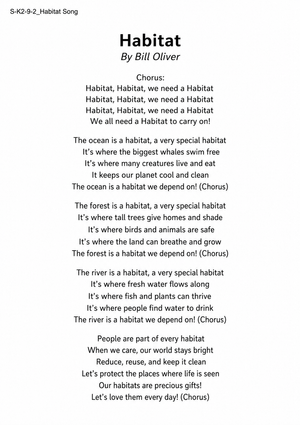
These 2nd grade animal habitats pdf worksheets give students structured practice connecting animals to the environments that meet their survival needs — not just naming animals, but explaining why a polar bear cannot live in a rainforest and why a camel is built for heat rather than moisture. The set targets five ecosystems: desert, rainforest, ocean, grasslands, and arctic tundra. Each worksheet applies the same organizing framework — food, water, shelter, space — across very different environments, which is exactly the kind of repeated comparison that builds scientific thinking at this age.
What Students Practice Across the Set
The five habitat areas provide enough contrast for students to develop real comparative thinking rather than simply memorizing animal names. Across the set, students:
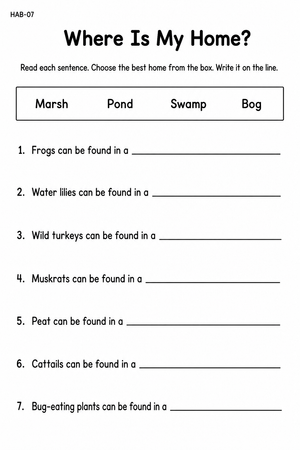
- Sort animals by physical trait — thick blubber, webbed feet, camouflage coloring — and explain what function each trait serves
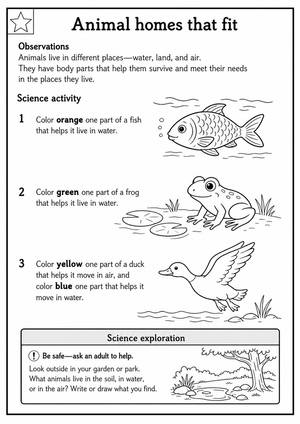
- Match adaptations to their purpose, connecting "large ears" to heat dissipation in desert air or "webbed feet" to propulsion in water
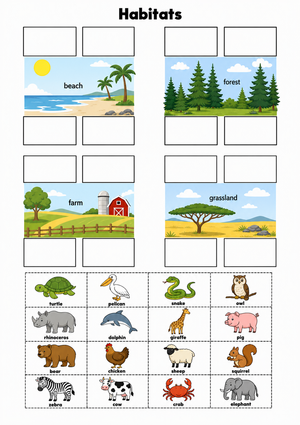
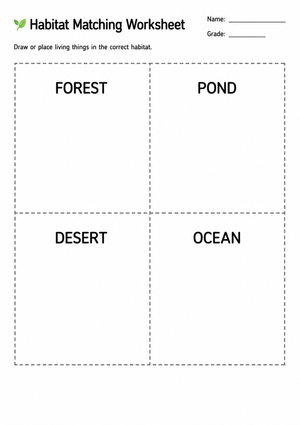
- Place animals into labeled habitat diagrams, distinguishing between specific zones within a single ecosystem
- Distinguish behavioral adaptations (migration, hibernation) from physical ones, then identify examples of each
- Compare two habitats side by side, identifying what changes in survival strategy and what stays the same
One worksheet in the rainforest section asks students to position toucans, jaguars, and poison dart frogs into the correct layer — canopy, understory, or forest floor. That placement task quickly reveals whether a student understands habitat as a specific location with specific conditions, or whether they treat it as a general setting. The distinction matters for the observation and comparison work the NGSS standard requires.
Student Errors Worth Anticipating Before the Lesson
The most persistent confusion across the set is treating habitat as a backdrop rather than a system of specific conditions. A student who knows the desert is hot will still draw the fennec fox and the rattlesnake in the same location on a diagram — both in open sun — without noticing that the fox shelters underground during peak heat and forages nocturnally, while the snake basks on exposed rock during the day. Worksheets that ask students to specify when and where an animal is active, not just which habitat it lives in, push against this oversimplification.
Ocean worksheets surface a different error: students commonly write that fish "breathe water." It is close enough to what adults say casually that it feels correct to a 7-year-old, and students will defend it. Worksheets that ask students to label gills and describe what they extract — dissolved oxygen, not water itself — push toward more accurate language. That correction is far easier to establish in 2nd grade than it is to undo in upper elementary when gas exchange becomes a formal topic.
A third error pattern appears in the arctic tundra section. Students frequently conflate hibernation and migration, treating both as ways animals "sleep through winter." Worksheets that ask students to sort animals into hibernators versus migrators, then write one sentence explaining each animal's strategy, expose this confusion quickly and give teachers a fast read on who needs another pass at the distinction.
Fitting These Worksheets Into Your Daily Science Block
Two moments in the week work consistently better than others for these resources. The first is during initial instruction, in a station rotation: one group handles plastic animal sorting figures while another works through the worksheet independently, which lets the teacher give direct support to the small group while others work without supervision. The second — and often more useful — moment is three to five days later, after the topic has technically moved on. Pulling out the desert worksheet during the 10 minutes before lunch after students have started the ocean unit is a clean spaced retrieval check. Students who genuinely understood desert adaptations apply that framework without prompting; students who memorized show the gaps immediately.
The 2nd grade animal habitats pdf worksheets also work as a pre-assessment before a habitat diorama project. Reviewing a student's labeled diagram before any cardboard or clay comes out tells you which students understand that a habitat must meet specific survival needs and which still treat it as a visual setting. That information shapes small-group instruction far more efficiently than waiting for the finished diorama to surface the same gaps.
Standard Alignment
NGSS 2-LS4-1 asks students to make observations of plants and animals to compare the diversity of life in different habitats. Every comparison task in this set — desert versus tundra, rainforest canopy versus forest floor — asks students to produce exactly that observation data. The habitat-labeling activities build the vocabulary students need to articulate comparisons in writing, and the adaptation-matching tasks give them a causal framework: diversity exists not randomly, but because different environments select for different traits.
One practical note on sequencing: 2-LS4-1 lands better in the second semester of 2nd grade, after students have spent time with basic living-versus-nonliving classification. A student still unsure whether soil is living will struggle to explain why polar bear blubber counts as a response to a nonliving condition. Waiting until that classification foundation is stable produces noticeably stronger student explanations on these worksheets and in whole-class discussion.
How to Adapt the Set Across Ability Levels
Students who move through the tasks quickly and accurately have a natural extension available: ask them to choose a habitat not covered in the set, identify three animals that live there, and write one sentence explaining an adaptation for each. That task moves from application to synthesis without requiring any additional printed materials.
For students who struggle with the comparison tasks, the problem is usually working memory overload rather than a content gap. Too many variables — habitat conditions, animal traits, survival functions — arrive at once. A simple two-column reference card, habitat conditions on one side and animal traits on the other, keeps the retrieval load off working memory so students can direct their attention toward reasoning rather than lookup. The 2nd grade animal habitats pdf worksheets pair particularly well with posted anchor charts showing habitat photographs and labeled features; students who can glance at a posted example of "arctic tundra: permafrost, sub-zero temperatures, few plants" need far fewer teacher redirects during independent work time.
For English language learners, the labeled diagram format already supports comprehension through visual context. Pairing each worksheet with a short bilingual vocabulary list — six to eight terms: blubber, migration, camouflage, canopy, nocturnal, adaptation — removes the language barrier without softening the science content itself.
Frequently Asked Questions
What is the difference between a habitat and an ecosystem, and how do I explain it at this grade level?
For 2nd graders, habitat is most usefully framed as an animal's specific home — the place where that particular animal gets everything it needs to survive. Ecosystem is the broader community: all the living things in an area interacting with each other and with nonliving factors like sunlight, soil, and temperature. Most 2nd-grade instruction stays at the habitat level, and that is the right call. Once students can explain why a polar bear requires sea ice, cold water, and seal prey, the ecosystem concept — that removing the seals affects the bear — becomes a natural next step rather than an abstract overlay.
Do these worksheets fit into a science notebook routine?
Yes. The labeled diagram worksheets transfer directly into science notebooks — students glue the completed worksheet alongside observational sketches or written notes from a hands-on activity. Teachers who use interactive notebooks find that the habitat comparison tasks give students a visual record to reference throughout the unit, which matters when the end-of-unit assessment asks students to compare two habitats from memory.
How many worksheets does the set include per habitat?
Each ecosystem has multiple worksheets covering different skill demands — basic animal identification, adaptation explanation, and cross-habitat comparison. That range lets a teacher select a straightforward identification task for an introductory lesson and a more demanding comparison task later in the unit without repeating the same format twice.
Do these worksheets require color printing?
The 2nd grade animal habitats pdf worksheets print cleanly in black-and-white. Some teachers use habitat coloring as a reinforcement task — asking students to shade the desert landscape or mark the ocean zones in blue — which converts what looks like a finishing activity into additional content review. No color ink is required for any of the core tasks.












 Interactive Worksheet Maker
 Quiz Maker
 Word Search Maker
 Crossword Puzzle Maker
 Word Scramble Generator
 Sentence Scramble Generator
 Handwriting Worksheet Generator
 Name Tracing Generator
 Fill In The Blank Generator