


























Views
Downloads

Essential Grassland Habitat Worksheet | Grade 2 Ready
Paste this activity's link or code into your existing LMS (Google Classroom, Canvas, Teams, Schoology, Moodle, etc.).
Students can open and work on the activity right away, with no student login required.
You'll still be able to track student progress and results from your teacher account.
Identifying specific biomes is a foundational step in early life science education. This Grade 2 science worksheet helps students recognize the physical characteristics and animal inhabitants of the grassland habitat. By distinguishing between various environmental traits, learners develop a concrete understanding of how biological communities are organized within specific global ecosystems.
At a Glance
- Grade: 2 · Subject: Science
- Standard:
2-LS4-1— Make observations of plants and animals to compare diversity in different habitats- Skill Focus: Grassland habitat characteristics and fauna identification
- Format: 1 page · 2 tasks · Answer key included · PDF
- Best For: Quick formative assessment or independent science centers
- Time: 10–15 minutes
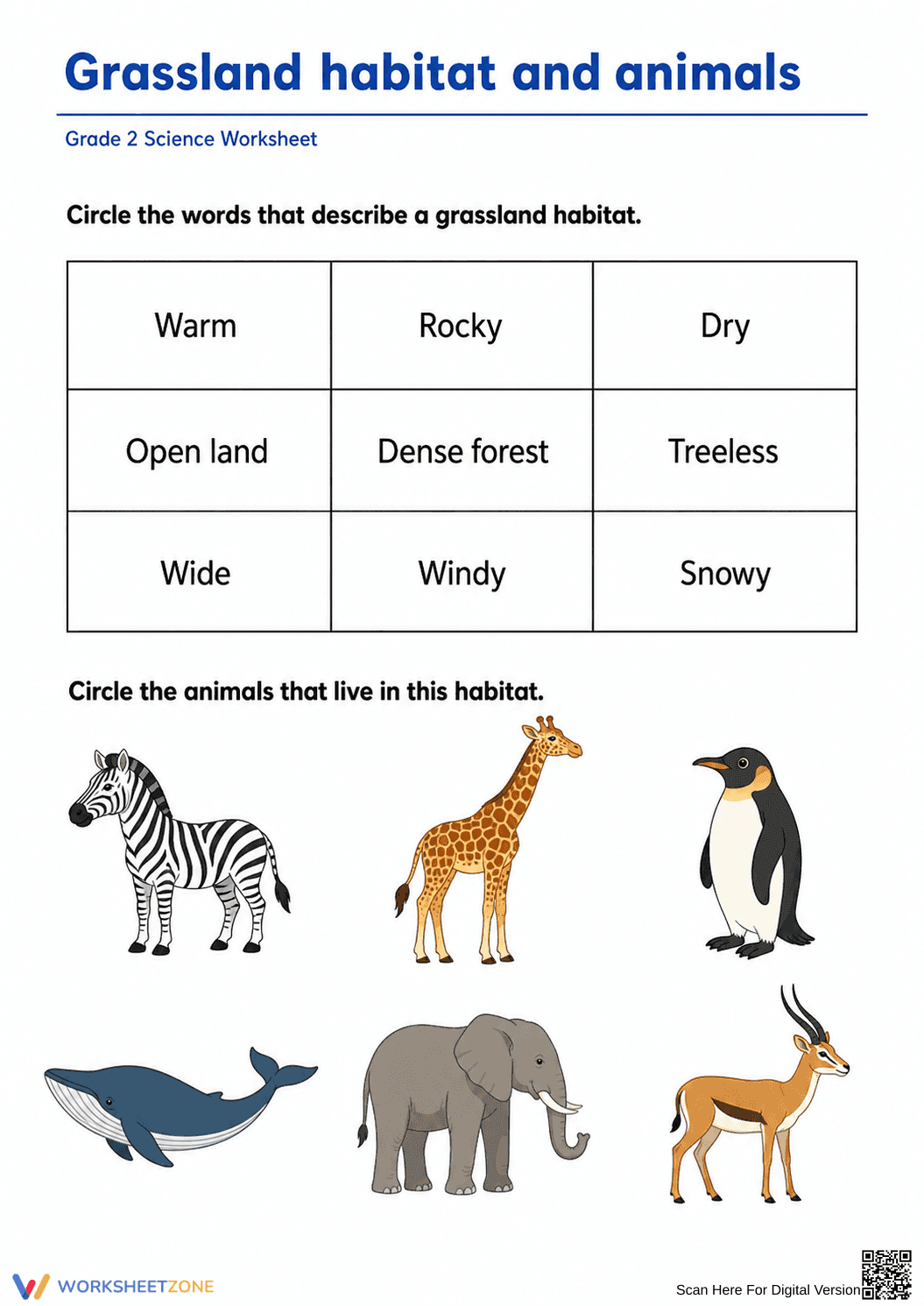
This 1-page PDF provides a focused exploration of the savanna and prairie environments. The first task features a word grid containing 9 descriptors where students must select terms like "Warm" and "Open land" while rejecting "Dense forest" or "Snowy." The second section presents 6 high-quality animal illustrations, requiring students to circle the species—such as zebras and elephants—that naturally thrive in grassland regions. A comprehensive answer key is included for rapid grading.
Zero-Prep Workflow
Designed for maximum teacher efficiency, this resource follows a clear three-step workflow: Print (15 seconds), Distribute (30 seconds), and Review (60 seconds). The total teacher preparation time remains under two minutes, making it an ideal choice for emergency substitute plans or a quick addition to a science center during busy instructional blocks. This zero-prep approach allows educators to focus on student engagement rather than administrative setup.
Standards Alignment
This resource is primarily aligned to 2-LS4-1, which requires students to make observations of plants and animals to compare the diversity of life in different habitats. By specifically isolating the grassland biome, students build the foundational knowledge necessary to compare it with other environments like the Arctic or rainforest. This standard code can be copied directly into lesson plans, IEP goals, or district curriculum mapping tools.
How to Use It
Use this worksheet as a formative assessment after a direct instruction lesson on biomes. As students work, observe whether they can distinguish between animals with similar features but different habitats, such as penguins versus gazelles. Alternatively, assign it as a warm-up activity to activate prior knowledge before starting a deeper unit on global ecosystems. Completion usually takes less than 15 minutes.
Who It's For
This resource is tailored for Grade 2 students but is also suitable for Grade 1 enrichment or Grade 3 review. It supports diverse learners through clear visual aids and a structured layout. For students requiring extra support, provide an anchor chart showing different habitats to help them cross-reference the descriptive words in the first task.
Effective science instruction in the early grades relies on the gradual release of responsibility, where students transition from guided observation to independent classification. According to Fisher & Frey (2014), providing structured practice with visual supports—such as the animal illustrations used in this 2-LS4-1 aligned worksheet—enhances the retention of domain-specific vocabulary and conceptual frameworks. By focusing on the grassland habitat, this resource allows students to practice the skill of identifying environment-specific traits without the distraction of overly complex text. The inclusion of two distinct task types ensures that learners engage with the material through both linguistic and visual processing channels. Educational research suggests that these low-floor, high-ceiling activities are vital for maintaining student engagement while meeting rigorous standards for biodiversity observation. This printable PDF serves as a reliable tool for classroom teachers seeking to document student mastery of basic ecological concepts and support future habitat comparison studies.


