




























Views
Downloads

Grade 2 Animal Habitats — Printable No-Prep Worksheet

Paste this activity's link or code into your existing LMS (Google Classroom, Canvas, Teams, Schoology, Moodle, etc.).
Students can open and work on the activity right away, with no student login required.
You'll still be able to track student progress and results from your teacher account.
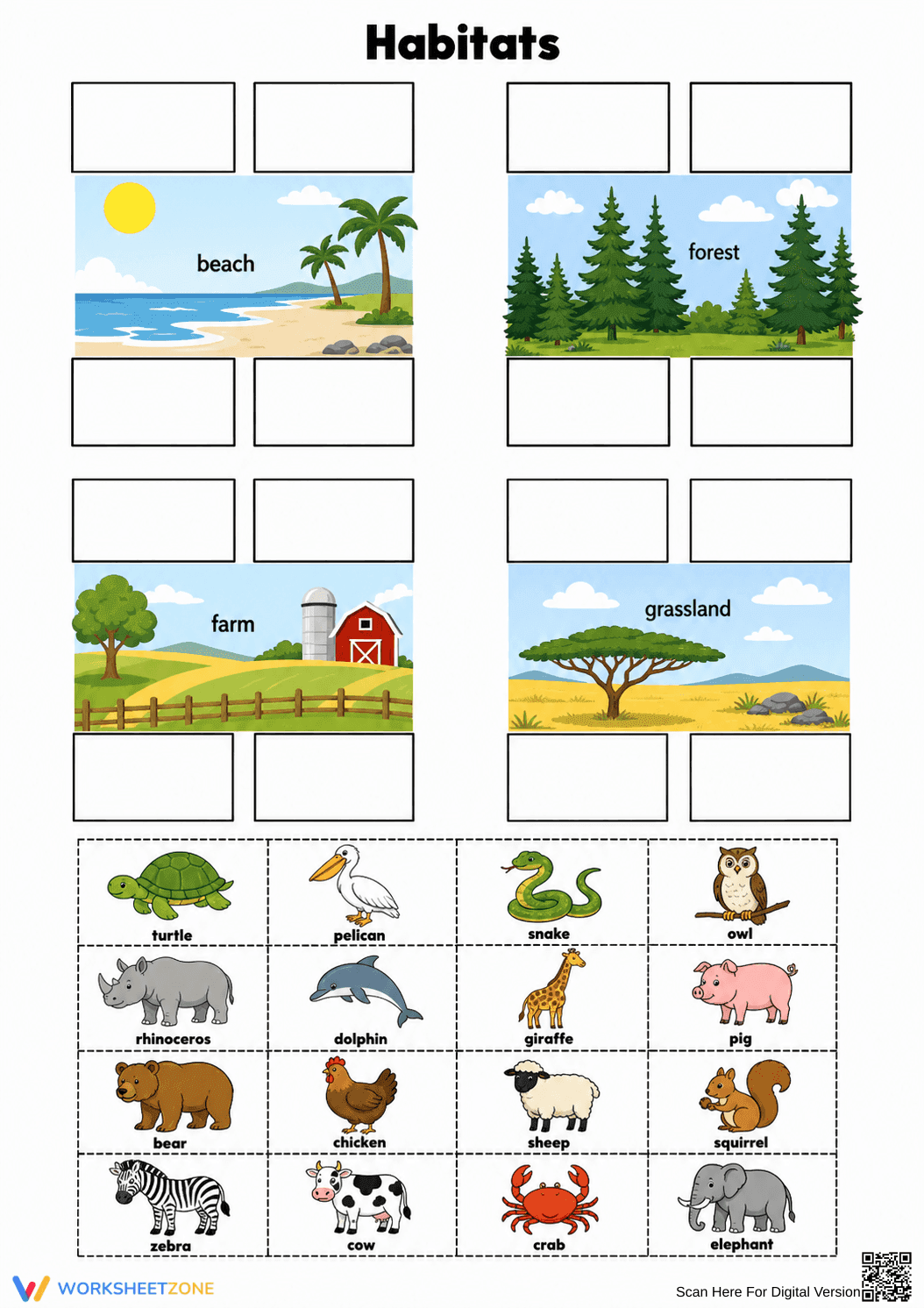
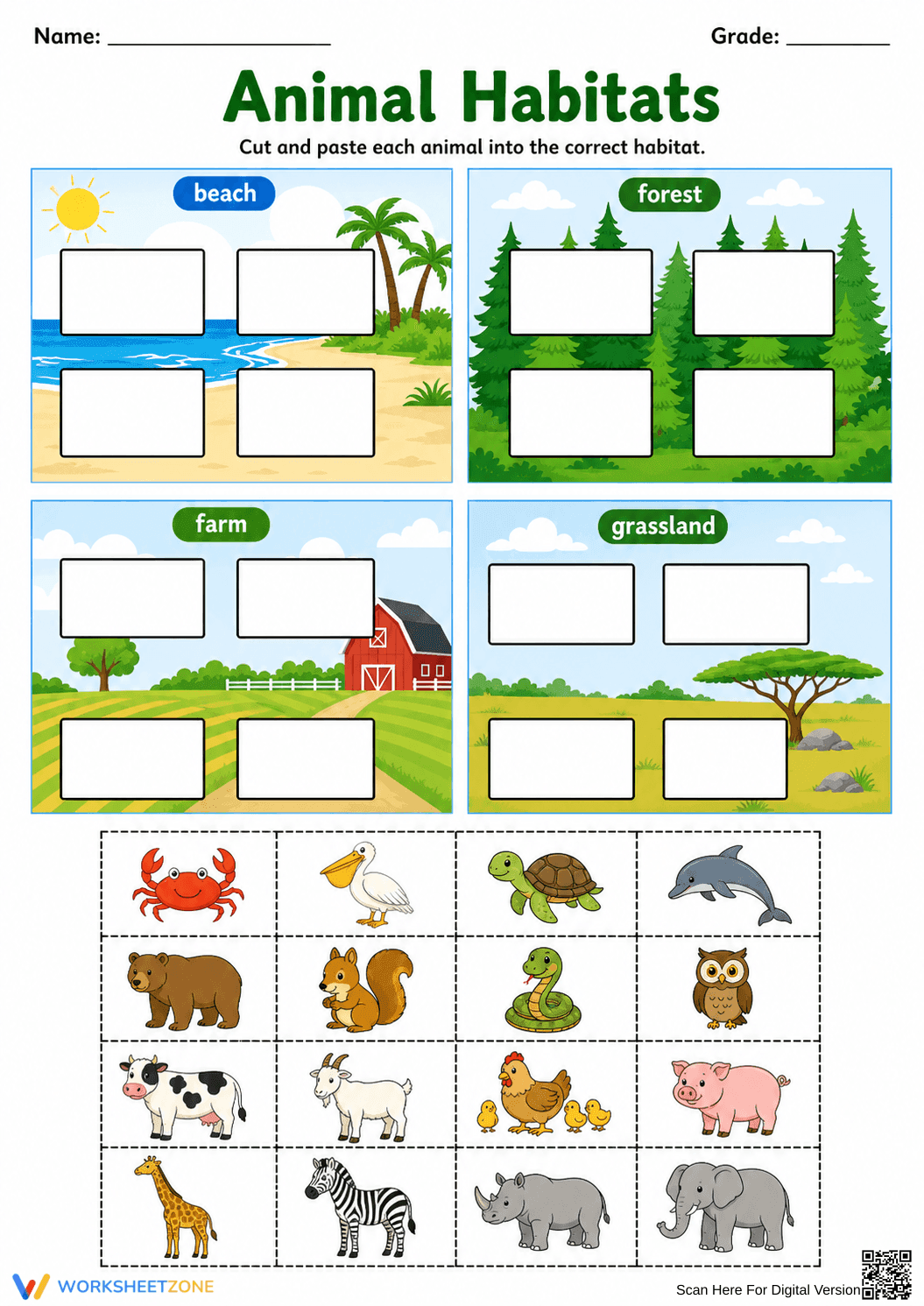
This Grade 2 animal habitats worksheet helps students classify sixteen animals into their correct environments. By cutting and pasting each animal into the beach, forest, farm, or grassland, learners actively build their understanding of biodiversity and specific environments.
At a Glance
- Grade: 2 · Subject: Science
- Standard:
2-LS4-1— Compare the diversity of life in different habitats- Skill Focus: Animal habitats classification
- Format: 2 pages · 16 problems · Answer key included · PDF
- Best For: Independent practice or science centers
- Time: 15–20 minutes
What's Inside
This interactive sorting activity requires students to cut out sixteen animal illustrations—including a dolphin, bear, cow, and owl—and paste them into four distinct habitat zones: beach, forest, farm, and grassland. The visual format supports early readers by pairing text labels with high-quality images. A full-color answer key is provided for quick teacher grading or student self-checking.
Zero-Prep Workflow
Designed for immediate classroom use, this activity requires minimal setup:
- Print (1 minute): Print the main activity page for each student.
- Distribute (1 minute): Hand out the worksheets, scissors, and glue sticks.
- Review (3 minutes): Use the visual answer key to quickly verify student work.
Standards Alignment
This worksheet aligns with Next Generation Science Standard 2-LS4-1: Make observations of plants and animals to compare the diversity of life in different habitats. By categorizing animals based on where they live, students demonstrate an understanding of how environments support life. Both standard codes can be copied directly into lesson plans, IEP goals, or district curriculum mapping tools.
How to Use It
This sorting activity works perfectly as independent practice following a whole-group lesson on ecosystems. Students can apply their knowledge by placing the animals in their correct homes. Alternatively, use it as an engaging science center. As a formative assessment tip, observe students while they sort; if a student places a crab in the forest, prompt them to explain their reasoning to uncover misconceptions. Expect completion in 15 to 20 minutes.
Who It's For
Ideal for second-grade students, this resource also serves first-graders learning about habitats. The visual cut-and-paste format provides built-in differentiation for visual learners and English language learners who benefit from picture cues. It pairs wonderfully with a read-aloud book about animal homes or a classroom anchor chart.
Integrating interactive sorting tasks into early elementary science instruction significantly reinforces foundational biological concepts. According to a ScienceDirect TpT Analysis, hands-on classification activities improve long-term retention of vocabulary and conceptual relationships by engaging multiple learning modalities. When students actively manipulate information—such as matching animals to their specific environments—they build stronger cognitive frameworks for understanding biodiversity and ecosystem dynamics. This resource directly supports standard 2-LS4-1 by requiring learners to compare the diversity of life in different habitats through a concrete, visual sorting process. By evaluating where sixteen distinct animals belong, students move beyond rote memorization to apply their knowledge of environmental needs and physical adaptations. Providing structured, visual categorization tasks ensures that young learners can successfully access complex ecological concepts while simultaneously developing essential fine motor and critical thinking skills required for future scientific inquiry.


