




























Views
Downloads
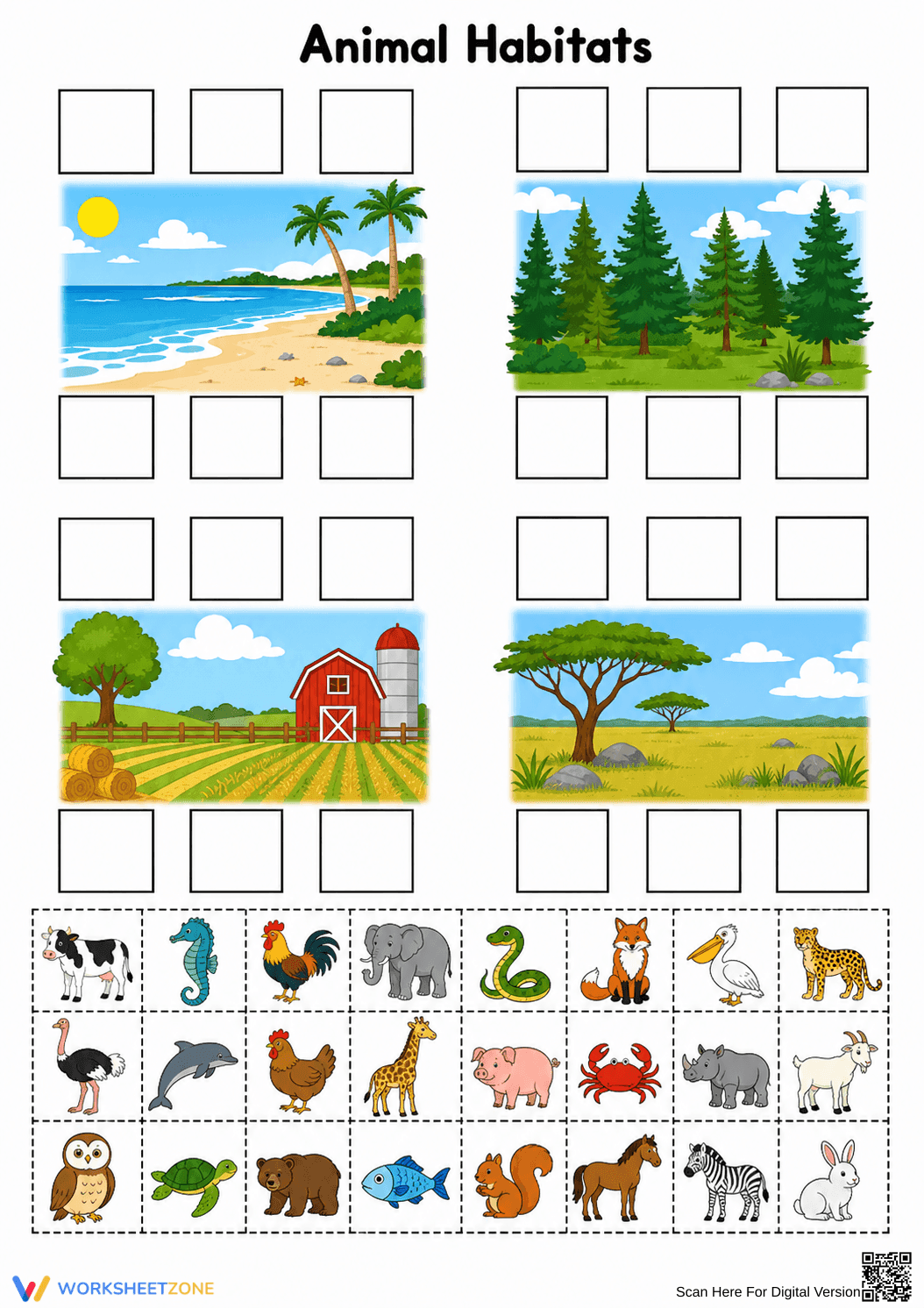

Grade 2 Animal Habitats — Printable No-Prep Worksheet

Paste this activity's link or code into your existing LMS (Google Classroom, Canvas, Teams, Schoology, Moodle, etc.).
Students can open and work on the activity right away, with no student login required.
You'll still be able to track student progress and results from your teacher account.
This Grade 2 animal habitats worksheet helps students identify where different creatures live by classifying 24 unique animals into four distinct ecosystems. By engaging in this hands-on sorting task, learners develop a foundational understanding of biological diversity and environmental requirements while reinforcing essential science vocabulary.
At a Glance
- Grade: 2 · Subject: Science
- Standard:
2-LS4-1— Compare life diversity in different habitats- Skill Focus: Habitat classification and animal identification
- Format: 1 page · 24 problems · Answer key included · PDF
- Best For: Independent practice or science centers
- Time: 15–20 minutes
Inside this resource, you will find a comprehensive one-page cut-and-paste activity featuring four primary habitat zones: beach, forest, farm, and grassland. The bottom of the page contains 24 detailed animal illustrations, including mammals, reptiles, and birds. This format encourages fine motor development while students determine the most appropriate environment for each creature, supported by a complete answer key for easy grading.
Zero-Prep Workflow
- Print: Select the single-page PDF and print enough copies for your class (30 seconds).
- Distribute: Provide students with scissors and glue to begin the sorting task (1 minute).
- Review: Use the included answer key to check for accuracy during a whole-group wrap-up (5 minutes).
Total teacher preparation time is under 2 minutes, making this an ideal choice for emergency sub plans or last-minute science center rotations.
Standards Alignment
This activity aligns with 2-LS4-1, which requires students to make observations of plants and animals to compare the diversity of life in different habitats. It also supports foundational ecosystem concepts by showing how animals live in places that have the things they need. Both standard codes can be copied directly into lesson plans, IEP goals, or district curriculum mapping tools.
How to Use It
Use this worksheet during the "Explain" or "Elaborate" phase of a 5E science lesson. It works best after a direct instruction session on ecosystem characteristics. For a formative assessment, observe if students can explain why a dolphin belongs in the beach category rather than the forest. Completion typically takes 15 to 20 minutes.
Who It's For
This resource is perfect for second-grade students exploring life sciences. It provides visual scaffolding for English Language Learners (ELLs) through clear iconography and recognizable animal illustrations. Pair this worksheet with a habitat-themed anchor chart or a non-fiction passage about biomes to deepen student comprehension and provide a multi-modal learning experience for all students.
According to the RAND AIRS 2024 report on elementary science instruction, hands-on classification tasks significantly improve long-term retention of biological concepts compared to passive reading alone. This worksheet targets the 2-LS4-1 standard, which focuses on comparing the diversity of life across various environments. By sorting 24 different animals into beach, forest, farm, and grassland categories, students engage in active observation and data organization. This plain-English skill—identifying where animals live and why—is a critical precursor to understanding complex ecological interdependencies. Research suggests that visual sorting activities provide the necessary cognitive scaffolding for young learners to transition from concrete observations to abstract scientific reasoning. This resource serves as a reliable tool for teachers to assess student mastery of habitat-specific traits while maintaining high engagement through interactive, tactile learning.


