


























Views
Downloads
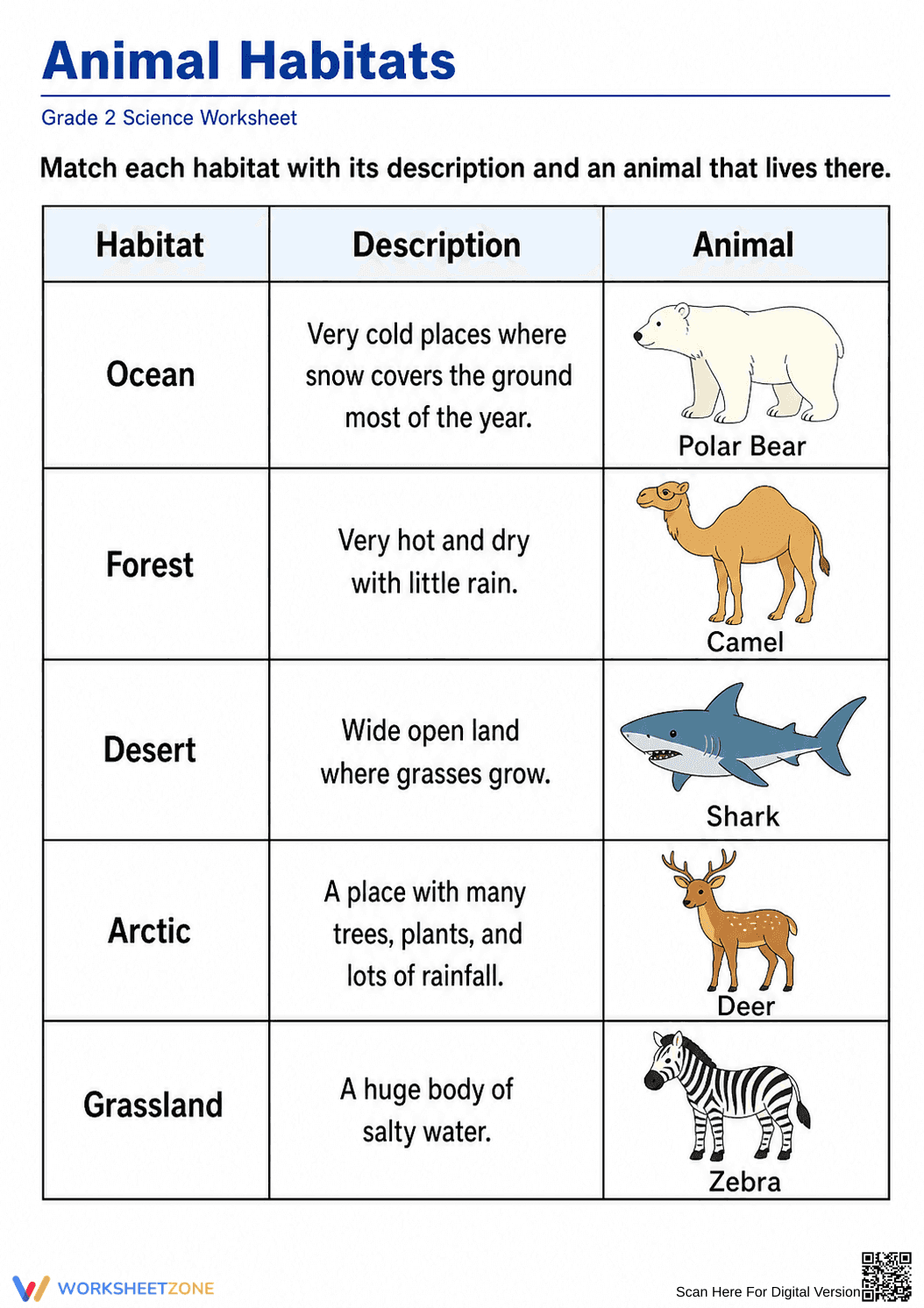

Grade 2 Animal Habitats — Printable No-Prep Worksheet
Paste this activity's link or code into your existing LMS (Google Classroom, Canvas, Teams, Schoology, Moodle, etc.).
Students can open and work on the activity right away, with no student login required.
You'll still be able to track student progress and results from your teacher account.
This Grade 2 animal habitats worksheet helps students identify and classify five major biomes by matching environments to their descriptions and resident animals. By connecting physical traits of habitats to specific wildlife, students build foundational life science knowledge. This resource ensures learners can distinguish between diverse ecosystems like the arctic and the desert.
At a Glance
- Grade: 2 · Subject: Science
- Standard:
2-LS4-1— Compare the diversity of life in different habitats- Skill Focus: Habitat classification and animal-environment matching
- Format: 1 page · 5 tasks · Answer key included · PDF
- Best For: Independent practice, science centers, or a quick assessment
- Time: 10–15 minutes
What's Inside
The worksheet features a clear three-column matching table. Students are presented with five habitat names (Ocean, Forest, Desert, Arctic, and Grassland), five concise physical descriptions, and five illustrated animals including a shark, camel, and polar bear. This single-page PDF includes the student activity and a complete answer key for rapid grading, making it a highly efficient classroom tool.
Zero-Prep Science Workflow
This resource is designed for immediate use with minimal teacher preparation time.
- Print (1 Minute): Generate copies for the whole class. The clean, high-contrast design is optimized for standard black-and-white printing to save ink.
- Distribute (1 Minute): Hand out the sheets for immediate engagement. The intuitive layout requires no complex verbal instructions or setup.
- Review (5 Minutes): Use the included answer key for a quick whole-class check or to provide instant feedback during science centers.
Total teacher preparation time is under two minutes, making this an ideal choice for emergency sub plans, morning work, or transition periods.
Standards Alignment
This resource is specifically designed to support NGSS standard 2-LS4-1, which asks students to "Make observations of plants and animals to compare the diversity of life in different habitats." By matching specific animals to their unique environments, students demonstrate an understanding of habitat diversity. This standard code can be copied directly into lesson plans, IEP goals, or district curriculum mapping tools.
How to Use It
Assign this worksheet as an independent practice activity following a direct instruction lesson on biomes. It also serves as an effective "exit ticket" to assess student comprehension before moving to the next unit. For a collaborative approach, have students work in pairs to justify why a specific animal belongs in its chosen habitat before finalizing their answers. Expect completion within 10 to 15 minutes.
Who It's For
This Grade 2 science resource is perfect for general education classrooms, but the visual animal cues also provide excellent support for English Language Learners and students with reading scaffolds. It pairs naturally with a classroom anchor chart about ecosystems or a read-aloud focused on animal adaptations and environmental survival.
Grounded in research on the effectiveness of classification tasks, this worksheet aligns with best practices for early science education. Fisher & Frey (2014) note that graphic organizers like matching tables provide essential scaffolding for students to organize new information and build mental models. This activity targets NGSS standard 2-LS4-1 by requiring students to compare life in different habitats through structured observation. By connecting an animal to a specific habitat description, students engage in the foundational observational processes fundamental to scientific inquiry. The National Assessment of Educational Progress (NAEP) data suggests that establishing foundational ecosystem knowledge in early elementary grades is a key predictor of later success in complex life science units. This 10-minute task offers a measurable and efficient way to build that critical academic foundation.


