


























Views
Downloads

Animal Habitats Sorting Mat | Grade 1 Printable
Paste this activity's link or code into your existing LMS (Google Classroom, Canvas, Teams, Schoology, Moodle, etc.).
Students can open and work on the activity right away, with no student login required.
You'll still be able to track student progress and results from your teacher account.
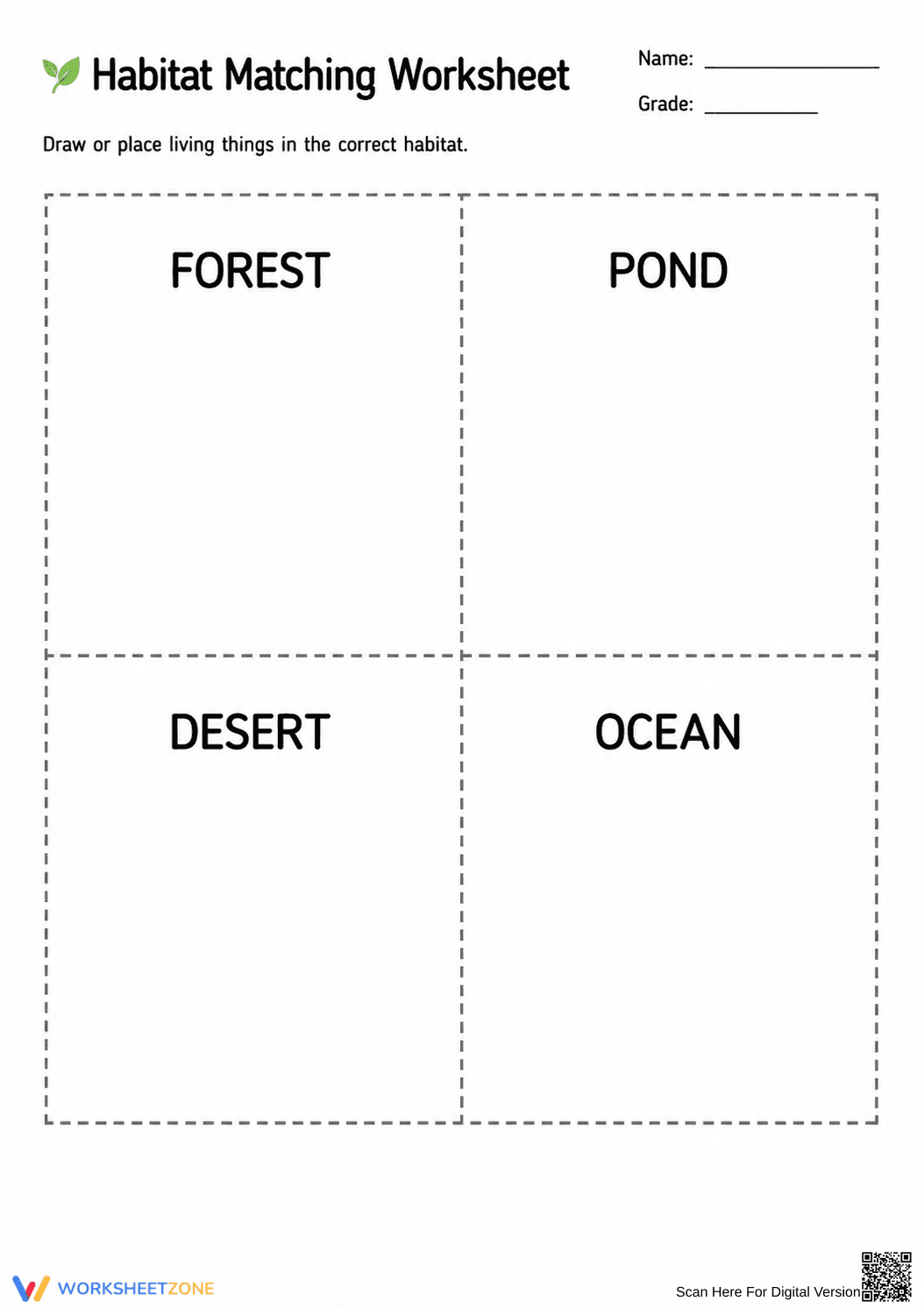
This Grade 1 science worksheet provides a hands-on sorting mat for students to identify and categorize where living things belong. By drawing or placing animals and plants into the correct environment, young learners build foundational knowledge of ecosystems and how different species adapt to their surroundings.
At a Glance
- Grade: 1 · Subject: Science
- Standard:
2-LS4-1— Compare the diversity of life in different habitats- Skill Focus: Identifying Animal Habitats
- Format: 1 page · 4 sorting areas · No answer key · PDF
- Best For: Independent practice or centers
- Time: 15–20 minutes
This single-page resource features four clearly labeled, dashed-line quadrants representing distinct ecosystems: Forest, Pond, Desert, and Ocean. The open-ended design allows students to either draw living things directly into the boxes or use it as a sorting mat for pre-cut animal and plant picture cards. The clean layout minimizes distractions and focuses entirely on the core scientific concept.
- Print (1 minute): Print a class set of the PDF or laminate a few copies for reusable science centers.
- Distribute (1 minute): Hand out the mats along with crayons, markers, or pre-cut animal sorting cards.
- Review (3 minutes): Briefly discuss the four habitats and ask students to share one example of an animal that lives in each before they begin.
With under two minutes of teacher prep time, this worksheet is an ideal zero-prep activity for busy mornings, science stations, or even as a reliable sub plan.
Aligned to primary standard 2-LS4-1: Make observations of plants and animals to compare the diversity of life in different habitats. While technically a second-grade standard, this foundational sorting activity perfectly introduces the concept to first graders. Both standard codes can be copied directly into lesson plans, IEP goals, or district curriculum mapping tools.
Use this mat during direct instruction as a guided activity where the teacher calls out an animal and students point to the correct habitat. Alternatively, place it in a science center with a basket of plastic animal figures or picture cards for independent sorting. As a formative assessment observation tip, watch to see if students can correctly distinguish between water habitats (pond vs. ocean) and land habitats (forest vs. desert). Expected completion time is 15 to 20 minutes.
This resource is designed for Kindergarten, 1st, and 2nd-grade students building early life science vocabulary. It naturally differentiates itself by allowing advanced students to draw complex ecosystems while others can focus on basic animal placement. Pair this mat with a read-aloud book about animal homes or a direct instruction lesson on basic survival needs.
Understanding where animals live is a critical step in early childhood science education and foundational to developing ecological literacy. According to a 2024 report by EdReports, hands-on categorization tasks significantly improve vocabulary retention and conceptual understanding in primary grades. By aligning with 2-LS4-1 to compare the diversity of life in different habitats, this activity ensures students are building evidence-based observational skills early in their academic journey. Connecting living things to their specific environments fosters early ecological awareness and sets the stage for more complex biological concepts in later grades. When young learners actively sort and classify organisms into forest, pond, desert, and ocean ecosystems, they begin to recognize essential patterns in nature. This structured practice helps them understand how physical adaptations are directly linked to survival, providing a robust framework for future scientific inquiry and environmental stewardship.


